


Home/
Blog/
Introduction to Spherical Roller Bearings: Design, Function, and Applications

6 min read

Introduction to Spherical Roller Bearings: Design, Function, and Applications

Introduction to Spherical Roller Bearings: Design, Function, and Applications
11:15

What Are Spherical Roller Bearings?

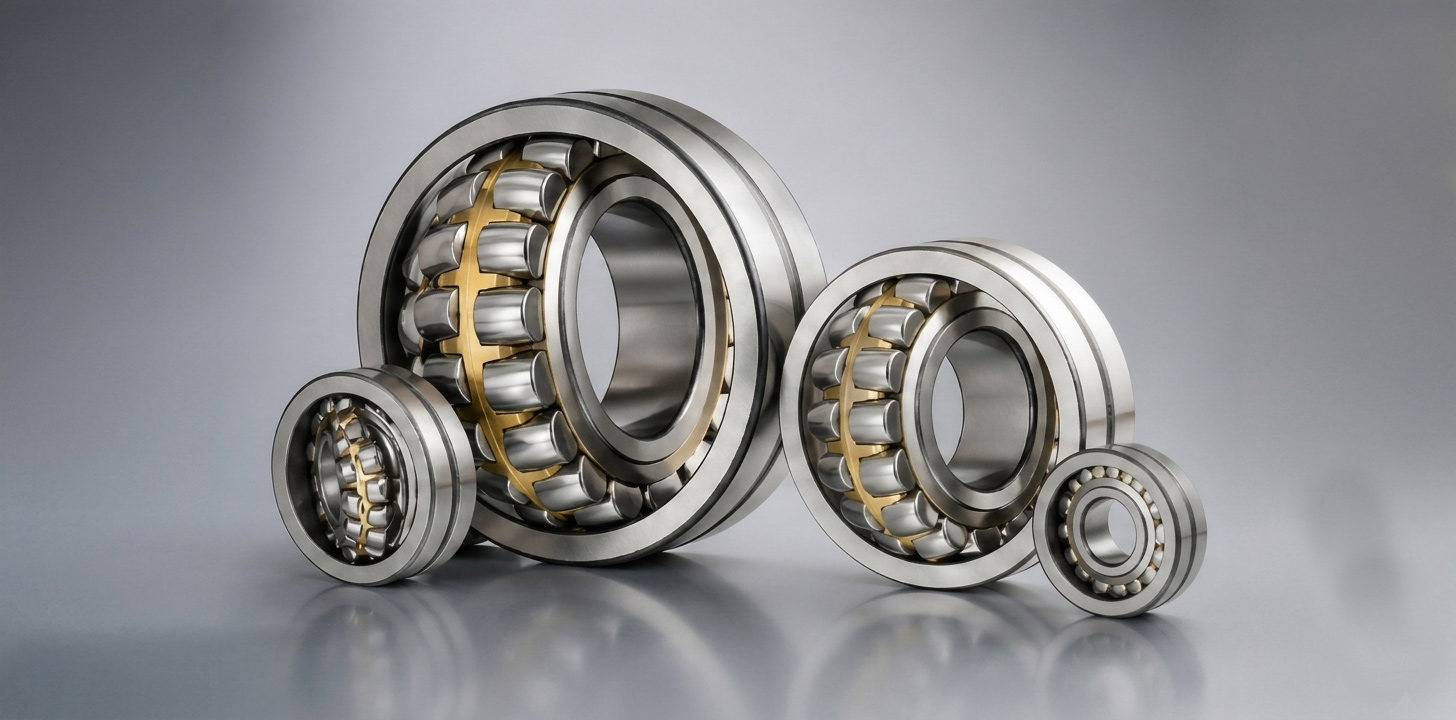
Spherical roller bearings (SRBs) are a type of rolling-element bearing specifically engineered to handle high radial loads, moderate axial loads, and — most critically — angular misalignment between the shaft and housing. They are among the most robust bearing types available and are indispensable in heavy industrial machinery.

The defining characteristic of an SRB is its double-row barrel-shaped rollers running inside a common sphered outer raceway. This geometry allows the bearing to automatically accommodate shaft deflections and mounting inaccuracies without compromising performance or service life.

Key Definition: A spherical roller bearing is a self-aligning, double-row rolling element bearing featuring barrel-shaped rollers and a sphered outer ring raceway, capable of accommodating angular misalignment typically up to 1–3°.


Design & Construction of Spherical Roller Bearings

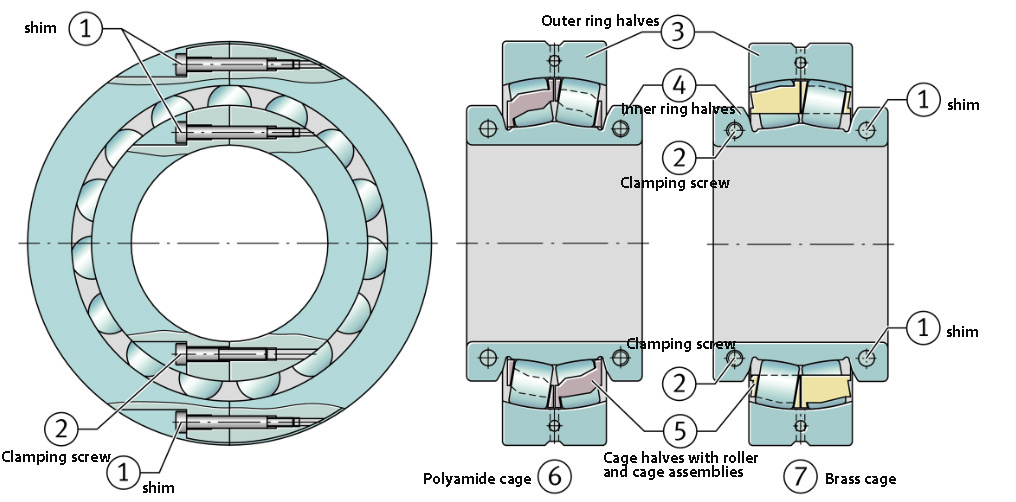
Understanding the internal anatomy of a spherical roller bearing is essential for engineers and maintenance professionals. Each component is precision-engineered to contribute to the bearing's exceptional load-carrying and misalignment capabilities.

Construction of Spherical Roller Bearings


Key Components Explained

Component

Material

Function

Design Feature

Outer Ring

Through-hardened bearing steel

Houses sphered raceway; allows self-alignment

Concave spherical raceway surface

Inner Ring

Through-hardened bearing steel

Mounts on shaft; transmits load to rollers

Two inclined raceways; may include tapered bore

Barrel Rollers

High-carbon chrome steel

Rolling elements transmitting radial & axial loads

Symmetrical or asymmetrical barrel profile

Cage / Retainer

Steel, brass, or polymer

Maintains equal roller spacing; reduces friction

Window-type, pressed steel, or machined brass

Bore

Shaft interface; cylindrical or tapered

Tapered bore (1:12 or 1:30) for adapter sleeve mounting

Seals / Shields

Rubber (NBR/FKM) or steel

Retains lubricant; excludes contaminants

Optional; on sealed variants (W33, E, CC)


How Spherical Roller Bearings Work

The operational genius of a spherical roller bearing lies in the geometric relationship between its components. The sphered outer raceway acts as the pivot point, allowing the inner ring (and shaft) to tilt relative to the outer ring (and housing) without transmitting harmful bending moments.

💡 The Self-Aligning Principle: When the shaft deflects or is misaligned during installation, the barrel rollers naturally re-orient within the sphered outer raceway. The center of the sphere always coincides with the bearing center, ensuring uniform load distribution across the roller length at any angle of tilt.


Load Transmission Mechanism

Spherical roller bearings transmit load through a combination of radial and axial force pathways:

Load Type

Capacity

Transmission Path

Notes

Radial Load

Very High

Shaft → Inner Ring → Rollers → Outer Ring → Housing

Both rows carry radial load simultaneously

Axial Load (both directions)

Moderate

Shaft → Inner Ring shoulders → Roller ends → Outer Ring flanges

Up to ~25% of radial capacity

Combined Load

High

Both pathways active simultaneously

Most common real-world operating condition

Moment Load

Limited

Distributed across roller rows

Self-aligning feature absorbs minor moments


Types of Spherical Roller Bearings

Over decades of industrial use, multiple SRB design variants have been developed to meet specific application demands. The key differences lie in roller geometry, cage design, and bore configuration.

Type / Designation

Key Feature

Best For

Common Suffixes

Symmetrical Roller (C-type)

Equal roller halves; inner ring center rib guide

General industrial; moderate speeds

CC, C3, C4

Asymmetrical Roller (E-type)

Larger, optimized rollers; higher load rating

High loads; mining; demanding environments

E, E1, MB, EB

Cylindrical Bore

Standard straight bore

Press-fit or interference-fit onto shaft

Standard (no suffix)

Tapered Bore (1:12)

Bore tapered at 1:12 ratio

Adapter or withdrawal sleeve mounting

K

Tapered Bore (1:30)

Bore tapered at 1:30 ratio

Large-bore applications; shaft ≥200mm

K30

Sealed Variant (W33)

Oil groove + holes in outer ring; pre-lubricated

Re-lubrication via housing; food processing

W33, 2CS2


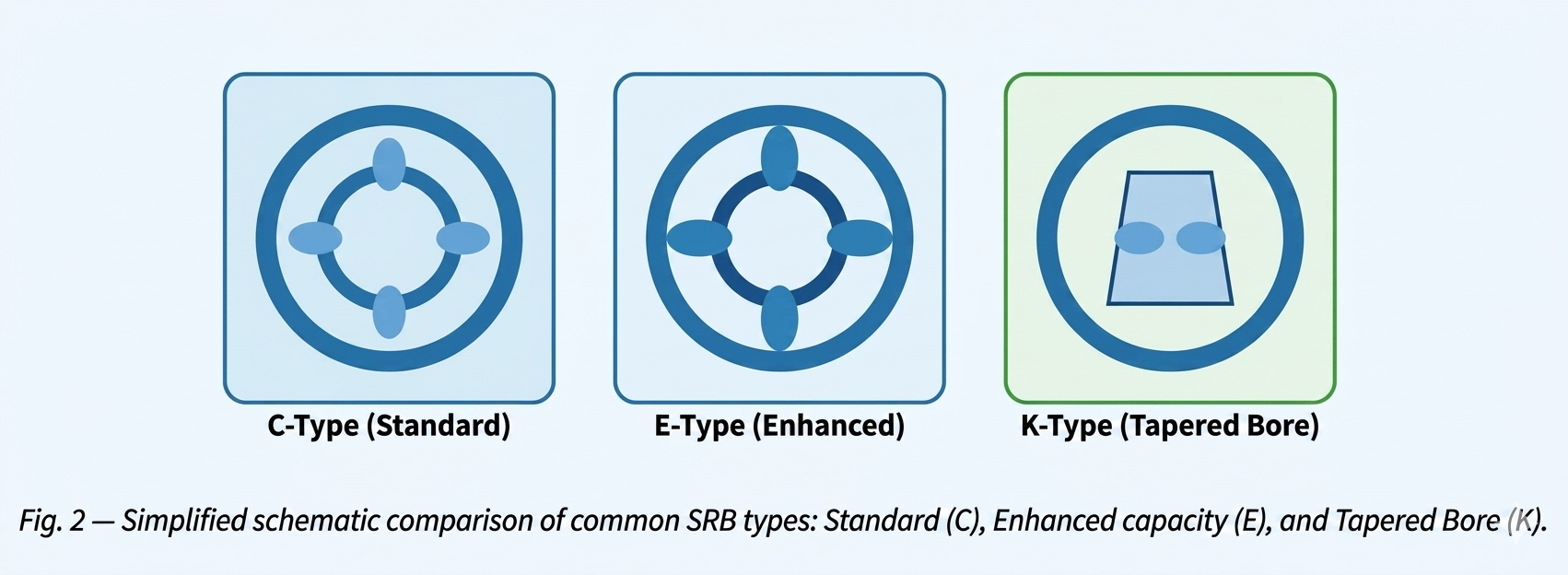
common SRB types


Advantages & Limitations

✅ Advantages

  • Self-aligning capability up to 3°
  • Extremely high radial load capacity
  • Carries axial loads in both directions
  • Long service life under heavy loads
  • Tolerates shaft deflection & housing distortion
  • Available in very large sizes (up to 1.5m bore)
  • Tapered bore allows easy mounting with adapter sleeves
  • Suitable for extremely demanding environments
  • Can be re-lubricated in service

⚠️ Limitations

  • Limited suitability for very high speeds
  • Higher friction than cylindrical roller bearings
  • More expensive than ball bearings
  • Not ideal for pure axial or moment loads
  • Cage design limits max speed (vs. full-complement)
  • Requires careful installation torque control
  • Heat generation higher under misaligned conditions


Industrial Applications of Spherical Roller Bearings

Spherical roller bearings are the workhorses of heavy industry. Their unique combination of load capacity and self-alignment makes them the bearing of choice wherever shafts are long, loads are heavy, and perfect alignment cannot be guaranteed.

Industrial Applications of Spherical Roller Bearings


Industry

Typical Application

Key Requirement

SRB Advantage

Mining

Jaw crusher eccentric shaft

Extreme shock loads, dusty environment

High dynamic load capacity; misalignment tolerance

Paper & Pulp

Paper machine dryer roll

Long shafts, thermal expansion, steam environment

Self-alignment accommodates thermal deflection

Steel

Rolling mill backup roll

Very high rolling forces, water/scale contamination

Massive radial load capacity; sealed variants available

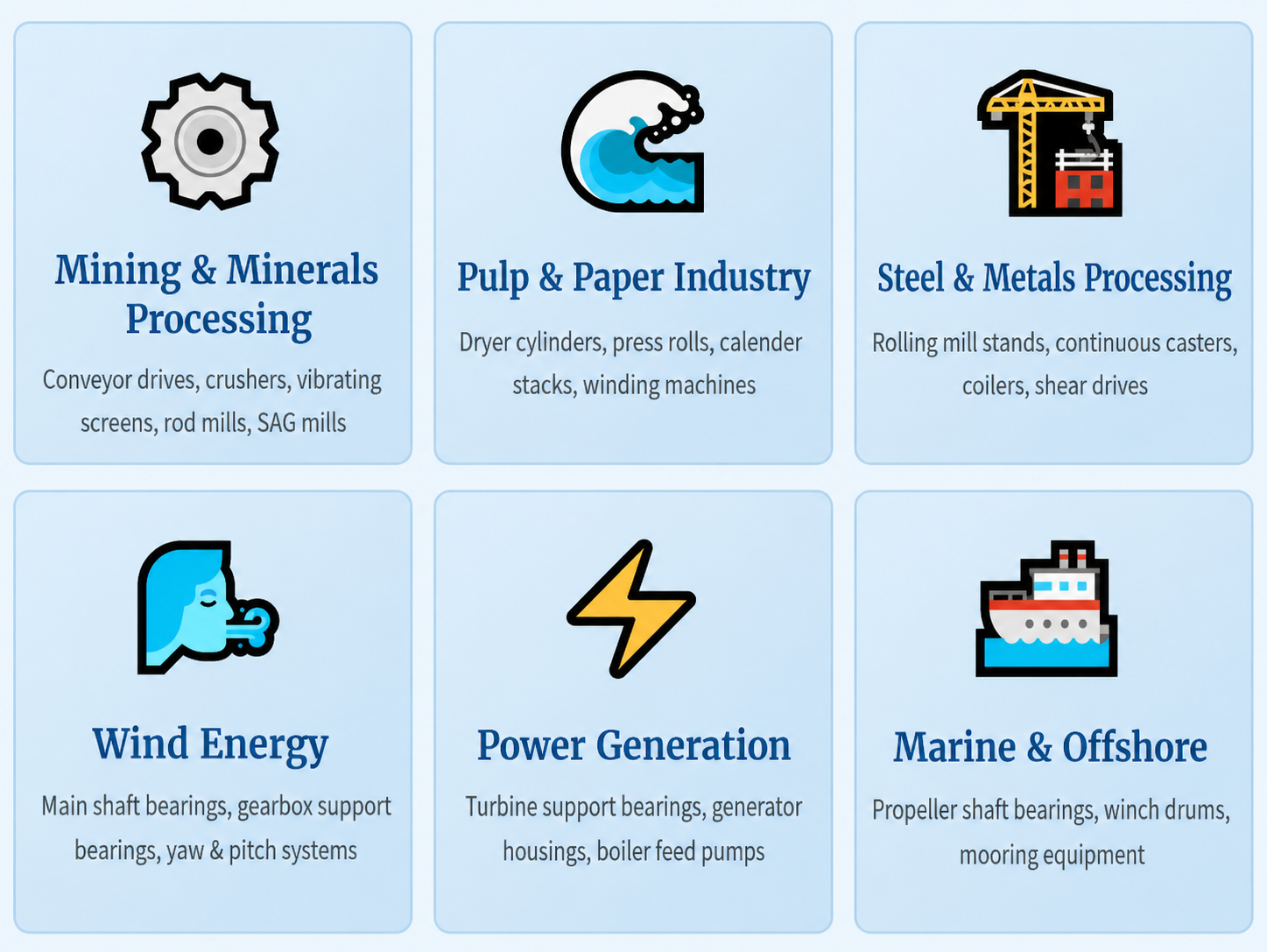
Wind Energy

Main shaft (direct drive turbine)

Variable wind loads, bending moments, long maintenance intervals

Combined load capability; large bore availability

Cement / Aggregate

Rotary kiln tyre support roller

Continuous 24/7 operation, high temperatures

High static load capacity; re-lubrication capability

Marine & Offshore

Propeller shaft bearings, winch drums

Corrosive environment, high torque, shock loading

Heavy-duty design; stainless and coated options


How to Select the Right Spherical Roller Bearing

Selecting the correct SRB is a multi-parameter engineering process. Using the wrong bearing is one of the most common causes of premature failure. Follow this systematic 6-step approach:

1

Define Load Conditions

Calculate radial load (Fr), axial load (Fa), and shock factors. Determine equivalent dynamic bearing load P = X·Fr + Y·Fa.


2

Establish Required Service Life (L10h)

Determine required bearing life in operating hours. Use ISO 281 formula: L10 = (C/P)ᵖ × (10⁶/60n).


3

Select Bore Diameter and Series

Match bore diameter to shaft size. Choose bearing series (2, 3, 4) based on load-to-size ratio needed — Series 4 for maximum load capacity.


4

Check Speed Rating (ndm)

Verify operating speed does not exceed the bearing’s speed limit. E-type bearings typically have higher speed ratings than C-type.


5

Choose Bore Type & Mounting Method

Select cylindrical bore (direct shaft fit) or tapered bore (K suffix) with adapter sleeves for easier mounting on long shafts.


6

Specify Clearance Class and Cage Material

Use C3 clearance for most industrial applications. Select brass cage (M) for high temperatures; polymer cage for quiet operation.


Parameter Standard Choice When to Go Higher
Clearance Group C3 (most common) C4 for very high temperatures or interference fits
Cage Type Pressed steel (standard) Machined brass (M suffix) for high speed / high temp
Bore Type Cylindrical bore Tapered K bore for long shafts or field service
Design Type E-type (enhanced capacity) C-type for budget, moderate loads
Sealing Open (re-lubricated via housing) Sealed (2CS2) for inaccessible or food-grade applications
Lubrication Grease (most common) Oil circulation for high speeds or high temperatures


Maintenance & Lubrication of Spherical Roller Bearings

Proper maintenance is the single biggest factor in achieving full design life from spherical roller bearings. Industry statistics indicate that over 70% of premature bearing failures are attributable to incorrect lubrication, contamination, or installation errors.


Lubrication Guidelines

Operating Condition

Recommended Lubricant

Re-lube Interval

Notes

General industrial (up to 80°C)

Lithium complex grease NLGI 2

3–6 months

Most common scenario

High temperature (80–150°C)

Polyurea or calcium sulfonate grease

Monthly to quarterly

Avoid mixing grease types

High speed (ndm > 200,000)

ISO VG 46–100 circulating oil

Per system schedule

Monitor oil temperature continuously

Wet / contaminated

Water-resistant EP grease

Every 2–4 weeks

Use labyrinth seals in housing

Low temperature (below −20°C)

Synthetic base oil grease NLGI 1

Quarterly

Ensure grease pumpable at startup


⚠️ Critical Installation Reminder: When mounting SRBs with tapered bore and adapter sleeves, always use the recommended drive-up distance (Δa) method or hydraulic method to achieve correct internal clearance reduction. Over-tightening is a leading cause of early fatigue failure.


Spherical Roller Bearings vs. Other Bearing Types

Choosing between bearing types requires a clear understanding of how each performs against the specific demands of your application.

Feature

Spherical Roller

Cylindrical Roller

Tapered Roller

Deep Groove Ball

Radial Load Capacity

★★★★★

★★★★★

★★★★

★★

Axial Load Capacity

★★★

★ (one dir.)

★★★★★

★★★

Misalignment Tolerance

★★★★★ (up to 3°)

★ (<0.04°)

★ (<0.04°)

★★★ (0.25°)

Speed Capability

★★★

★★★★★

★★★

★★★★★

Friction Level

Medium

Low

Medium-High

Low

Relative Cost

Medium-High

Medium

Medium

Low


Frequently Asked Questions (FAQ)


Q: What is the maximum misalignment angle for an SRB?

Most standard spherical roller bearings can accommodate angular misalignment of up to 1° to 3°, depending on the bearing size and design series. However, continuous operation at maximum misalignment significantly reduces service life. Consult the manufacturer’s catalog for series-specific limits.


Q: What does the “E” suffix mean in SRB part numbers?

The “E” designation (used by SKF, FAG/Schaeffler, and others) denotes an enhanced internal design featuring larger, optimized barrel rollers and an improved cage geometry. E-type bearings offer higher dynamic load ratings — typically 20–30% greater than standard designs of the same envelope dimensions.


Q: Grease or oil lubrication — which is better for SRBs?

Grease is preferred for the vast majority of industrial applications due to its simplicity, sealing properties, and lower maintenance demands. Oil lubrication (circulation or oil bath) is recommended when operating speeds are high (ndm > 150,000–200,000 mm/min), when operating temperatures exceed 120°C, or when heat removal from the bearing is critical.


Q: What is the difference between C3 and C4 internal clearance?

C3 clearance is larger than the standard (CN) group and is the most widely used clearance class for industrial SRBs — it compensates for clearance reduction caused by press-fit mounting and thermal expansion. C4 clearance is even greater and is specified for applications with high interference fits, significantly elevated operating temperatures, or when using tapered bore bearings driven further onto steep tapers.


Need Help Selecting the Right Spherical Roller Bearing?

Our team of bearing engineers can help you identify the correct specification, provide load calculations, and source the best bearing for your application.

Contact us today — Request a Quote | Browse Our Catalog | 


Schaeffler Group Sells Subsidiary Lacey Manufacturing Inc

Schaeffler Group Sells Subsidiary Lacey Manufacturing Inc

Strategic Business Decision by Schaeffler Group The Schaeffler Group, headquartered in Herzogenaurach, Germany, has announced the sale of its U.S....
Read More
Mounted Bearing Selection Process: A Step-by-Step Guide

Mounted Bearing Selection Process: A Step-by-Step Guide

When you choose mounted bearing solutions for your application, your main goal is to ensure good performance and reliability. You also want to keep...

Read More
Linear Motion Solutions for Semiconductor Manufacturing

Linear Motion Solutions for Semiconductor Manufacturing

The semiconductor industry stands at the forefront of technological innovation, demanding unprecedented levels of precision, cleanliness, and...

Read More