


Top Uses for Super Precision Angular Contact Ball Bearings
Super Precision angular contact ball bearings play a vital role in many industries. They can handle high-speed and precise tasks, making them crucial...
8 min read
William
:
Apr 8, 2026 5:28:56 AM
Table of Contents
Deep groove ball bearings (DGBBs) and angular contact ball bearings (ACBBs) look nearly identical on a drawing.
Same bore, same OD, sometimes even the same width.

Yet swap one for the other without thinking, and you can see L10 bearing life collapse by 60–80% — or worse, catastrophic seizure within hours of startup.
This isn't a theoretical concern.
NASA rolling-element bearing fatigue research analysing over 7,900 bearings across deep-groove, angular contact, and roller types found that failures classified as avoidable — including load mismatch and incorrect specification — consistently account for a significant share of sub-rated service life outcomes.
The fix is straightforward: understand what each bearing type is actually designed to do, and match it to your load conditions.
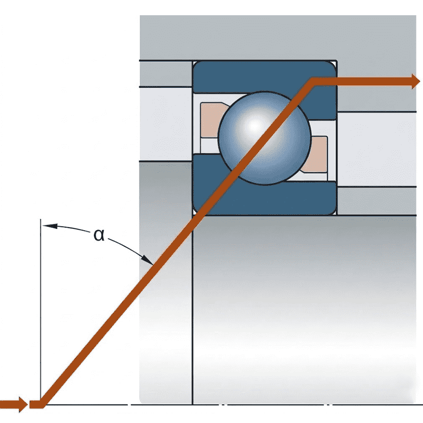
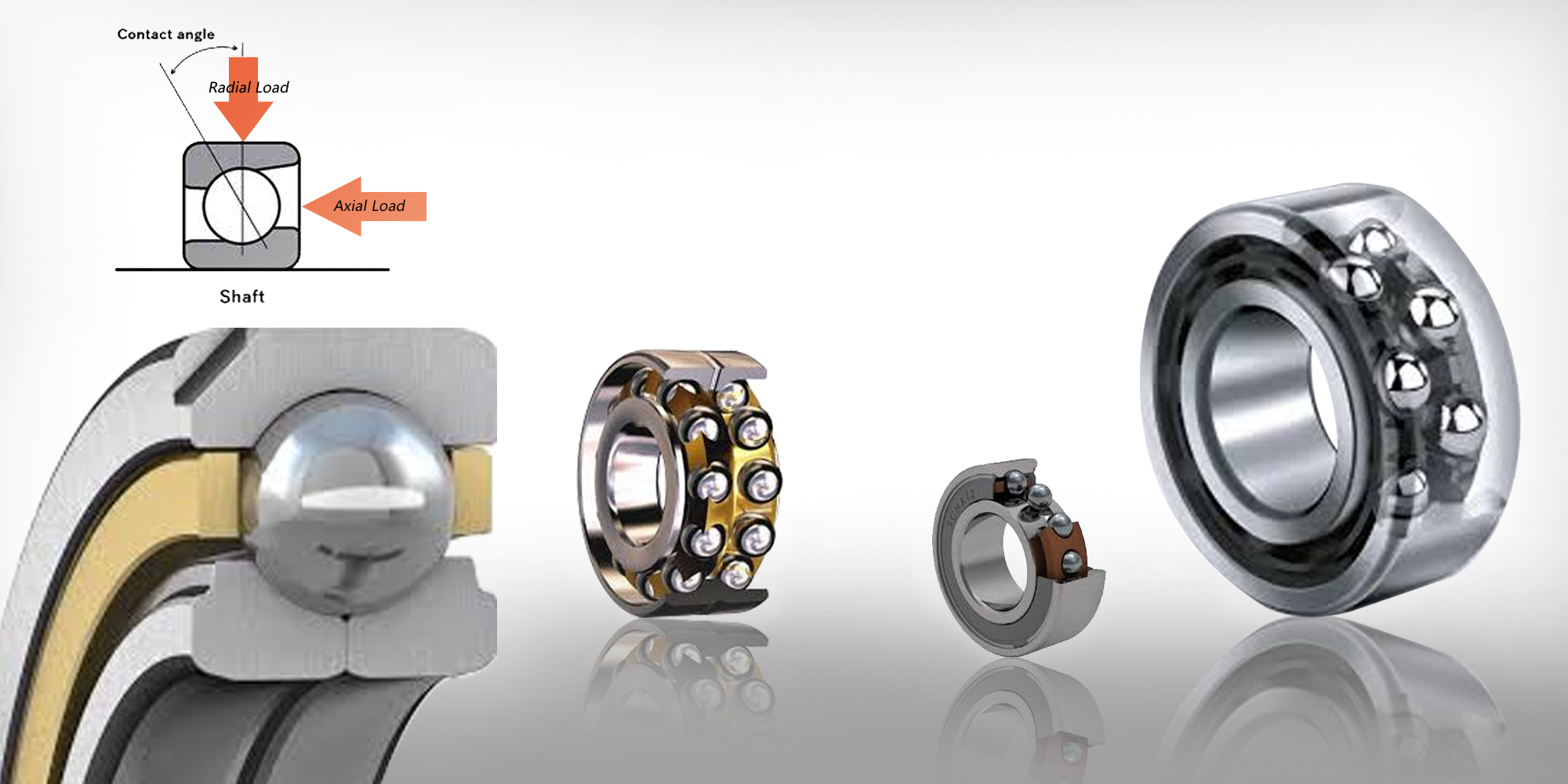
To understand why these bearings behave so differently, you need to look at one number: the contact angle.
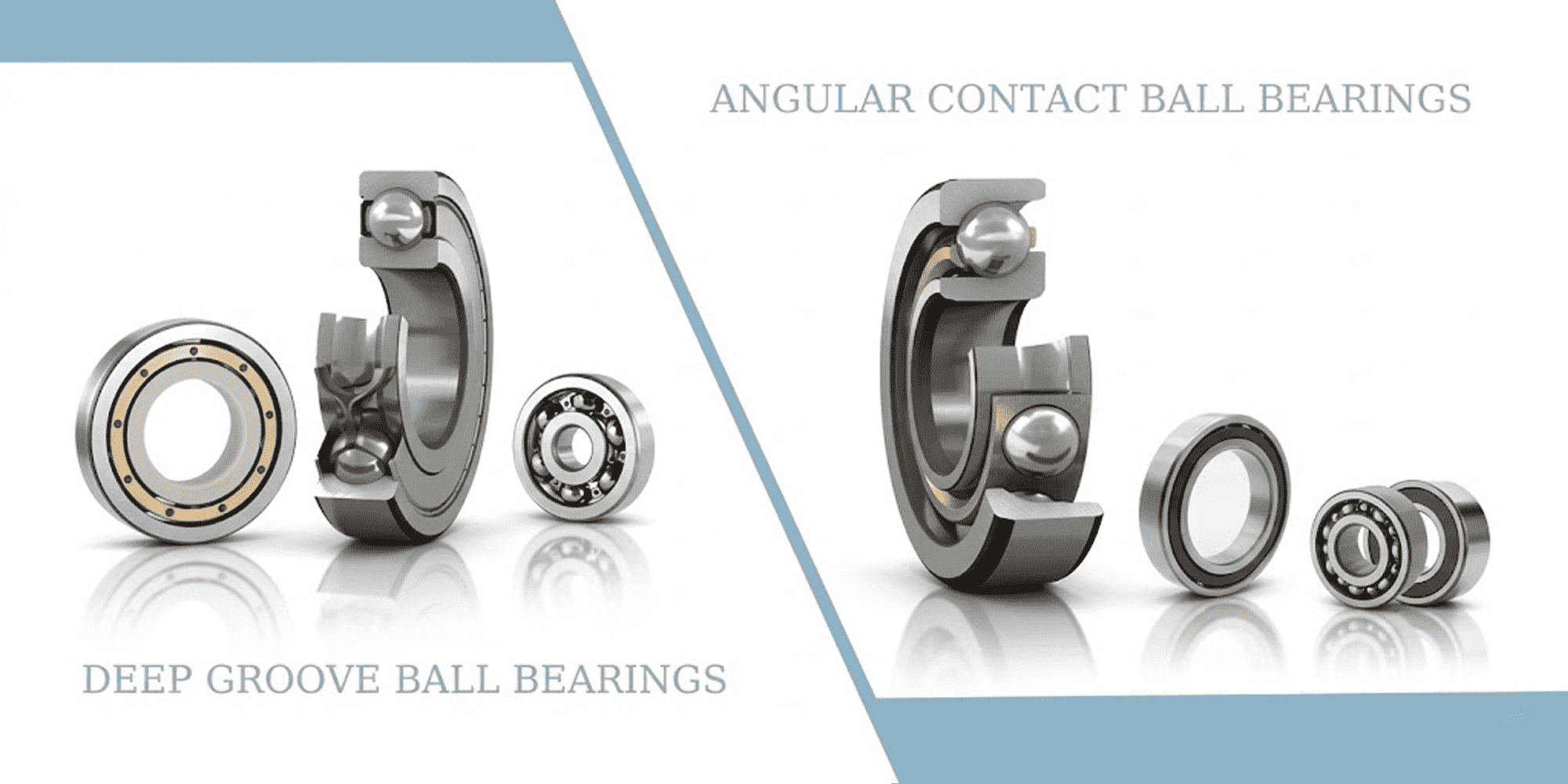
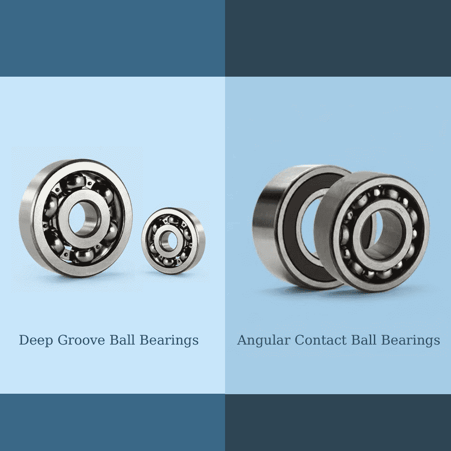
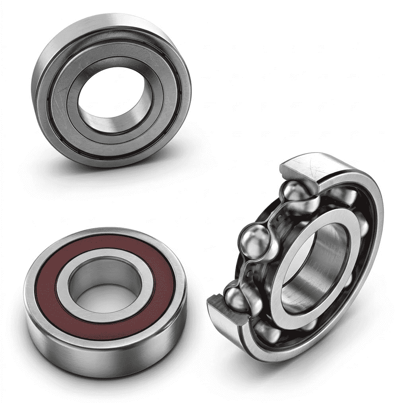
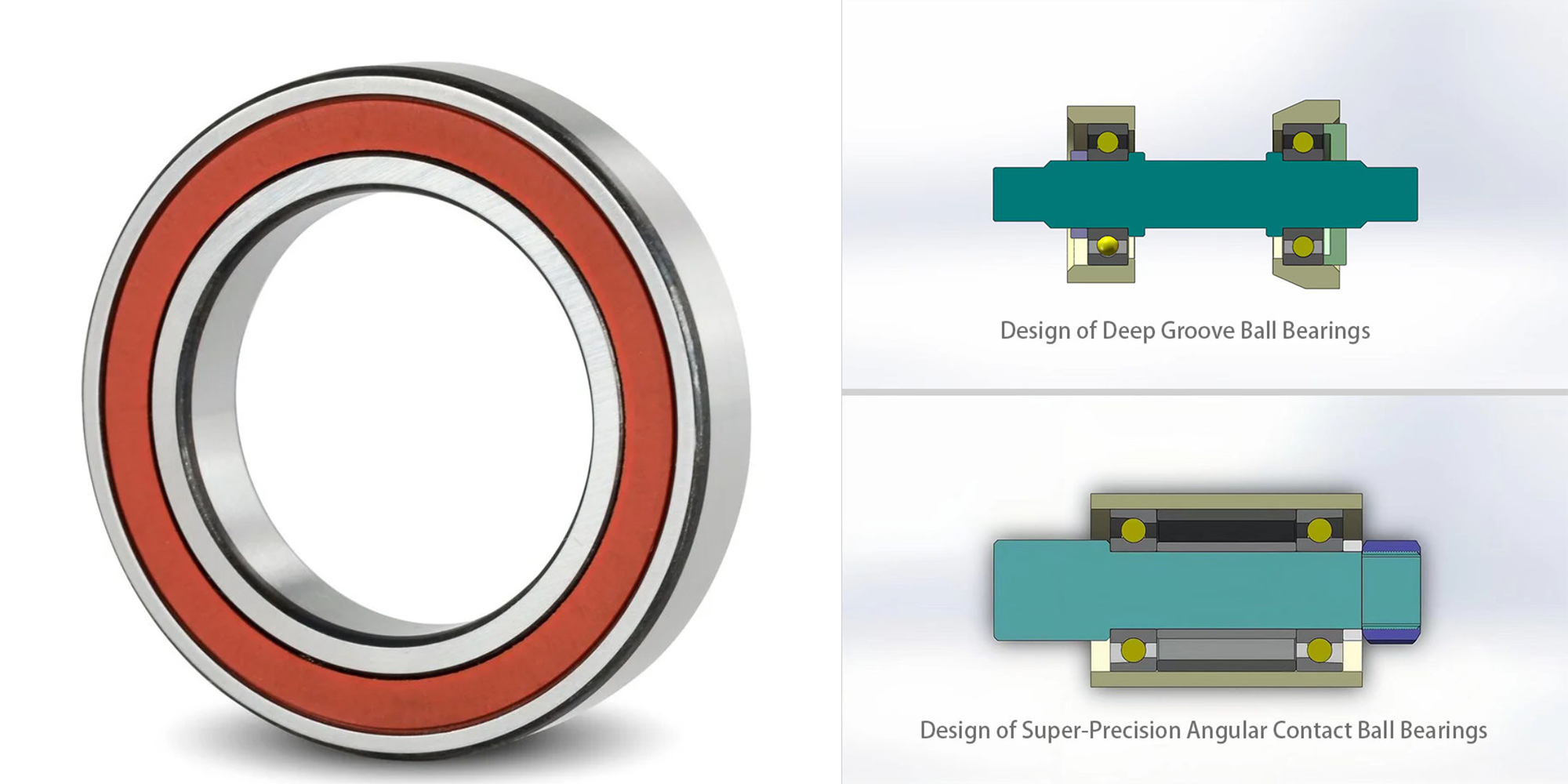
DGBBs have deep, symmetrical raceways in both inner and outer rings.
The ball-to-raceway contact occurs at an effective angle of roughly 5–8° under radial load, rising slightly under combined load.

This symmetric geometry means the bearing can handle axial load in both directions simultaneously — a critical advantage when thrust direction is unpredictable.
The design is inherently low-friction.
Because the ball contact area is small and the raceways are smooth and continuous, DGBBs produce very little rolling resistance, which is why they dominate in motors, fans, and appliances where energy efficiency matters.

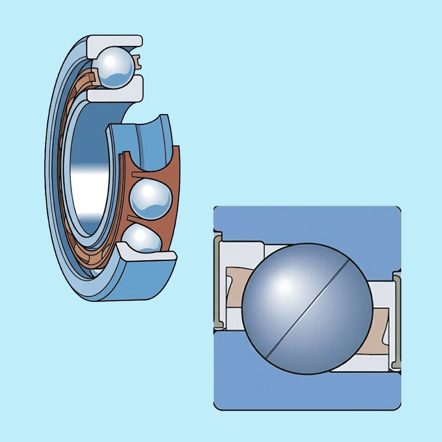
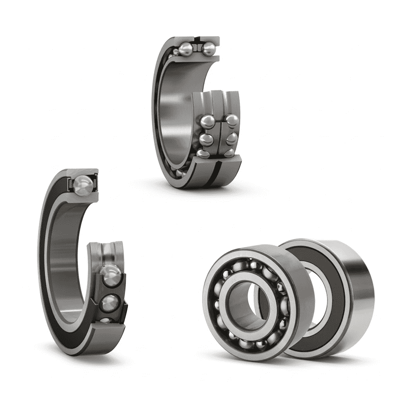
ACBBs use an asymmetric outer ring — one shoulder is machined taller than the other, forcing the load to transfer at a defined contact angle.

Standard contact angles are 15°, 25°, and 40°. The higher the angle, the greater the axial load capacity — but with a trade-off in maximum speed.
This asymmetry has one important consequence: a single ACBB can only resist axial force in one direction.
In practice, if your application sees thrust from both sides, you'll always need a matched pair — there's no workaround.

Practical tip:
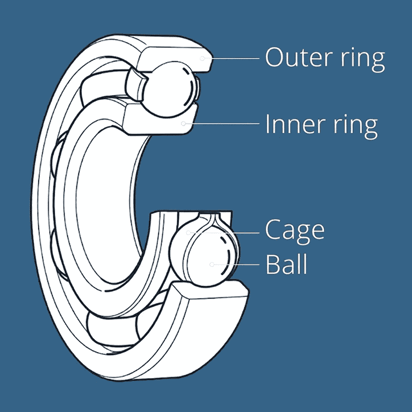
When inspecting unmounted bearings, look at the outer ring from the side. A DGBB has two equal shoulders on either side of the ball groove.
An ACBB has one tall shoulder and one low shoulder — the tall side is the load-bearing face and must be oriented toward the thrust load source during installation.
If you're new to bearing load concepts, our guide on understanding bearing loads covers the fundamentals. For those already familiar, here's how the numbers compare between DGBBs and ACBBs:
For pure radial load applications, DGBBs typically offer slightly higher radial capacity within the same envelope.
The symmetric groove geometry allows more balls and a larger contact area — a 6206 DGBB (30mm bore) has a dynamic radial load rating (C) of approximately 19.5 kN.
A comparable 7206 ACBB with a 25° contact angle carries around 17.8 kN radially — about 9% less.
This is where ACBBs pull decisively ahead.
A 7206 ACBB at 25° contact angle can handle an axial load of up to ~8.5 kN continuously.
The equivalent DGBB is typically limited to about 30–40% of its dynamic radial rating in the axial direction — and only at low to moderate speeds.
For applications with significant thrust — helical gears, ball screws, angular machining forces — DGBBs simply run out of capacity.
Pushing them beyond their axial limit causes the balls to ride up the raceway shoulder, generating concentrated stress, elevated temperatures, and accelerated fatigue.
For a deeper look at the difference between these two load types, see our guide on radial vs. axial load. For a more detailed breakdown of axial load behaviour specifically, see understanding bearing axial load.
When radial and axial loads arrive simultaneously, ACBBs handle combined loading far more efficiently.
ISO 281 life calculations account for equivalent dynamic load (P = X·Fr + Y·Fa).
For ACBBs, the Y factor (axial load factor) is significantly more favourable than for DGBBs, meaning the calculated L10 life is substantially longer under the same combined load conditions.
If you'd like to understand how static and dynamic load ratings factor into these calculations, our article on static vs. dynamic load in bearings goes into more detail.
| Factor | Deep Groove Ball Bearing | Angular Contact Bearing |
|---|---|---|
| Primary Load | Radial + moderate axial (both directions) | Combined radial + high axial (one direction per unit) |
| Contact Angle | ~5–8° (effective) | 15°, 25°, or 40° (standard) |
| Speed Capability | High — low friction, simple geometry | Very high — optimised for speed + load |
| Axial Load Direction | Both directions (limited) | One direction per bearing; paired for bi-directional |
| Mounting | Simple — single bearing, no special orientation | Requires correct orientation; often used in pairs (DB/DF/DT) |
| Precision Level | P0 to P6 | P4 to P2 (spindle-grade) |
| Typical Applications | Motors, pumps, fans, conveyors, appliances | Machine tool spindles, robotics, gearboxes, aerospace |
| Relative Cost | Lower — widely available | Higher — tighter tolerances, often sold in matched sets |
| Noise / Vibration | Excellent for quiet, general-duty use | Low when correctly preloaded; sensitive to setup |
If you've decided to go with angular contact bearings, contact angle selection is the next critical decision.

Many engineers default to 25° without thinking about it. Here's what each actually means:
Practical rule:
If your application runs above 12,000 RPM, start at 15°. If axial load exceeds 50% of radial load at moderate speed, move to 25° or 40°. When in doubt, 25° is the safe middle ground.
For a closer look at how super precision variants push these limits further, see our guide on benefits of super precision angular contact ball bearings.
Single ACBBs are rarely used alone in precision applications.
In practice, three paired arrangements are standard, and each one suits a different load profile:
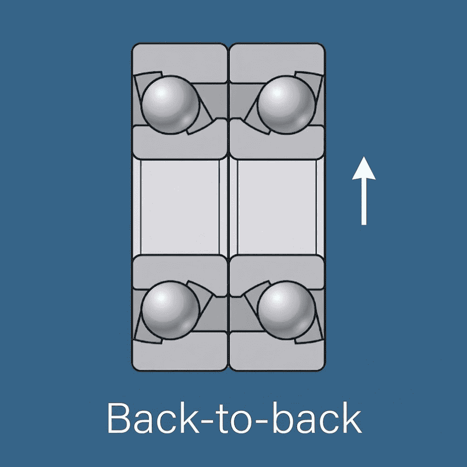
The wide faces of the outer rings face each other.
This creates a wider effective load centre, giving the arrangement high moment rigidity.
DB is the most common configuration for machine tool spindles because it resists bending moments caused by cutting forces.
If you're specifying a milling spindle or grinding spindle, DB is almost always the starting point.

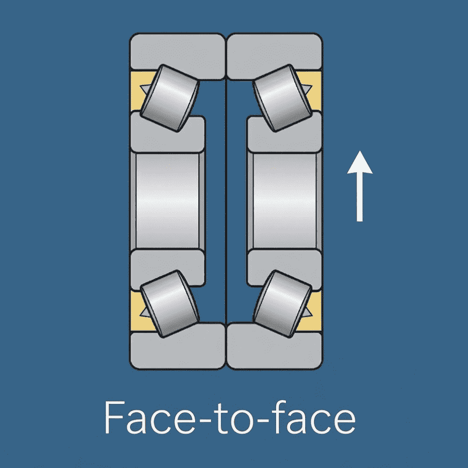
The narrow faces of the outer rings face each other.
Load lines converge inward, giving a narrower effective load centre and lower moment rigidity than DB.
That narrower load centre is actually an advantage in one specific situation: DF tolerates shaft misalignment better than DB, because the geometry is less sensitive to angular error between the inner and outer rings.
This makes it the preferred choice for automotive gearboxes and industrial gearboxes with longer shafts, where perfect housing alignment across the full shaft length is difficult to guarantee.

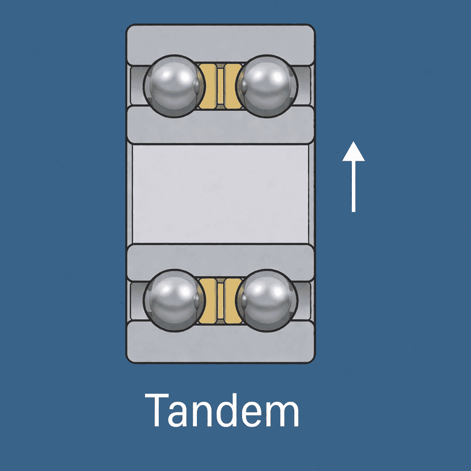
Both bearings face the same direction.
Axial load capacity doubles in one direction, but the arrangement provides no resistance to thrust in the opposite direction.
DT is used specifically when unidirectional axial load exceeds what a single bearing can handle — such as heavy-duty ball screw support on CNC gantry axes.
For application examples across industries, see our article on top uses for super precision angular contact ball bearings.

Important:
DB and DF arrangements require correctly matched bearing sets — do not randomly pair two bearings from different manufacturing batches.
Manufacturers supply matched pairs with controlled preload. Using unmatched bearings causes unequal load distribution and rapid fatigue.
DGBBs are genuinely competitive on speed.
A 6206 DGBB (30mm bore) has a reference speed of 13,000 RPM in grease lubrication — high enough for most motors and compressors.
With oil lubrication and proper cooling, this rises further.
ACBBs with a 15° contact angle can exceed this, with reference speeds above 15,000–20,000 RPM in matched-set precision spindle configurations.
But they come with a setup cost: preload must be carefully controlled.
Too little and the balls skid at high speed, generating heat and wear; too much and you'll dramatically shorten L10 life.
Getting preload right matters far more for ACBBs than any other installation parameter.
Budget matters, and the numbers here are significant.
A standard 6206 DGBB from a reputable manufacturer (NSK, SKF, FAG, NTN) typically costs 30–60% less than a comparable 7206 ACBB of the same precision grade.
For a machine with 40–60 bearing positions, that gap adds up fast.
Beyond unit price, consider total installed cost:
| Your Application | Recommended Bearing |
|---|---|
| General motor, pump, fan — radial load dominant | Deep Groove Ball Bearing |
| Machine tool spindle — speed + combined load | Angular Contact (paired, P4+) |
| EV auxiliary motor — compact, moderate axial | Deep Groove Ball Bearing |
| Robotics wrist joint — precision + axial thrust | Angular Contact (DB or DF pair) |
| Conveyor roller — radial load, low cost | Deep Groove Ball Bearing |
| Aerospace gearbox — combined load, high precision | Angular Contact (matched set, P2) |
| HVAC fan — low noise, both axial directions | Deep Groove Ball Bearing |
| High-speed grinding spindle (>15,000 RPM) | Angular Contact (15° contact angle) |
Not without engineering review.
If the housing and shaft are designed for a single bearing position, fitting a single ACBB creates a one-directional axial constraint that can generate unpredictable preload or leave the shaft floating axially.
In many cases, a redesign to accommodate a DB pair is necessary.
For a foundational overview of DGBB design, see our guide on what is a deep groove ball bearing.
Effectively, yes — though it's not a design parameter in the same way. Under pure radial load, DGBBs operate at a contact angle of approximately 0°.
As axial load increases, the effective contact angle rises to around 5–15°.
This is why DGBBs can handle some axial load — but the capacity is modest and decreases rapidly as speed increases.
Preload is a deliberate axial compressive force applied to a pair of ACBBs during assembly.
It eliminates internal clearance and stiffens the bearing arrangement — both of which improve rotational accuracy and prevent ball skidding at high speed.
Preload is typically classified as light (C), medium (CA), or heavy (CB) and is specified when ordering matched bearing sets.
Manufacturer-matched sets come with preload pre-set; don't adjust it unless you have the means to verify the result.
In the vast majority of electric motors, DGBBs are the correct choice.
Motors typically have moderate axial loads (from rotor weight, belt tension, or coupling misalignment) in both directions.
DGBBs handle this naturally. ACBBs are only justified in motor designs with significant one-directional thrust — such as vertical motors with heavy rotors or direct-coupled pump shafts with high hydraulic thrust.
Look for these signs: discolouration or bluing of the bearing rings near the ball track (thermal indicator), ball track migration toward one shoulder on the outer ring, or spalling that initiates at one edge of the contact ellipse rather than the centre.
All of these suggest the bearing is operating at the edge of its axial capacity.
Deep groove ball bearings are the workhorses of the rotating machinery world — versatile, affordable, and more capable than they're often given credit for.
For the majority of industrial applications, they are the right answer.
Angular contact bearings earn their place in a narrower but critical set of conditions: combined loading with significant axial thrust, high-precision spindle applications, and situations where bearing stiffness and runout accuracy are paramount.
Run the ISO 281 equivalent dynamic load calculation before specifying.
Look at your actual load spectrum — not just the peak — and check whether axial load direction is fixed or reversing.
Those three steps will point you clearly to the right bearing, every time.
Super Precision angular contact ball bearings play a vital role in many industries. They can handle high-speed and precise tasks, making them crucial...
In the following case, Lily Bearing helped a client to customize a solution about super-precision angular contact ball bearings. This client is a...
Angular contact bearings are essential for high-speed, high-precision applications. They are particularly suitable for machine tool spindles,...