

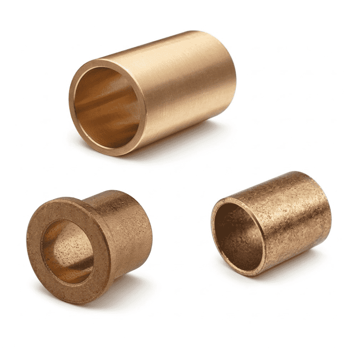
14 Types of Bushings: Design, Material & Selection Guide
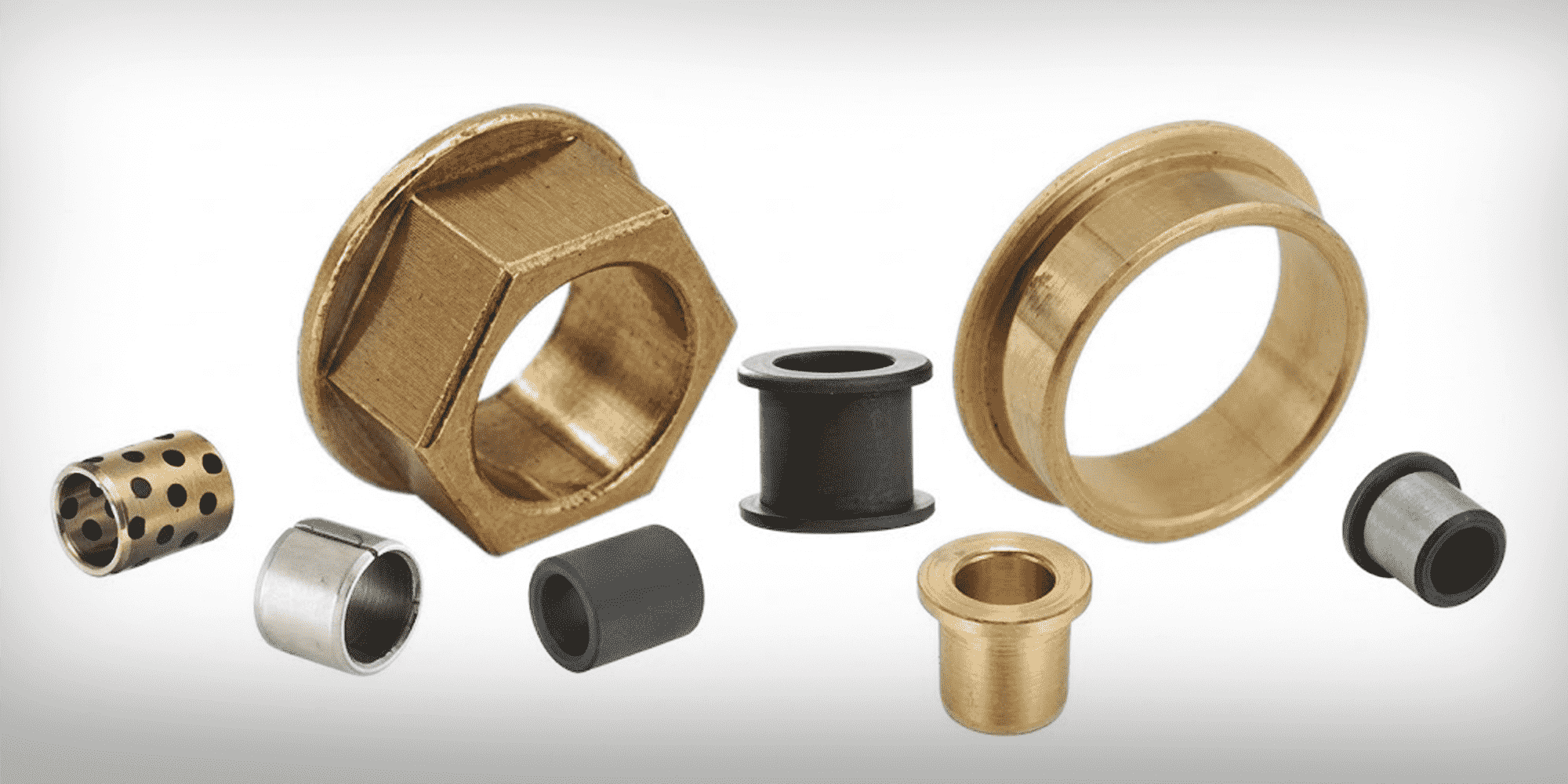
There are more bushing types than most catalogs make obvious. Part of the confusion is that "bushing" gets organized two different ways: by physical...
8 min read
William
:
Mar 12, 2026 4:10:55 AM
A shaft spinning inside a housing, metal grinding against metal — without a bushing, that's a wear problem waiting to happen.
With the right one installed, that same shaft can run for years with minimal attention.
Bushings are easy to overlook until something fails.
This guide covers what they are, how they work, what materials to consider, and what actually matters when choosing one.
A bushing — also called a plain bearing, sleeve bearing, or journal bearing — is a single-part cylindrical component that sits between a moving shaft and its surrounding housing.
Its job: give the shaft a smooth surface to move against, and absorb the wear so the more expensive parts don't have to.

That last part is the key.
A bushing is sacrificial by design. It wears gradually over time, protecting the shaft and housing from damage. Replacing a bushing is cheap. Replacing a shaft is not.
Unlike ball bearings or roller bearings, which reduce friction through rolling contact, a bushing works through direct sliding contact.
The material is chosen to be softer or more lubricious than the shaft — so when something wears out, it's the bushing.
💡 In plain terms
A bushing is a replaceable wear surface. It sits between two parts, controls friction and load, and wears down so your shaft and housing don't have to.
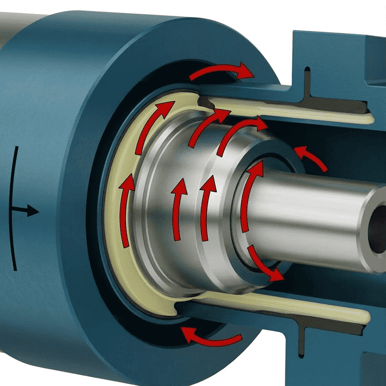
The bushing is pressed into a housing bore and stays stationary.
A shaft runs through the inner diameter and moves against the bushing surface — rotating, sliding, or oscillating.
In lubricated designs, an oil or grease film forms between shaft and bushing.
In self-lubricating designs, the bushing does the work itself. Sintered bronze releases oil from its pores as it heats up — a process enabled by the powder metallurgy manufacturing process that creates its porous structure.
PTFE composite surfaces deposit a transfer film onto the shaft during the first few hours of operation.
That film stays there permanently — providing lubrication throughout the bushing's entire service life without any input from you.
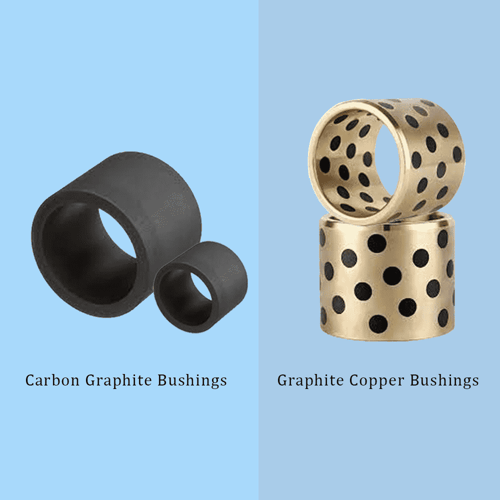
Graphite bushings work differently again: graphite's layered atomic structure shears easily, reducing friction with no liquid at all.

Beyond friction, bushings serve other functions depending on design:
Shock and vibration absorption — rubber bushings in automotive suspension are the most familiar example
Axial location — flanged designs keep shafts from drifting along their centerline
Misalignment compensation — spherical bushings allow angular movement between connected components
Electrical insulation — ceramic or polymer bushings prevent current from flowing between shaft and housing
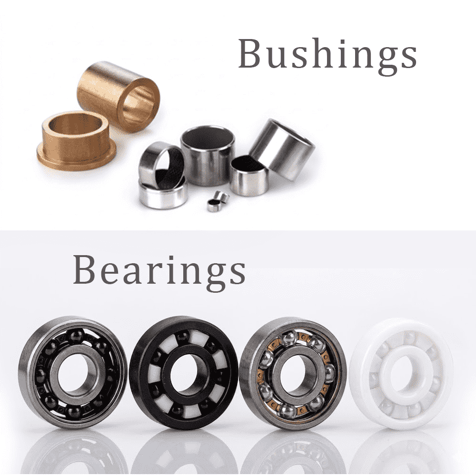
Technically, a bushing is a type of bearing — it's classified as a plain or sliding bearing.
In practice, when engineers say "bearing" they usually mean a rolling-element bearing (ball, roller, tapered).
That's the functional distinction that matters for selection.

The full comparison is covered in our article Bushing vs. Bearings: Everything You Need to Know.
Here's a quick summary:
| Factor | Bushing (Plain Bearing) | Rolling-Element Bearing |
| Friction mechanism | Sliding contact | Rolling contact |
| Load capacity | Excellent — handles heavy and shock loads | Moderate; vulnerable to shock |
| Speed range | Low to medium RPM | High RPM |
| Lubrication | Self-lubricating options available; many run dry | Almost always requires grease or oil |
| Noise | Generally quieter | More noise at high speed |
| Cost | Lower — simpler to buy and replace | Higher; more precise to install |
| Best for | Heavy loads, hard-to-reach locations, sealed joints | High speed, high precision, lighter loads |
In large steam turbines and marine propulsion shafts, you'll find plain bushings — not ball bearings.
The loads are too heavy for rolling elements, and properly designed hydrodynamic journal bushings can run indefinitely with adequate oil supply.
Material selection is where the real engineering decisions happen.
The same sleeve form in different materials can have completely different load limits, temperature ranges, and maintenance needs.
Bronze is the workhorse of bushing materials.
Sintered (powder metal) bronze is oil-impregnated during manufacture — the porous structure acts like a sponge, releasing oil as the bushing heats up and reabsorbing it as it cools. This self-lubricating mechanism is a direct result of the powder metallurgy sintering process.
This gives sintered bronze effective self-lubrication for light-to-moderate loads, which is why it's found in electric motors, fans, light machinery, and appliances everywhere.
Cast or wrought bronze trades some self-lubricating benefit for higher load capacity and fatigue strength.
Typical range: −40°C to +150°C.

Three-layer construction: steel backing for strength, sintered bronze interlayer for bonding, PTFE-based bearing surface for ultra-low friction.
Coefficient of friction as low as 0.04–0.08 — lower than well-lubricated bronze. No external lubrication required.
Used in modern automotive hinges, aerospace control linkages, and industrial automation joints — all running without a drop of added lubricant.
PTFE is recognized by the U.S. FDA as an acceptable material for food contact applications, which is why PTFE-based bushings are widely used in food processing equipment.
Temperature range: −40°C to +280°C for standard PTFE-based surfaces (specialized grades down to −200°C).
%20Bushings.png?width=480&height=480&name=Metal-Polymer%20Composite%20(PTFE-based)%20Bushings.png)
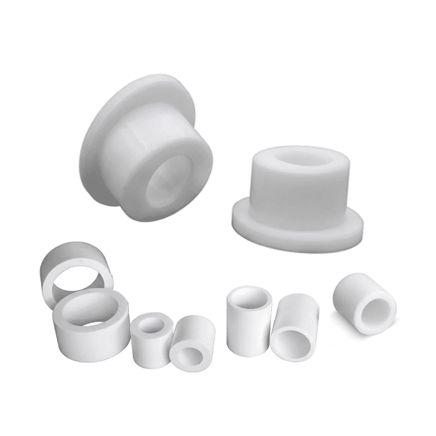
Nylon, acetal, UHMW-PE, PTFE, PEEK — corrosion-resistant, chemically resistant, lightweight, and self-lubricating.
Standard nylon grades top out at 100–130°C; acetal (POM) is lower at ~100°C. High-performance PEEK reaches ~250°C.
Standard choice for food processing, medical devices, and consumer appliances where cleanliness and chemical resistance matter most.

Above 300°C, most lubricants and polymers are gone.
Graphite's layered atomic structure shears easily, providing effective dry lubrication up to 400°C and beyond.
Standard solution for industrial ovens, steam equipment, glass manufacturing lines, and any high-temperature application where liquid lubrication isn't practical.

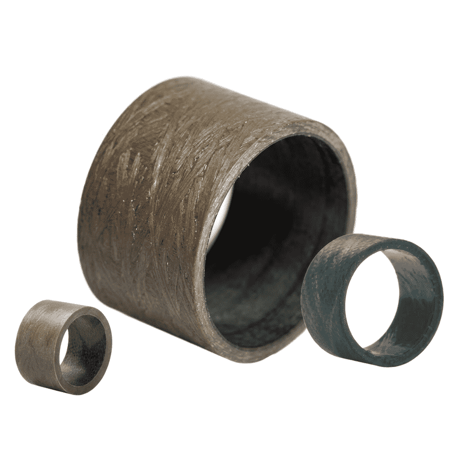
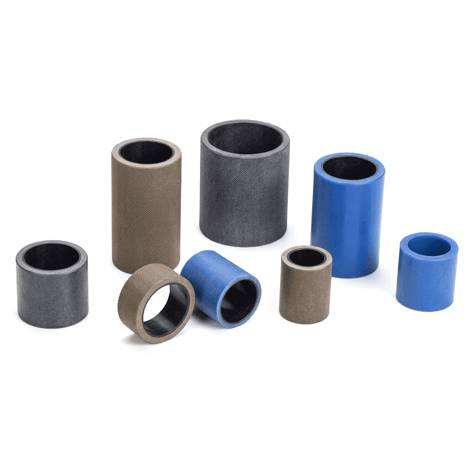
Glass or carbon fiber wound in high-temperature epoxy resin, with a low-friction bore lining.
Handles high impact loads and resists aggressive chemicals.
Used in offshore equipment, crane pins, and chemical processing machinery where metal bushings would corrode and polymer designs would fail under load.

Not sure which material fits your application? This table covers the key specs at a glance.
| Material | Temp Range | Friction Coefficient | Self-Lubricating | Typical Applications |
| Sintered Bronze | −40°C to +150°C | 0.05–0.15 | ✅ Yes | Motors, fans, light machinery |
| Cast Bronze | −40°C to +150°C | 0.10–0.20 | ❌ No | Heavy load, slow speed |
| PTFE Composite | −40°C to +280°C | 0.04–0.08 | ✅ Yes | Automotive hinges, aerospace linkages |
| Nylon | up to +130°C | 0.10–0.30 | ✅ Yes | Food processing, medical devices |
| Acetal (POM) | up to +100°C | 0.10–0.30 | ✅ Yes | Food processing, medical devices |
| PEEK | up to +250°C | 0.10–0.25 | ✅ Yes | High-temp clean environments |
| Graphite | up to +400°C | 0.10–0.20 | ✅ Yes | Ovens, steam equipment, glass lines |
| Filament-Wound Composite | up to +130°C | 0.05–0.15 | ✅ Yes | Offshore, crane pins, chemical processing |
Material selection is where the real engineering decisions happen. For a complete breakdown of all design types and materials — including PV limits, temperature ranges, and application guidance — see our Types of Bushings: Complete Guide.
Bushings wear gradually, which means problems are easy to ignore — until the shaft or housing is damaged too.
Watch for these early signs:
Clunking, squeaking, or knocking at a joint or pivot point, especially under load or during direction changes
More play or looseness than usual at a shaft location
Increased vibration that wasn't present before
Unusual heat near a joint — a bushing running dry or over its load limit will run hot
Visible scoring, pitting, or material loss if you can inspect the surface directly
Don't wait for failure.
Replacing bushings at planned maintenance intervals — based on manufacturer-rated operating hours — is always cheaper than the unplanned downtime and collateral damage that follows a failure in service.
Work through these six factors in order and the field narrows quickly.
Radial loads (pushing the shaft toward the housing wall)? Plain sleeve bushing.
Axial loads (along the shaft centerline)? Add a thrust washer, or use a flanged design.
Both? Flanged bushing, or sleeve plus separate thrust washer.
Contact pressure (P, in MPa) multiplied by sliding velocity (V, in m/s) gives the PV value.
Every bushing material has a maximum rated PV. This parameter is a standard tribological criterion used to evaluate sliding bearing performance.
Exceed it and the bushing overheats and fails.
Target a working PV of no more than half the rated maximum for demanding applications.
💡 PV Calculation Example
A shaft rotating at 200 RPM, diameter 50 mm, carrying a radial load of 500 N across a bearing length of 40 mm:
P = 500 ÷ (0.05 × 0.04) = 250,000 Pa = 0.25 MPa
V = π × 0.05 × 200 ÷ 60 = 0.52 m/s
PV = 0.25 × 0.52 = 0.13 MPa·m/s
A standard PTFE composite bushing is rated to ~0.10 MPa·m/s continuous — this application exceeds that limit. A reinforced composite or sintered bronze grade would be the appropriate choice.
Can the location be serviced?
If the joint is sealed, inaccessible, or in a food or pharma environment, self-lubricating materials are essential — PTFE composite, sintered bronze, graphite, or engineering plastic.
A lubricated bushing in an unserviceable location will eventually run dry.
Standard nylon bushings max out at 100–130°C; acetal at ~100°C; PEEK at ~250°C. PTFE composites go to ~280°C.
Above that, metallic self-lubricating designs or graphite are required.
Always account for both ambient temperature and frictional heat — the bushing runs hotter than the surrounding environment.
Moisture, chemicals, abrasives, and contaminants all drive material selection.
Stainless-backed composites, PTFE, and engineering plastics resist corrosion. Sealed or wiped designs exclude abrasives.
FDA-compliant materials are mandatory in food and pharmaceutical applications.
The gap between shaft OD and bushing ID must be within the specified range for the material.
Too tight risks seizure.
Too loose allows shaft movement that accelerates wear on surrounding components.
For press-fit bushings in small-to-medium diameters, interference between bushing OD and housing bore is typically 0.010–0.025 mm; larger sizes require more.
Always verify with the manufacturer's fit tables for the specific material and size.
Not sure where to start? Work through these questions in order.
① What type of load does the bushing carry?
→ Radial only → Sleeve bushing
→ Axial only → Thrust washer
→ Both → Flanged bushing
② Can the location be lubricated during service?
→ Yes → Bronze or steel-backed designs with external oil/grease are suitable
→ No → Self-lubricating required: PTFE composite, sintered bronze, graphite, or engineering plastic
③ What is the operating temperature?
→ Up to 100°C → Nylon, acetal, sintered bronze
→ Up to 150°C → Bronze
→ Up to 250°C → PEEK
→ Up to 280°C → PTFE composite
→ Above 280°C → Graphite
④ What environment does it operate in?
→ Corrosive / wet → Stainless-backed composite, PTFE, or engineering plastic
→ Food / pharmaceutical → FDA-compliant materials only
→ High impact / chemicals → Filament-wound composite
→ Standard industrial → Bronze or PTFE composite
⑤ Check the PV value
Calculate P (MPa) × V (m/s). Confirm the result is below 50% of the material's rated PV maximum.
If it exceeds that — move up to a higher-rated material or increase the bearing area.
The most common selection mistake
Choosing a bushing that requires lubrication for a location you can't actually service. It runs dry, overheats, and fails in a fraction of its rated life. Match the lubrication requirement to what the application genuinely provides — not what you plan to provide.
A bushing is technically a type of bearing — specifically a plain or sliding bearing.
The practical distinction is that rolling-element bearings (ball, roller, tapered) use rolling contact, while bushings use sliding contact.
Bushings handle heavier loads at lower speeds and often require less maintenance.
Rolling bearings handle higher speeds with lower friction.
It depends on the material. Sintered bronze releases oil from its pores. PTFE composite surfaces are dry-running by design.
Graphite bushings require no liquid at all. Solid bronze and steel-backed designs typically need external oil or grease.
The critical rule: always match the bushing's lubrication requirement to what the application can actually deliver.
A correctly specified bushing in normal operating conditions can last tens of thousands of hours.
An over-loaded or under-lubricated bushing can fail in hours.
Most manufacturers publish rated operating hours or load-cycle data.
Use these as the basis for planned maintenance intervals rather than waiting for failure.
For maximum load capacity, cast bronze, bi-metallic steel-bronze composites, and metallic self-lubricating designs (steel or bronze backing with embedded solid lubricants) perform best.
For heavy loads in a dry-running, maintenance-free application, metallic self-lubricating designs with graphite or MoS₂ are the standard choice.
Sometimes. Bushings work well at lower speeds and with heavy or shock loads.
For high-speed, high-precision, or light-load applications, a rolling-element bearing is usually more appropriate.
When the application is borderline, consult an applications engineer — the cost of getting it wrong is always higher than the cost of getting it right.
In automotive applications, bushings are used throughout the suspension system to absorb shock and reduce vibration between metal components. The rubber bushings in control arms and sway bars are the most common examples — they cushion road impacts and prevent metal-on-metal contact, which would cause noise and accelerated wear.
It depends on how high. PTFE composite bushings handle up to around 280°C. Above that, graphite is the standard choice — its layered atomic structure provides effective dry lubrication up to 400°C and beyond, with no liquid lubricant required. For most industrial oven, steam, or glass manufacturing applications, graphite is the answer.
There are more bushing types than most catalogs make obvious. Part of the confusion is that "bushing" gets organized two different ways: by physical...
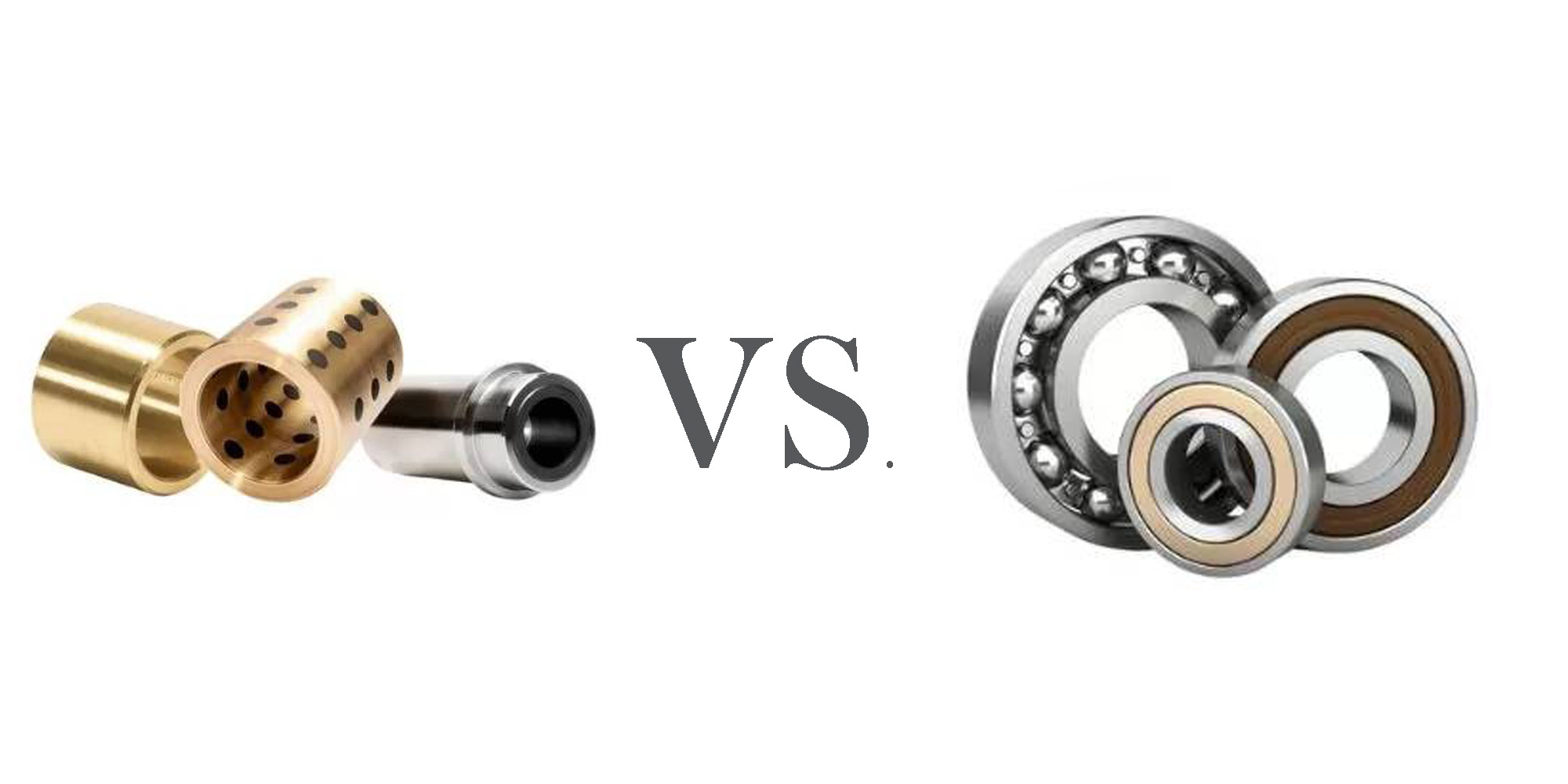
In the world of machinery and mechanical engineering, bearings and bushings are two essential components that are used to support and guide moving...
Worm gears are everywhere in daily life. You'll find them in car steering systems, conveyor belts, and stand mixers—often working invisibly behind...