

Polyurethane Rollers vs. Wheels: How to Choose
In my 15 years at LILY Bearing, I've seen one specification error cost companies $30K-50K in unplanned downtime: confusing polyurethane rollers with...
13 min read
Richard
:
Apr 16, 2026 5:58:36 AM
Table of Contents
A conveyor drive shaft in a copper mine. A 200 kW electric motor in a packaging line. A paper mill press roll running 24/7.
Each of these machines needs roller bearings.
And in each case, the wrong bearing type will fail — not from a manufacturing defect, not from poor maintenance, but simply from being in the wrong application.
Spherical and cylindrical roller bearings are the two most common heavy-duty roller bearing types.
Both carry large radial loads.
Both are built from hardened bearing steel.
But the spherical vs cylindrical roller bearing comparison reveals differences that run deeper than geometry: different tolerance for misalignment, different speed ceilings, different axial load capability.
Those differences define exactly where each one belongs.
This guide covers the five engineering factors that separate the two types, where each one excels in practice, the selection mistakes that show up repeatedly in the field, and a decision checklist you can apply directly to your own projects.
Here is a quick-reference overview before we go into the detail:
| Parameter | Spherical Roller Bearing | Cylindrical Roller Bearing |
|---|---|---|
| Roller shape | Barrel-shaped | Straight cylinder |
| Misalignment tolerance | 0.5° – 2° | ~0° — essentially none |
| Radial load capacity | Very high | Very high |
| Axial load capacity | Moderate–high, both directions | None to limited, type-dependent |
| Speed capability | Moderate | High |
| Self-aligning | Yes | No |
| Separable design | No | Yes (most types) |
| Mounting method | Interference fit or adapter sleeve | Independent ring mounting |
| Typical industries | Mining, paper, wind energy, conveyors | Motors, machine tools, rolling mills |
| Unit cost (same bore) | Higher | Lower |
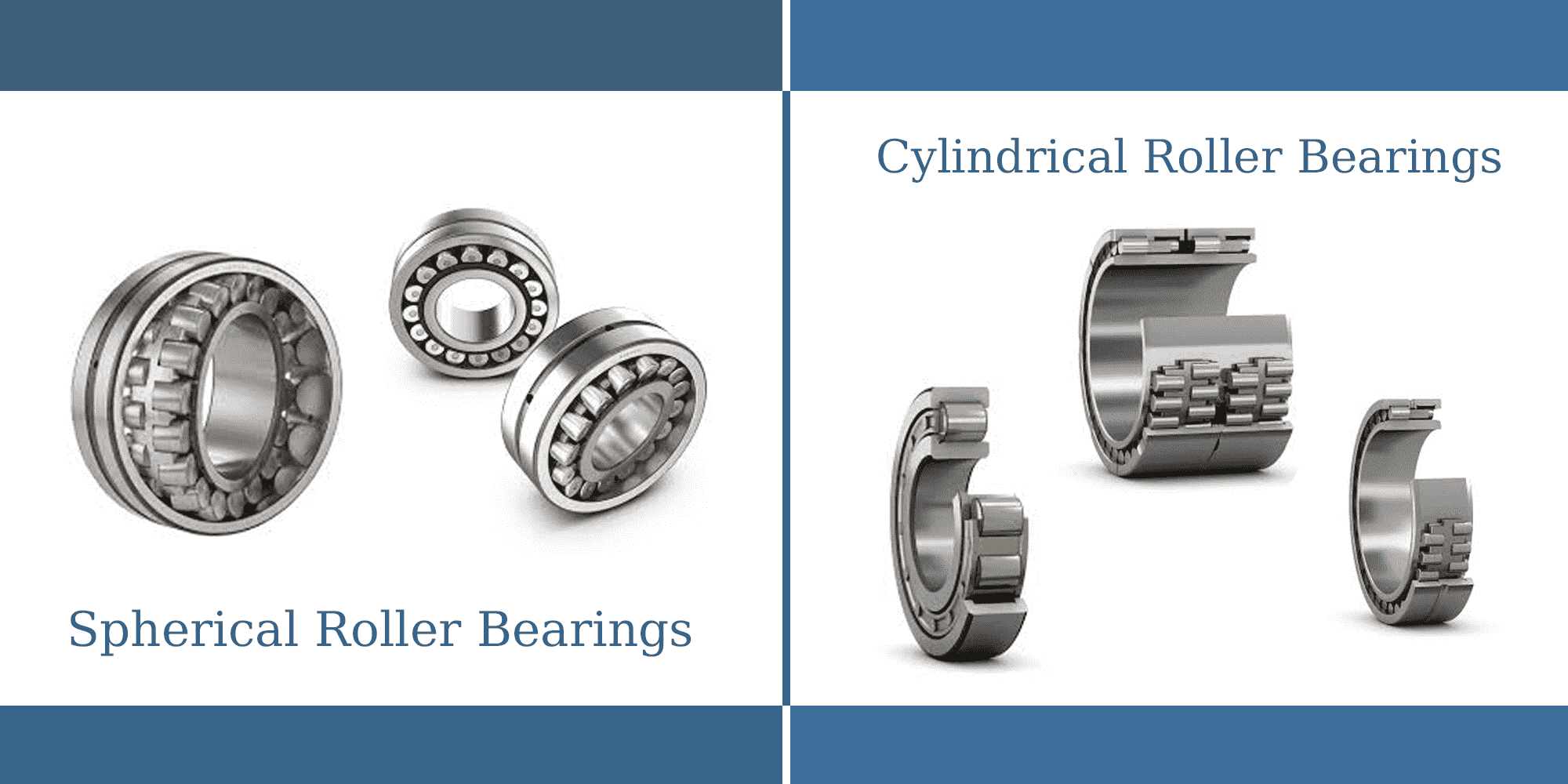
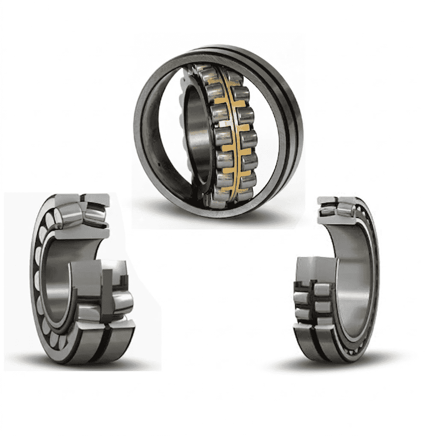
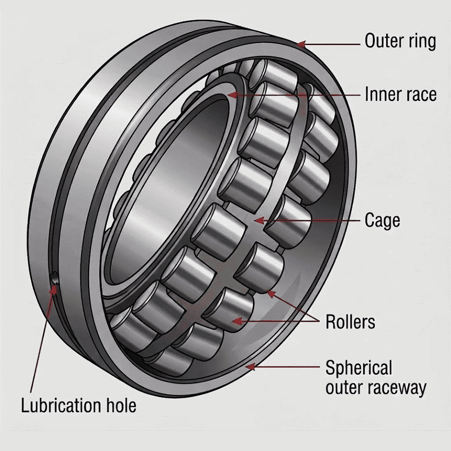
A spherical roller bearing uses two rows of barrel-shaped rollers running on a common sphered outer ring raceway.

That curved outer raceway is what makes the bearing special: it allows the bearing to self-align, absorbing angular error between the shaft and housing without building up damaging internal stress.
The inner ring carries two raceways inclined at an angle to the bearing axis.
This geometry lets the bearing accommodate angular misalignment of 0.5° to 2° — exact range depends on the bearing series — during normal continuous operation.
For a broader look at spherical bearing types including spherical plain bearings, see What Is a Spherical Bearing?

Spherical roller bearings are made in bore diameters from 25 mm to over 1,000 mm.
A mid-range example: the SKF 22220 EK (100 mm bore, 180 mm OD, 46 mm width) carries a dynamic load rating of 433 kN and a static rating of 490 kN — enough for very heavy industrial duty.
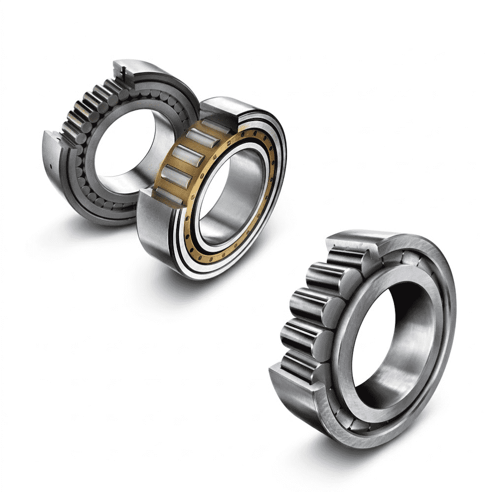
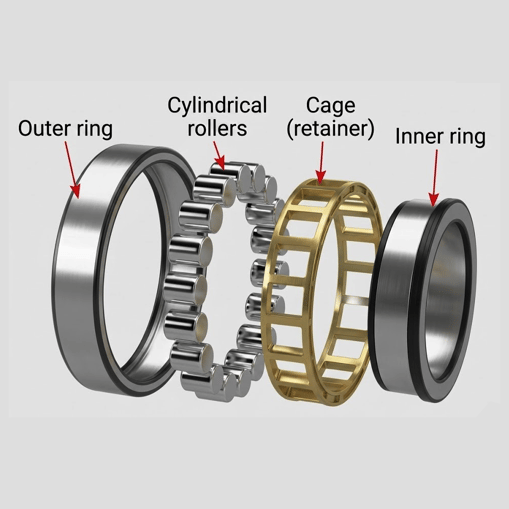
A cylindrical roller bearing uses straight rollers — not barrel-shaped — that make true line contact with flat raceways.

That line contact is the defining advantage: exceptional radial stiffness and the ability to sustain high rotational speeds with very low friction.
The trade-off is sensitivity to misalignment.
A shaft tilt of as little as 0.04° starts concentrating stress at the roller ends — a condition called edge loading — which leads to spalling and early failure.
For a full breakdown of cylindrical roller bearing design and variants, see What Is a Cylindrical Roller Bearing?

Understanding the flange configuration is essential before specifying a cylindrical roller bearing.
The wrong type in the wrong location is a common cause of premature failure.
| Type | Inner Ring Flanges | Outer Ring Flanges | Axial Load Capability |
|---|---|---|---|
| NU | None | Both sides | None — free floating |
| N | Both sides | None | None — free floating |
| NJ | One side | Both sides | One direction |
| NF | Both sides | One side | One direction |
| NUP | One fixed + one loose flange | Both sides | Both directions |
NU and N types are non-locating (floating) bearings — they carry no axial load. NJ and NF locate the shaft in one direction.
NUP locates in both directions.
An NU bearing in a helical gearbox — where axial thrust is always present — will let the rollers walk off the raceways.
That is a failure built into the specification from the start.
When engineers work through the spherical vs cylindrical roller bearing decision, five factors consistently determine the outcome. Each one is examined below.
| Spherical Roller Bearing | Cylindrical Roller Bearing | |
|---|---|---|
| Roller shape | Barrel-shaped (convex) | Straight cylinder |
| Contact with raceway | Modified line contact | True line contact |
| Behaviour under misalignment | Contact patch redistributes — stress is shared | Stress concentrates at roller ends |
| Radial stiffness | High | Very high |
The barrel-shaped roller in a spherical bearing can shift its contact patch when the shaft tilts.
Stress redistributes across the roller face rather than spiking at the edges.
A cylindrical roller has no such mechanism — the contact either stays uniform or it edge-loads.
This single factor drives most bearing selection decisions in heavy industry.
Spherical roller bearings accommodate continuous angular misalignment of 0.5° to 2°. In practice, that covers:
Cylindrical roller bearings require near-perfect alignment. Tilt beyond roughly 0.04° initiates edge loading. That demand translates to:
The practical implication: if your machine is large, heavily loaded, or assembled in the field rather than a controlled workshop environment, some degree of misalignment is essentially guaranteed.
That is where spherical roller bearings earn their cost premium.
Both bearing types handle heavy radial loads.
The difference becomes significant when axial (thrust) loads are involved.
Spherical roller bearings carry:
Standard cylindrical roller bearings (NU, N types):
A practical example: helical gears always generate an axial thrust component.
In a helical gearbox intermediate shaft position, a standard NU bearing simply cannot handle that thrust.
The three options are:
Cylindrical roller bearings have a clear structural speed advantage.
Their straight rollers generate less sliding contact than barrel-shaped rollers, which means less friction and less heat at equivalent speeds.
The SKF NU 220 ECP (100 mm bore, polyamide cage) has a reference speed of 4,500 rpm.
Spherical roller bearings generate more internal friction.
Barrel-shaped rollers produce sliding contact against the guide ring, and the self-aligning geometry adds to frictional losses.
The SKF 22220 EK (same 100 mm bore) has a reference speed of 3,400 rpm.
At this bore size, the cylindrical bearing has roughly a 30% speed advantage.
The exact margin varies with cage material and bearing series, but cylindrical roller bearings consistently outrun spherical ones of the same bore.
Running a spherical roller bearing above its reference speed accelerates lubricant degradation and causes smearing of the roller surfaces.
Speed ratings matter — and they should be verified for every application, not assumed.
The inner ring slides onto the shaft; the outer ring presses into the housing separately.
This makes installation and removal faster — a meaningful operational advantage where planned maintenance windows are short.
Cylindrical bore versions require an interference fit on the shaft, achieved by heating the bearing or using a hydraulic press.
Tapered bore (K) versions with adapter sleeves simplify the process: you advance the lock nut until the specified axial displacement is reached, which drives the sleeve up the taper and creates the interference fit.
For smaller bore sizes — typically up to around 150 mm — this can be done with standard spanners and a dial gauge.
Above that, a hydraulic nut is the practical tool, and for large bore sizes above roughly 200 mm, axial displacement measurement becomes critical to avoid under- or over-tightening.
On unit cost: cylindrical roller bearings are generally less expensive than spherical roller bearings of the same bore size — the margin varies by manufacturer, series, and quantity, but a meaningful price difference exists at standard catalogue grades.
That gap can narrow or reverse at the system level — if a spherical roller bearing eliminates the need for a precision-bored housing or a second separate thrust bearing, the total installed cost may actually favour the spherical option.
The sections below cover the most common scenarios where each bearing type is the clear choice.
For a deeper look at spherical roller bearing applications specifically, see What Is a Spherical Roller Bearing Used For?

This is the most common reason spherical roller bearings end up in a specification.
Long, heavily loaded shafts deflect under load — and that deflection misaligns the bearings at each support point.
A shaft spanning three metres under a 500 kN radial load can deflect enough at mid-span to produce several tenths of a degree of angular error at the bearing seats.
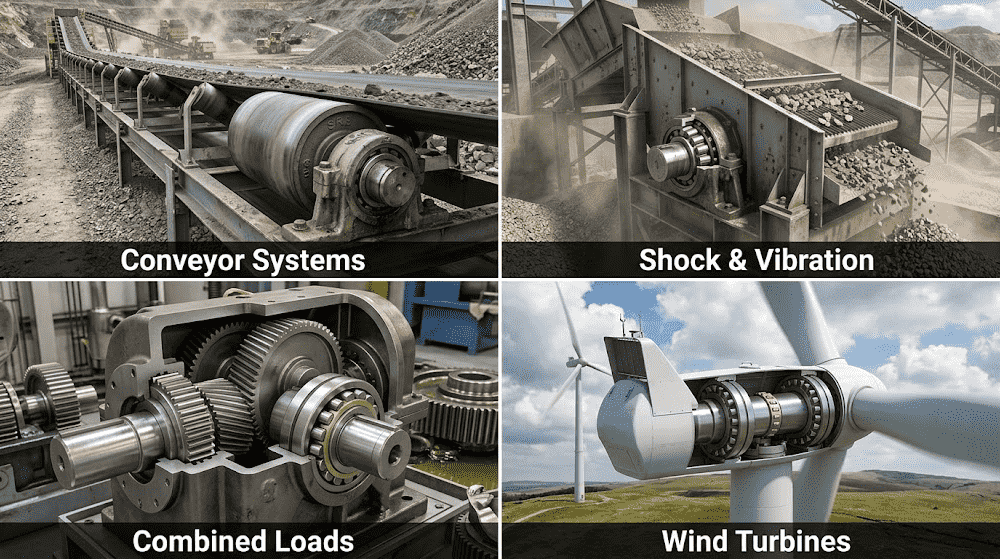
Conveyor drive shafts, bucket elevator head shafts, and paper machine press rolls are classic cases.
Spherical roller bearings absorb that deflection without adding internal stress to the system.
Cylindrical roller bearings in the same position would be in edge loading within weeks.
This also makes spherical roller bearings the natural choice for field-assembled equipment — remote mine sites, offshore platforms, underground installations — where achieving the precision alignment that cylindrical bearings require is simply not practical.
Mining crushers, vibrating screens, and road construction equipment impose impact loads that can momentarily reach 3–5× the nominal rated load.
The barrel-shaped rollers of spherical bearings distribute those impacts more tolerantly across the contact area.
This is also why vibrating screen manufacturers almost universally specify spherical roller bearings — the shock tolerance is simply not available in a cylindrical design.
Where a shaft carries thrust alongside radial force, a spherical roller bearing handles both in a single unit. Simpler arrangement, fewer components to fail.
Large-bore spherical roller bearings — typically above 500 mm bore in multi-megawatt machines — dominate the main shaft position.
Continuously varying load directions as wind speed and angle change make self-alignment non-negotiable.

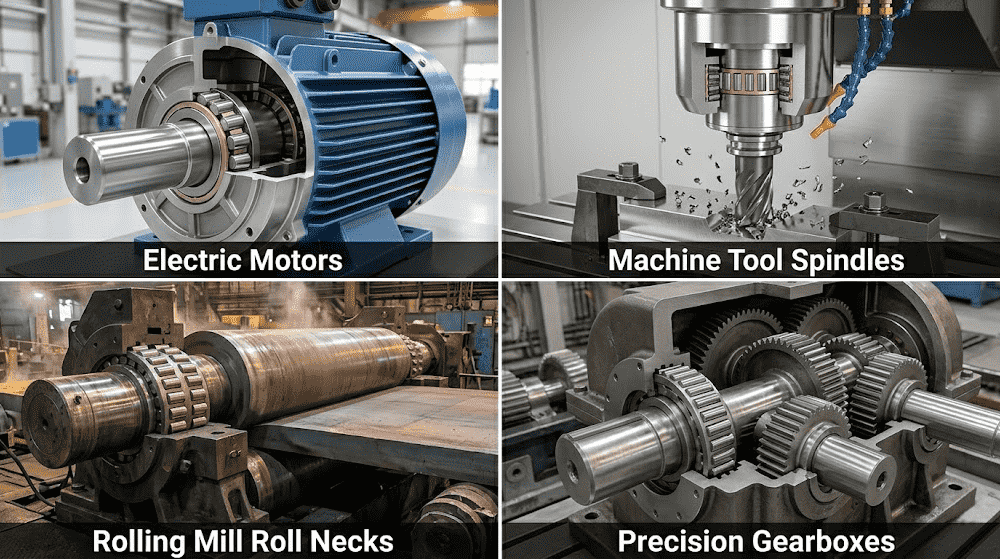
The standard motor arrangement — cylindrical roller bearing (NU or NUP type) at the drive end, deep groove ball bearing at the non-drive end — has been proven across millions of machines.
The cylindrical bearing handles the radial load from belt or coupling forces; the ball bearing carries any residual axial load.
Cost-effective and simple to service.
This is where cylindrical roller bearings are irreplaceable.
Machine tools need maximum rigidity and minimum internal compliance.
Precision grades P4 and P2 hold their geometry under heavy cutting forces — that stiffness translates directly into dimensional accuracy of the workpiece.
No spherical bearing can offer the same rigidity, and any compliance in the spindle bearing shows up in the part.
Four-row cylindrical roller bearings (FC and FCD types) for backup roll positions are a case where there is simply no alternative.
Backup roll loads in a hot strip mill regularly exceed 20,000 kN.
The four-row design delivers that radial capacity in a compact axial envelope that fits within the roll neck geometry.
Spur gears produce primarily radial loads.
Where shaft alignment is controlled and maintained, cylindrical roller bearings give better radial load performance and speed capability than spherical alternatives — and their separable design makes bearing changes faster during planned maintenance.
Engineers regularly underestimate shaft deflection under load, or accept housings machined to looser tolerances than specified.
The result is edge loading, surface spalling, and failure well short of the calculated bearing life.
Working rule:
If angular misalignment could exceed 0.04° under any operating condition — including peak load, thermal state, or wear over time — a cylindrical roller bearing is the wrong choice for that position.
A spherical roller bearing has a thermal speed ceiling.
The reference speed is where steady-state operating temperature stabilises under standard test conditions; the limiting speed is the absolute ceiling.
Exceeding the reference speed in service means lubricant degrades faster than it can protect the contact surfaces.
Smearing follows — and it is not a gradual process.
Check both values in the catalogue and confirm that your application speed sits comfortably below the reference speed, not just below the limit.
Standard NU and N bearings carry zero axial load.
Helical gears, bevel gears, worm drives, and screw mechanisms all generate thrust.
If the bearing designation cannot carry the axial load present, the rollers load flanges not designed for that contact — and the bearing fails rapidly.
Always confirm the load type before selecting the designation.
The same internal accommodation that enables self-alignment also means the bearing has some compliance — and compliance reduces system rigidity.
For machine tool spindles or other precision applications where stiffness directly affects output quality, use cylindrical roller bearings in appropriate precision grades.
The added effort of precise installation and alignment pays back in machining accuracy and dimensional consistency.
If you are also evaluating tapered roller bearings for your application, see Tapered Roller Bearing vs. Spherical Roller Bearing for a direct comparison.
Grease is suitable for moderate speeds and temperatures.
At higher speeds, the speed parameter ndm — rotational speed multiplied by mean bearing diameter, expressed in mm·r/min — is a useful guide.
When ndm exceeds approximately 500,000, circulating oil or oil mist becomes the better choice.
Oil dissipates heat more effectively than grease at sustained high speeds, which matters in motors and high-speed spindle applications.
Because cylindrical roller bearings generate less internal friction than spherical ones at equivalent speeds, they run cooler and regreasing intervals are generally longer.
More sensitive to lubrication quality than cylindrical bearings.
The sliding contact between the barrel-shaped rollers and the guide ring generates heat that cylindrical bearings do not produce.
Two practical consequences: lubrication quantity and viscosity matter more, and the interval between relubrication events is typically shorter at comparable speeds.
EP (extreme pressure) additives are worth specifying for heavily loaded applications.
For operating temperatures above 70°C, check that the grease base oil viscosity at actual operating temperature still meets the minimum film thickness requirement — a grease that performs well at 40°C may be too thin at 90°C.
Sealed spherical roller bearings (suffix 2CS or equivalent) come pre-greased for bearing life.
In contaminated environments — dusty, wet, or chemically aggressive — they are often the most cost-effective solution: no relubrication labour, no contamination ingress, longer service life between replacements.
Once you have selected the right bearing type, the next step is confirming it will last long enough.
Both spherical and cylindrical roller bearings use the ISO 281 standard for rating life calculation.
The key formula for roller bearings is:
L₁₀ = (C / P)(10/3)
Where L₁₀ is the basic rating life in millions of revolutions — the point at which 90% of a population of identical bearings will still be running — C is the dynamic load rating from the catalogue, and P is the equivalent dynamic bearing load in your application.
Two things are worth remembering in practice.
First, use the 10/3 exponent for both spherical and cylindrical roller bearings — the cube exponent (³) applies only to ball bearings.
Second, calculating P correctly requires the right X and Y factors for your specific bearing and load ratio.
These vary between bearing types and between bearing series within the same type.
The manufacturer's catalogue is the only reliable source — do not carry over Y-factor values between different bearing designations.
Choose a Spherical Roller Bearing if:
Choose a Cylindrical Roller Bearing if:
Start with the shaft span and load. A long shaft under heavy radial load will deflect — the longer the span and the higher the load, the more deflection, and the more angular error at the bearing seats.
As a rough check: if your shaft spans more than 10–15 times its diameter between supports under significant load, shaft deflection alone is enough to justify a spherical roller bearing.
Beyond shaft deflection, consider the housing: cast housings, fabricated frames, and field-assembled structures all introduce bore alignment errors that precision-machined housings in a controlled environment do not.
If any of these conditions apply, misalignment risk is real, and a cylindrical roller bearing is a liability.
Generally not without engineering changes to the surrounding system.
You would need to eliminate the misalignment source first — precision-bore the housing, add intermediate shaft supports, or redesign the shaft layout.
In most retrofit situations, the engineering effort and cost of doing this exceeds the savings from switching to the less expensive bearing type.
For pure radial loads at the same bore size, cylindrical roller bearings typically have a higher dynamic radial load rating.
True line contact maximises the available contact area.
For combined radial plus axial loads, spherical roller bearings are clearly superior — standard cylindrical types carry no axial load at all.
Not necessarily. Sealed spherical roller bearings are maintenance-free for their service life in many applications.
Open cylindrical roller bearings in high-speed service, by contrast, require careful attention to oil film quality and system cleanliness.
The maintenance burden depends more on the application conditions than on bearing type alone.
Spherical roller bearings are the standard choice for conveyor drives and idler roll positions, for the same reasons covered in the application section above: long shafts, heavy loads, and field assembly all introduce misalignment that cylindrical bearings cannot tolerate.
These are fundamentally different bearing types.
A spherical plain bearing operates on sliding contact between a convex inner ring and a concave outer ring — no rolling elements.
It is designed for oscillating or slow rotational movement, commonly used in rod ends, hydraulic cylinder pins, and linkage pivots.
A spherical roller bearing uses rolling elements (barrel-shaped rollers) and is designed for continuous rotation under high radial and axial loads.
CARB bearings — developed by SKF — occupy a specific niche between the two types: they self-align like a spherical roller bearing and accommodate axial displacement like a cylindrical non-locating bearing.
They are designed specifically for the non-locating (floating) position in two-bearing shaft arrangements, particularly in paper machines, large industrial fans, and dryer rolls.
They are a specialised product with a corresponding price premium, but worth evaluating when the non-locating position involves both misalignment and significant axial thermal displacement.
Choose the right bearing for the application, and it will run quietly in the background for years.
Choose the wrong one, and you will be back at the machine well before its rated life is up.
The decision comes down to two questions:
Is there any risk of misalignment?
If yes — or if you are unsure — specify a spherical roller bearing. Even modest shaft deflection or housing inaccuracy will shorten a cylindrical bearing's life dramatically.
Is speed or precision the primary requirement?
If yes, specify a cylindrical roller bearing in the right designation for your load type, and invest in the alignment precision it needs.
The unit cost difference between the two bearing types is relatively small. The cost of an unplanned production shutdown is not.
At LILY Bearing, we carry both spherical and cylindrical roller bearings across a full bore size range, including standard and custom configurations.
If you have load data, speed requirements, or application conditions to review, contact our engineering team — we will help you confirm the right selection before you commit to an order.
In my 15 years at LILY Bearing, I've seen one specification error cost companies $30K-50K in unplanned downtime: confusing polyurethane rollers with...
In the vast world of machinery, ever pondered the question, "how do bearings work?" These unassuming devices play a monumental role in numerous...
Slewing bearings, also known as slew bearing or slewing ring bearings, facilitate pivotal movement in machinery, handling axial, radial, and moment...