

Home/
Blog/
Linear Guides vs. Linear Bushings vs. Dovetail Slides

5 min read

Linear Guides vs. Linear Bushings vs. Dovetail Slides

Linear Guides vs. Linear Bushings vs. Dovetail Slides
11:11

Introduction: Why Linear Motion Choice Matters

Every machine that moves in a straight line relies on a linear motion system — from the most delicate semiconductor inspection stage to the heaviest gantry router cutting thick steel plate.

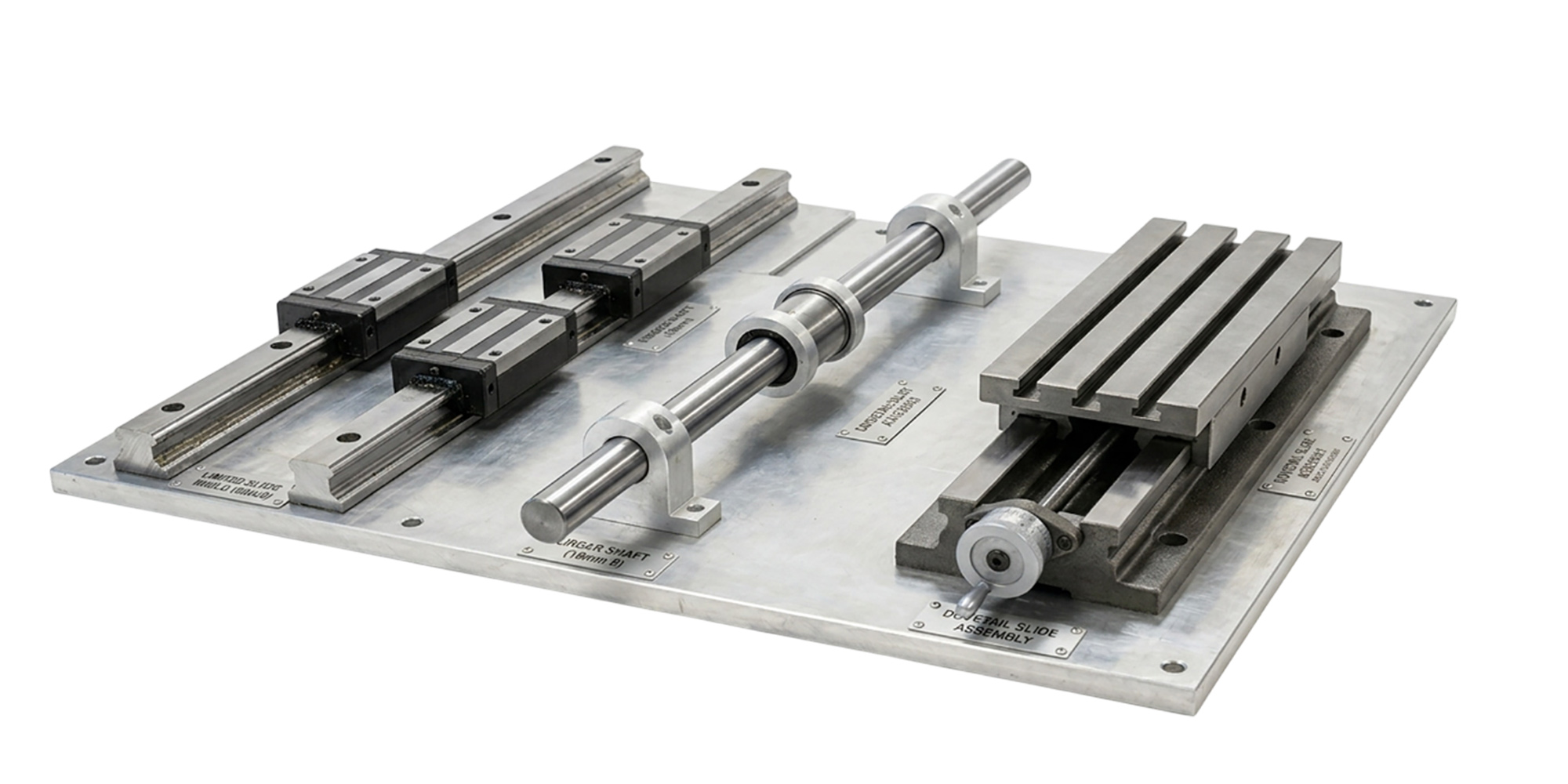
The three dominant technologies you'll encounter are linear profile rail guides, linear bushings on round shafts, and dovetail slides. On the surface, all three do the same job: constrain motion to a single axis. But their underlying mechanics, performance envelopes, and ideal applications are wildly different.

Choose the wrong system, and you pay for it — in premature wear, inadequate stiffness, poor accuracy, over-engineering costs, or all of the above. This guide cuts through the noise with a rigorous, application-focused comparison so you can specify with confidence.

 💡 Key Insight: The 'best' linear motion system doesn't exist in the abstract — it only exists relative to your load profile, accuracy requirements, environment, budget, and service life targets.


Quick Overview of Each System

linear guides

linear bushings

Dovetail slides


Linear Guides (Profile Rail Guides)

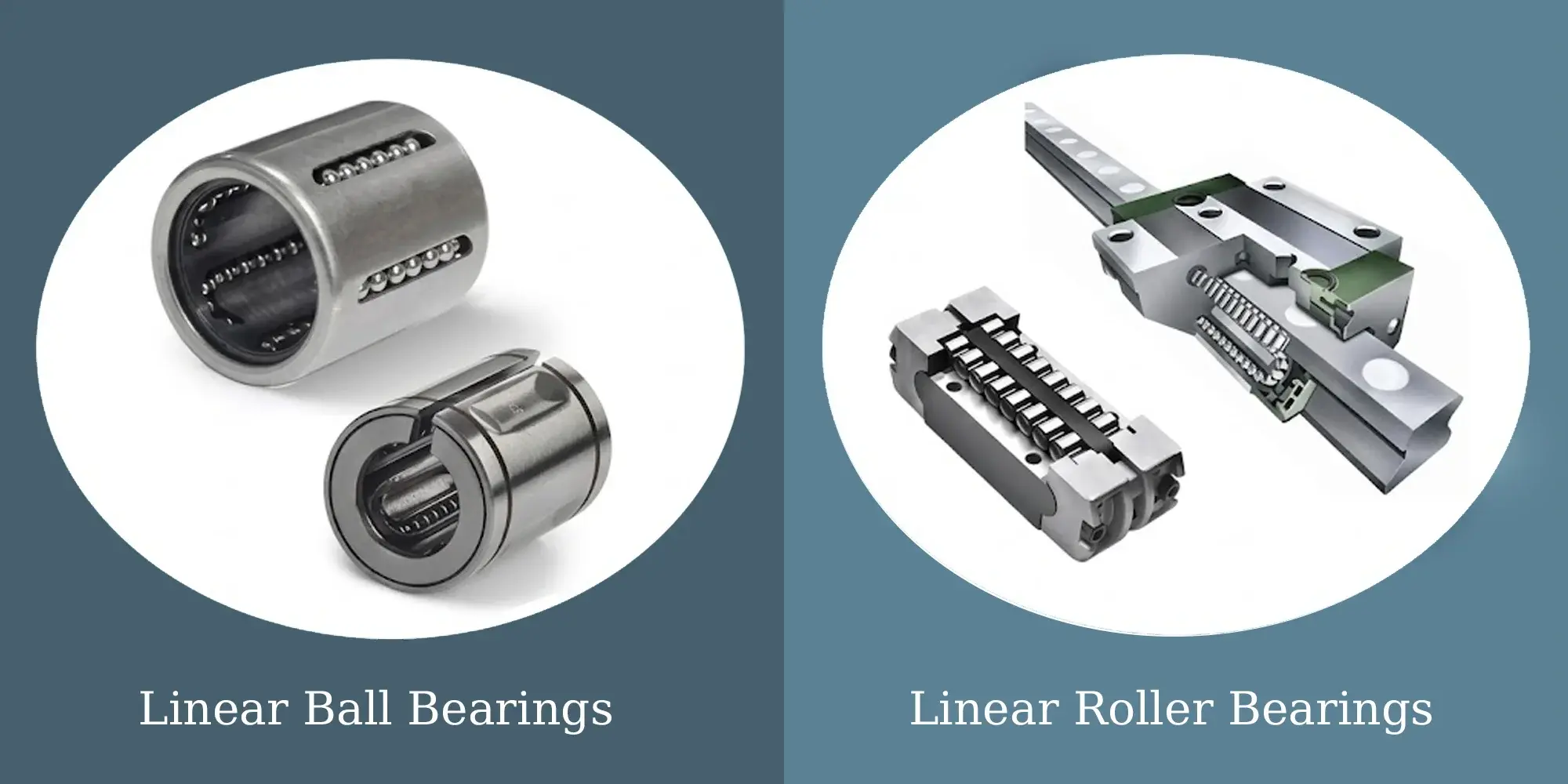
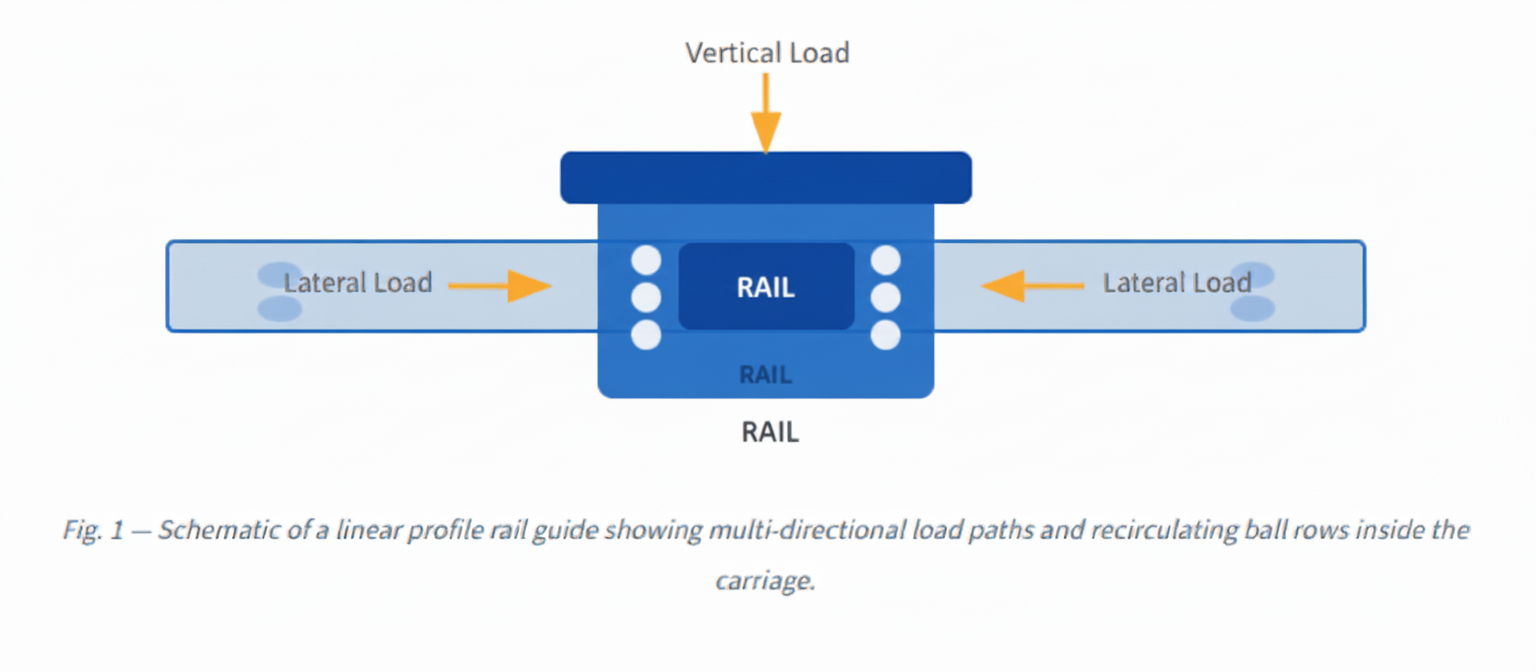
Linear profile rail guides — sometimes called linear motion guides or LM guides — use precision-ground hardened steel rails paired with recirculating ball or roller bearing carriages. The carriage contains multiple rows of rolling elements that circulate in a closed loop, distributing load across the full contact zone.


How They Work

linear guides

The ball or roller elements contact the rail raceways at precisely engineered angles (typically 45° contact angle for ball guides), enabling the carriage to support loads in all four directions: radial, reverse-radial, and both lateral directions — plus pitching, rolling, and yawing moments. This four-way load capacity is what makes profile rail guides so versatile.


Key Variants

Variant

Rolling Element

Load Capacity

Best For

Standard Ball Guide

Balls

★★★☆☆ Medium

CNC, robotics, general automation

Roller Guide

Cylindrical Rollers

★★★★★ Very High

Heavy cutting, large gantry machines

Miniature Guide

Small Balls

★★☆☆☆ Low

Medical devices, optics, micro-stages

Cam Roller Guide

Cam followers

★★★★☆ High

Long-stroke, open/dirty environments


Pros & Cons — Linear Guides

✅ Pros

❌ Cons

Highest load capacity for size

Highest unit cost

Multi-directional load support

Sensitive to contamination

High precision & repeatability

Requires accurate mounting surfaces

Low friction, high speed capability

Lower vibration damping vs. dovetails

Available with integrated lubrication


Linear Bushings (Round Shaft Guides)

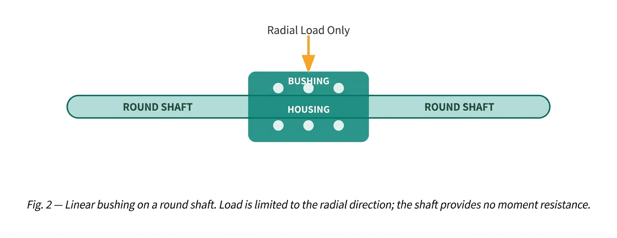
Linear bushings pair a cylindrical hardened shaft with a bearing housing containing either recirculating balls (in ball-type bushings) or a plain low-friction liner (in plain bushings). The shaft acts as both the structural element and the rail, which keeps the system exceptionally compact and low-cost to integrate.


How They Work

linear bushings

The fundamental limitation of round-shaft bushings is geometry: a cylinder resting on a cylinder only provides radial load support. Moment loads, lateral forces, and off-axis loads must be handled by using two parallel shafts with two bushings each — which adds cost and alignment complexity.


⚠️ Important: Using a single round shaft with a single bushing provides zero moment stiffness. Two parallel shafts are the minimum for any meaningful moment resistance — and even then it is modest compared to profile rail guides.


Pros & Cons — Linear Bushings

✅ Pros

❌ Cons

Very low cost (shaft + bushing)

Shaft deflects under load (limited span)

Self-aligning — tolerates shaft deflection

Limited moment capacity

Easy to install and replace

Lower positional accuracy

Available in stainless for corrosive environments

Open construction vulnerable to contamination

Plain variants are maintenance-free

Ball contacts concentrate stress on shaft


Dovetail Slides

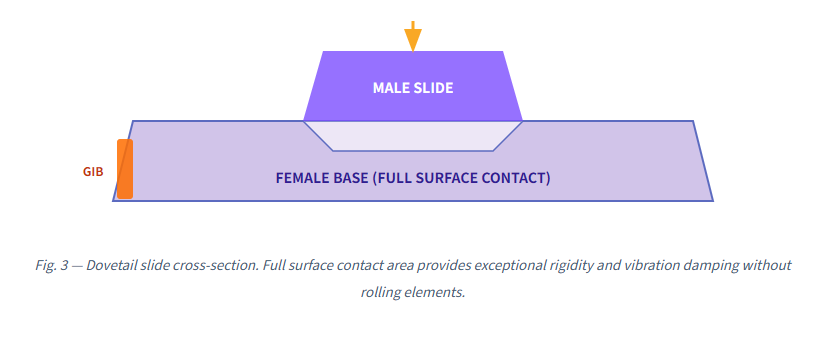
The dovetail slide is arguably the oldest precision linear motion technology still in common use. A male dovetail profile slides within a female dovetail channel; adjustable gibs (thin tapered strips) take up wear and allow preload to be set precisely. Traditionally machined in cast iron or hardened steel, modern versions include aluminum alloy and even polymer-composite variants.


How They Work

Dovetail Slides

The key advantage of dovetail slides is full-surface contact. Unlike rolling-element guides that transfer load through tiny contact ellipses, dovetails spread the load across the entire mating surface. This gives dovetail slides extraordinary rigidity and vibration-damping characteristics — the reason they dominated precision machine tools for 150 years and are still chosen for manual lathes, milling machines, and optical benches today.


Pros & Cons — Dovetail Slides

✅ Pros

❌ Cons

Exceptional rigidity under heavy loads

Highest friction — stick-slip at low speed

Outstanding vibration damping

Not suitable for high speed

Long service life (decades with care)

Requires regular lubrication

Adjustable preload via gib strips

Heavy and large for equivalent travel

Tolerates dirty/abrasive environments

Manual adjustment skill required


Head-to-Head Comparison Table

The table below rates each system across the most important engineering criteria. Use this as a quick reference filter before diving into detailed specification.

Criterion

�� Linear Guide

�� Linear Bushing

�� Dovetail Slide

Load Capacity (radial)

★★★★★ Excellent

★★★☆☆ Medium

★★★★★ Excellent

Moment Load Capacity

★★★★★ Excellent

★★☆☆☆ Poor

★★★★★ Excellent

Positional Accuracy

★★★★★ Excellent

★★★☆☆ Medium

★★★☆☆ Medium

Repeatability

★★★★★ Excellent

★★★☆☆ Medium

★★★☆☆ Medium

Rigidity / Stiffness

★★★★☆ High

★★☆☆☆ Poor

★★★★★ Excellent

Vibration Damping

★★☆☆☆ Poor

★★★☆☆ Medium

★★★★★ Excellent

Max Speed Capability

★★★★★ Excellent

★★★★☆ High

★★☆☆☆ Poor

Friction / Efficiency

★★★★★ Excellent

★★★★☆ High

★★☆☆☆ High Friction

Ease of Installation

★★★☆☆ Medium

★★★★★ Excellent

★★☆☆☆ Complex

Unit Cost

★★☆☆☆ High Cost

★★★★★ Low Cost

★★★☆☆ Medium

Contamination Tolerance

★★★☆☆ Medium

★★★☆☆ Medium

★★★★☆ Good

Service Life

★★★★☆ High

★★★☆☆ Medium

★★★★★ Excellent


Performance Deep Dive


Load Capacity & Life Calculation

Linear guide manufacturers publish dynamic load ratings (C) in kN and static load ratings (C₀). Travel life (L) is calculated using the standard rolling-element life equation:

Life Formula

Round-shaft bushings use a similar formula but shaft deflection often limits practical life more severely than bearing fatigue. For spans greater than 400–600 mm, shaft sag under load becomes the dominant design constraint — not the bushing's rated capacity.

Dovetail slides have no conventional fatigue life formula because they wear rather than fatigue. Service life is instead governed by surface hardness, lubrication film thickness, and contact pressure. A well-maintained hardened steel dovetail can outlast an entire production line.


Speed & Acceleration

Parameter

 🔵   Linear Guide

 🟢  Linear Bushing

🟣 Dovetail Slide

Max Speed

3 – 10 m/s

1 – 3 m/s

0.05 – 0.5 m/s

Max Acceleration

50 – 200 m/s²

20 – 80 m/s²

1 – 10 m/s²

Stick-Slip Tendency

Very Low

Low–Medium

High

Low-Speed Smoothness

Excellent

Good

Fair–Poor


Accuracy & Precision

Linear profile guides are available in accuracy grades from Normal (N) through Ultra Precision (UP), with running parallelism tolerances as tight as 2–5 μm/m at the UP grade. This makes them the standard choice for semiconductor wafer handling, metrology equipment, and laser cutting machines.

Round-shaft systems are inherently less precise because the shaft itself deflects, the bushing has radial clearance, and two-shaft configurations add alignment error. Expect positional errors of 0.05–0.3 mm in typical light-duty applications.

Dovetail slides achieve moderate precision when ground and hand-scraped, but the stick-slip friction and thermal growth of large iron castings limit the precision attainable in practice without hydrostatic lubrication.


Friction & Thermal Behavior

Rolling-element guides (both profile rail and ball bushing) have starting friction coefficients of 0.002–0.004, making them ideal for servo-driven positioning. Dovetail slides with oil lubrication typically exhibit friction coefficients of 0.05–0.15 — 10–40× higher. This has major implications for motor sizing, thermal generation, and closed-loop positioning stability.


Which One Should You Choose?

Use the decision guide below to match your application requirements to the right system. These are not rigid rules — hybrid solutions and special cases exist — but they cover the vast majority of real-world scenarios.

linear guides

linear bushings

dovetail slides


Hybrid Solutions Worth Considering

 🔀 Roller + Dovetail (Turcite®): Modern CNC machine tools often combine hardened steel dovetail ways lined with Turcite polymer for reduced stick-slip, combining the damping of dovetails with much lower friction.

🔀 Profile Rail + Polymer Carriage: In cleanroom or food-grade environments, plastic-bodied miniature rail systems offer FDA-compliant corrosion resistance while retaining most of the positional accuracy of steel guides. 


Application Quick-Reference

application quick-reference


Conclusion & Key Takeaways

After breaking down the mechanics, performance data, and application profiles, the picture becomes clear:

  • Linear profile rail guides are the benchmark for modern precision automation — highest performance, most versatile, and right choice whenever accuracy, speed, or multi-directional loads matter more than budget.

  • Linear bushings on round shafts are the cost-performance king for light, simple, lower-accuracy applications. Easy to source, easy to replace, and hard to beat at their price point.

  • Dovetail slides are the unsung workhorse of heavy machining — irreplaceable where vibration damping, extreme rigidity, and very long service life outweigh the need for speed.

The best approach is always to start with your application's critical requirements — accuracy, load direction, speed, environment, budget — and let those drive the selection, rather than defaulting to what you know or what's cheapest.

 📌  Bottom Line: Profile rail guides for precision and speed · Round-shaft bushings for economy · Dovetail slides for rigidity and longevity. Match the technology to the job.


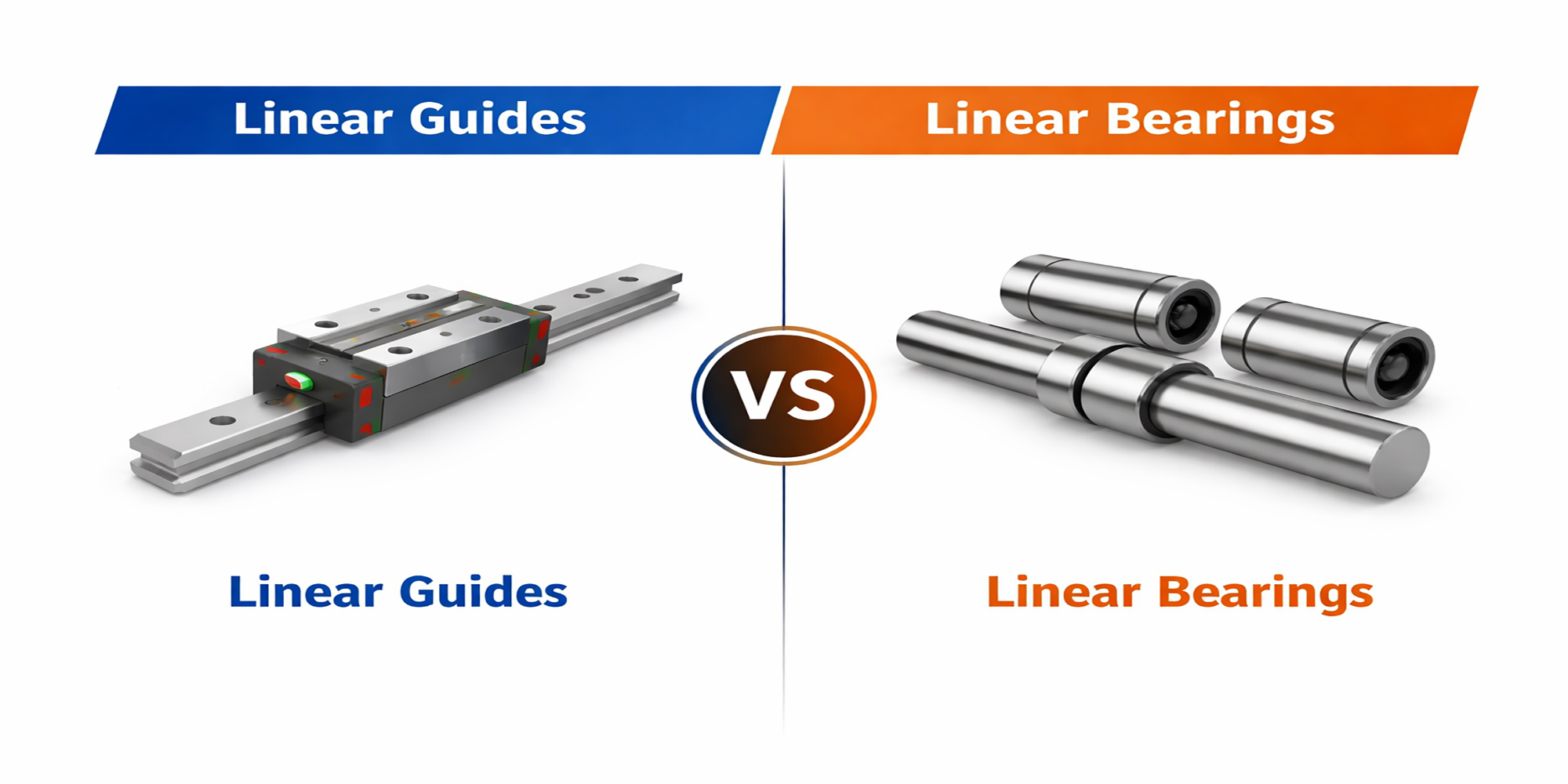
Linear Guides vs Linear Bearings: What’s the Difference?

Linear Guides vs Linear Bearings: What’s the Difference?

Both move things in a straight line — but choosing the wrong one can cost you precision, payload capacity, or thousands in unplanned downtime. Here’s...
Read More
Linear Guide: Key Factors That Influence Linear Rail Costs

Linear Guide: Key Factors That Influence Linear Rail Costs

For purchasing engineers or equipment manufacturers, the cost of linear motion guides is a key consideration when selecting products. However, the...

Read More
Linear Guide Installation: Step-by-Step Guide

Linear Guide Installation: Step-by-Step Guide

Linear rail guides are engineered for applications requiring precise motion and strong load capacity. However, incorrect installation can introduce...

Read More