

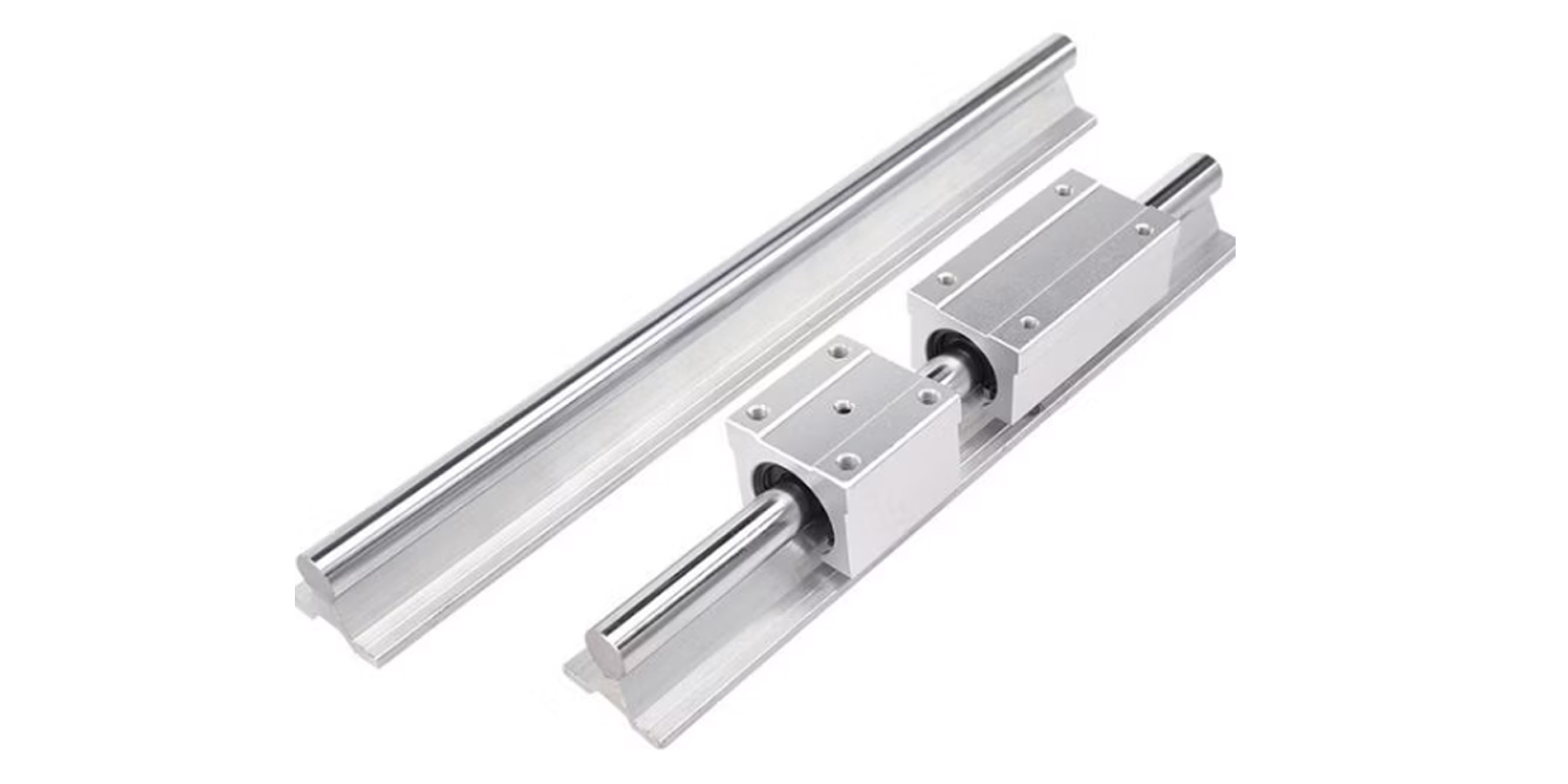
Troubleshooting Common Linear Guide Failures
Linear guides are the backbone of precision motion in modern manufacturing, automation, and CNC machinery. When these critical components fail,...
7 min read
Richard
:
May 15, 2026 3:54:11 AM
Table of Contents
|
$8.2B Global Market (2024) |
6.4% CAGR Through 2030 |
20+ Industries Served |
Think about the last time you had a blood test. The automated analyzer that processed your sample moved its pipette head with sub-millimeter precision — guided by a linear guide rail no longer than your forearm. Think about the laptop you're reading this on. The machines that etched its processor chips, positioned wafers in vacuum chambers, and soldered its circuit boards all relied on the same fundamental technology.
Linear guides are the unsung heroes of precision motion. They are the reason a robotic arm can place a component within 5 microns of its target, the reason an MRI-guided surgical robot can navigate tissue without tremor, and the reason your car's door panels fit flush every single time.
|
"A linear guide does one thing — it constrains motion to a single axis with maximum rigidity and minimum friction. But that one thing is the foundation of nearly every precision machine on Earth." |
In this guide, we'll pull back the curtain on this overlooked technology: what it is, how it works, where it lives, and — critically — how engineers and procurement specialists can specify the right linear guide for any application.
A linear guide (also called a linear guideway, linear rail, or linear motion guide) is a precision-machined assembly that enables a carriage (also called a block or slider) to travel along a rail in a straight line with controlled load capacity, rigidity, and minimal friction.
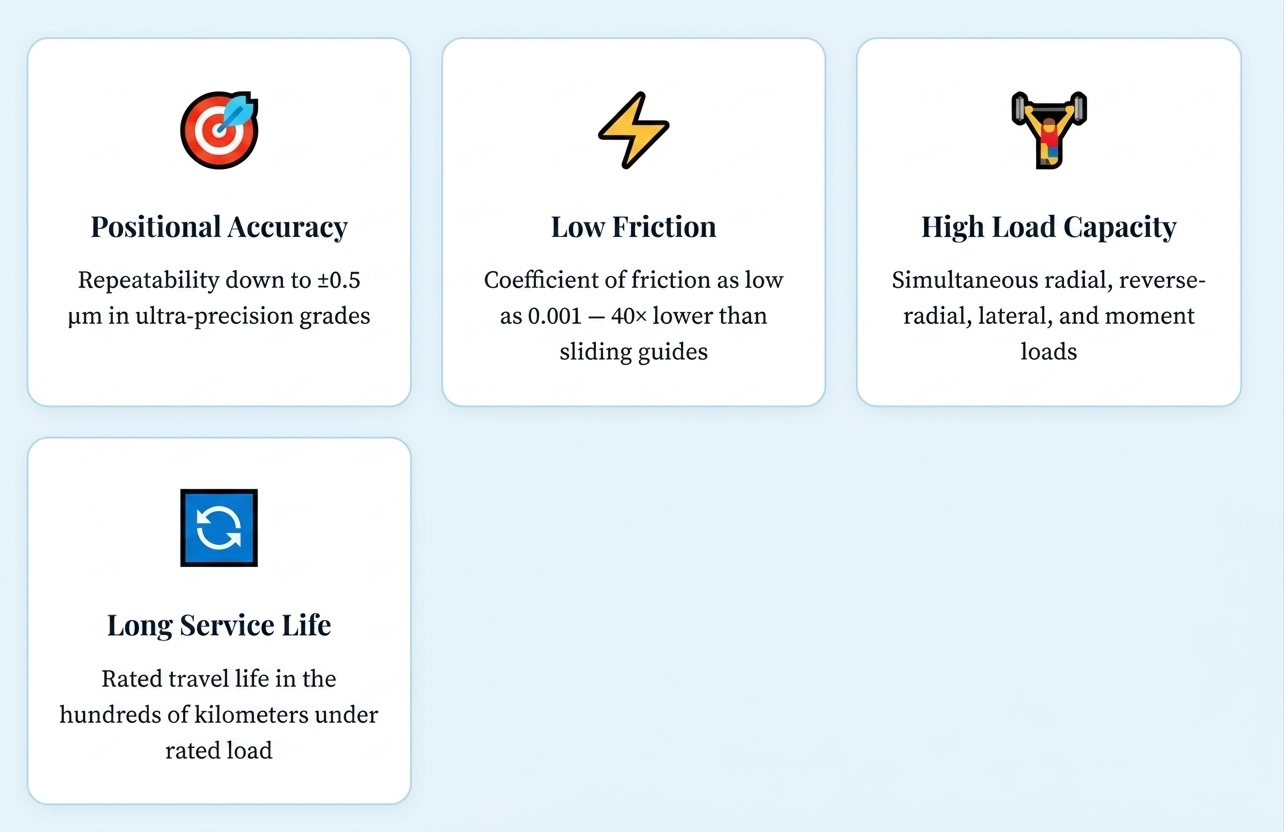
At the heart of most modern linear guides are recirculating ball or roller elements. These rolling elements travel in hardened raceways ground to tolerances measured in micrometers. The result is a motion system that combines:

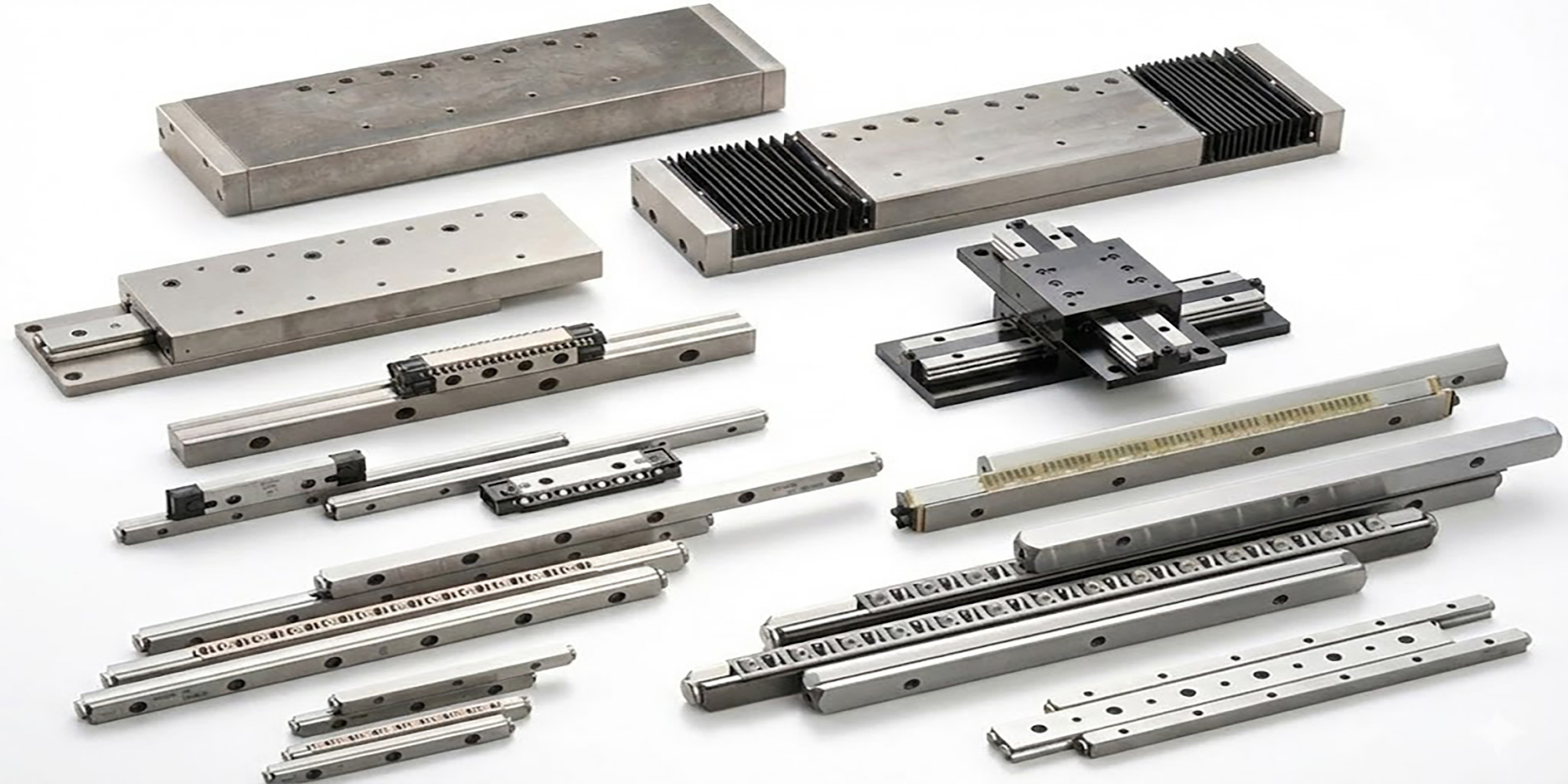
Not all linear guides are created equal. The right type depends on load requirements, speed, precision, environment, and budget. Here is a complete overview of the primary categories:
|
Type |
Rolling Element |
Load Capacity |
Precision |
Best For |
|
Ball-Type Linear Guide |
Steel balls |
Medium |
Very High |
SMT machines, laser cutters, general automation |
|
Roller-Type Linear Guide |
Cylindrical rollers |
Very High |
High |
Heavy machining centers, press brakes, transfer lines |
|
Miniature Linear Guide |
Micro balls |
Low–Medium |
Ultra-High |
Medical devices, optical instruments, lab automation |
|
Cam Follower Rail |
Cam followers |
Medium |
Medium |
Packaging, conveyors, clean environments |
|
Crossed Roller Guide |
Crossed cylinders |
Medium |
Extreme |
Semiconductor wafer stages, metrology equipment |
|
Profile Rail (HG / EG) |
Balls or rollers |
High |
High |
CNC machining, robotics, gantry systems |
|
Round Shaft Linear |
Balls (in bushing) |
Low–Medium |
Medium |
3D printers, light automation, cost-sensitive designs |
|
⚠️ Engineer's Note: Ball vs. Roller • Ball guides offer higher speeds and lower noise — ideal when precision and smoothness matter more than brute load capacity. • Roller guides can carry 2–3× the load of equivalent ball guides due to line contact vs. point contact. Choose them for heavy-duty machine tools and structural gantries. • Miniature guides (width under 9mm) are a growing segment driven by medical robotics and portable diagnostic equipment. |

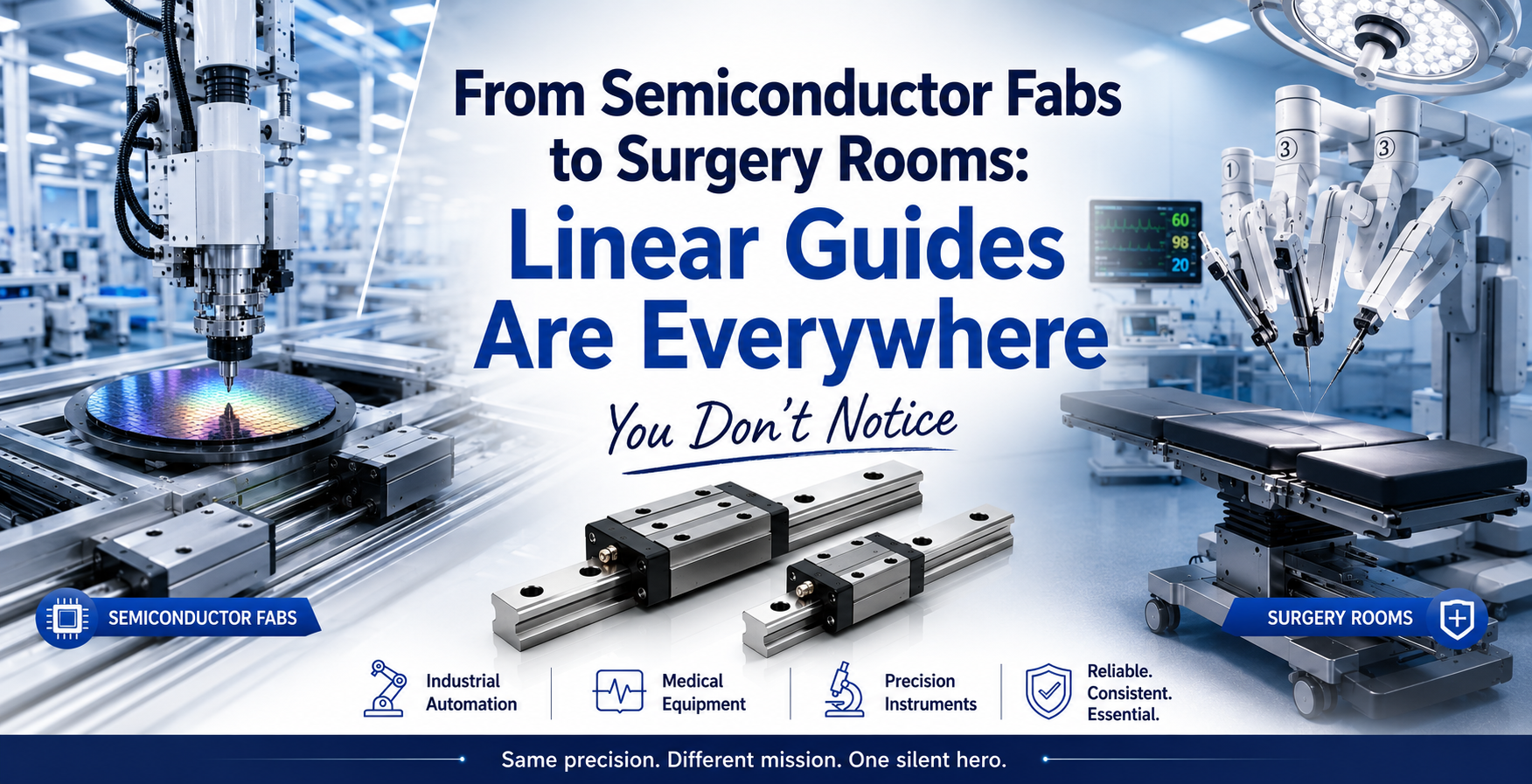
Nowhere is the demand for linear guide performance more extreme than in a chip fab. Wafer exposure systems (steppers and scanners) require stage positioning at nanometer-scale accuracy — with zero particle contamination, zero magnetic interference, and operation inside high-vacuum chambers. Crossed roller guides and air-bearing linear stages are the only technologies that meet these requirements.
A single EUV lithography machine contains hundreds of linear motion components. Downtime in a fab costs upwards of $1 million per hour, making linear guide reliability not just a technical requirement but a financial imperative.
Miniature linear guides enable a new generation of medical devices: robotic-assisted surgical systems, automated pathology analyzers, radiation therapy positioning tables, and implant manufacturing equipment. In surgical robotics such as the da Vinci system, the end-effector's tremor filtering and instrument positioning depend on ultra-smooth, zero-backlash linear motion.
Key requirements in medical applications include biocompatibility (often requiring stainless steel or ceramic guides), sterilizability (autoclave resistance), and compliance with ISO 13485 manufacturing standards.
Linear guides are the linear joints in Cartesian and gantry robots — the machines that pick, place, weld, dispense, and inspect in factories worldwide. A typical 6-axis collaborative robot adds a 7th axis (a linear track) using profile rail guides to extend its workspace without sacrificing repeatability.
In aerospace, linear guides appear in flight simulator motion platforms, aircraft assembly jigs, satellite solar panel deployment mechanisms, and weapons system actuators. Requirements here include extreme temperature ranges (−60°C to +150°C), vibration resistance, and in some applications, radiation hardening.
Modern automotive assembly lines are dense with linear motion: welding robots move on profile rail guides, body panel press lines use heavy-duty roller guides, and coordinate measuring machines (CMMs) inspect finished components with precision ball guides. Electric vehicle battery assembly, with its fine-pitch cell stacking requirements, has created new demand for high-speed, high-precision linear systems.
High-speed filling, sealing, and labeling machines in food and pharmaceutical packaging rely on linear guides that can survive washdown environments (stainless steel, FDA-compliant lubricants), operate at up to 5 m/s, and maintain accuracy over billions of cycles.
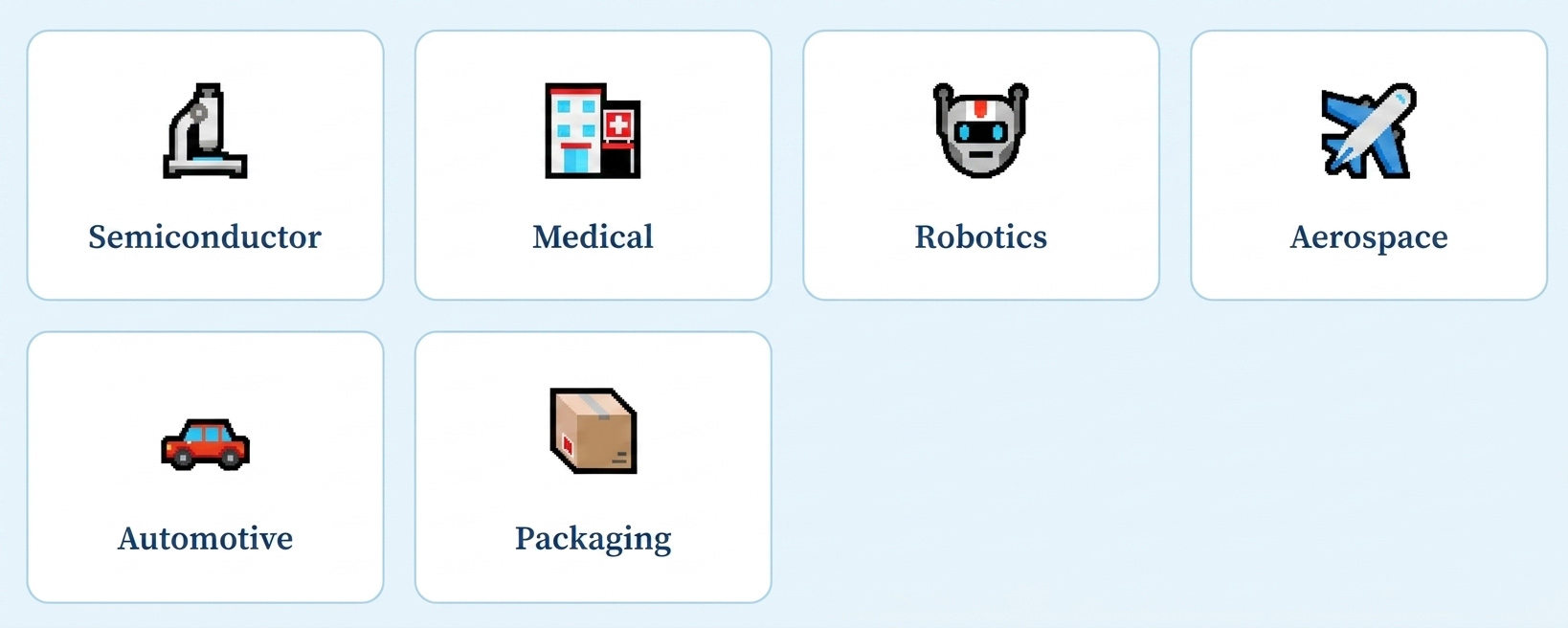
|
Industry |
Typical Guide Type |
Critical Requirement |
Example Application |
|
Semiconductor |
Crossed roller / Air bearing |
Nanometer precision, cleanroom |
Wafer stepper stages |
|
Medical Devices |
Miniature ball guide |
Biocompatibility, sterilization |
Surgical robot arms |
|
Industrial Robotics |
Profile rail (HG series) |
High speed + rigidity |
7th-axis robot tracks |
|
Aerospace |
Stainless / specialty |
Temp. range, vibration |
Satellite deployment |
|
Automotive |
Roller-type linear guide |
Load capacity, service life |
Press transfer lines |
|
Packaging |
Stainless ball guide |
Corrosion resistance, speed |
High-speed fillers |
Linear guide datasheets are dense with numbers. Here's what actually matters — and what each specification tells you about real-world performance:
|
Specification |
What It Means |
Why It Matters |
Typical Range |
|
Basic Dynamic Load (C) |
Load at which 90% of guides achieve 50km travel life |
Primary sizing parameter for life calculations |
0.5 kN – 500 kN |
|
Basic Static Load (C₀) |
Maximum load without permanent deformation |
Critical for shock/static applications |
1 kN – 800 kN |
|
Accuracy Grade |
H (Normal) / P (Precision) / SP / UP / SU |
Determines parallelism and height tolerance |
±20 µm to ±0.5 µm |
|
Preload Class |
C0 (no preload) to C3 (heavy) |
Affects rigidity and running friction |
0–10% of C₀ |
|
Max Speed (Vmax) |
Maximum rated operating velocity |
Determines suitability for high-speed applications |
1–10 m/s typical |
|
Travel Life (L) |
Rated kilometers of travel under load |
Directly determines maintenance interval |
50–20,000 km |
|
Moment Load Capacity |
MA (pitch), MB (yaw), MC (roll) ratings |
Critical for cantilevered or off-center loads |
Varies by size/type |
|
📐 Life Calculation Formula: L = (C / P)³ × 50 km — where L is rated travel life in km, C is the basic dynamic load rating, and P is the applied dynamic equivalent load. Doubling the load reduces life by a factor of 8. |
Selecting a linear guide is a multi-variable engineering decision. Follow this systematic approach to avoid costly over- or under-specification:
|
Application Type |
Recommended Size |
Preload |
Accuracy Grade |
Special Features |
|
Semiconductor / Metrology |
15–25 mm width |
C1–C2 |
SP / UP |
Low-outgassing lube, corrosion coating |
|
Medical / Lab |
5–15 mm width |
C0–C1 |
P / SP |
Stainless steel, autoclavable |
|
Machine Tool |
25–65 mm width |
C2–C3 |
H / P |
Heavy-duty seals, high C/C₀ |
|
General Automation |
15–35 mm width |
C0–C2 |
H / P |
Standard lube port, end seals |
|
Packaging / Food |
15–25 mm width |
C0–C1 |
H |
316L stainless, FDA lubricant |
Even the best-specified linear guide will fail prematurely without proper maintenance. These four practices extend service life dramatically:
• Lubrication Intervals: Re-lubricate every 100 km of travel or every 6 months, whichever comes first. Use manufacturer-specified grease grade. Over-greasing can be as damaging as under-greasing.
• Contamination Control: Inspect and replace end seals and wipers annually. Use bellows or telescopic covers in environments with chips, dust, or coolant. Contamination is the #1 cause of premature failure.
• Alignment Checks: Check rail parallelism whenever the machine undergoes maintenance. Misalignment as small as 20 µm can reduce life by 50% and cause uneven carriage wear.
• Condition Monitoring: Monitor motor current draw, vibration signatures, and positioning error over time. Upward trends indicate wear before catastrophic failure occurs.
The linear guide industry is not standing still. Several technology trends are reshaping what's possible:
|
Trend |
Driver |
Impact on Linear Guides |
|
AI-Powered Predictive Maintenance |
Industry 4.0 / IIoT |
Embedded sensors monitoring load, temperature, vibration in real time |
|
EV Battery Manufacturing |
Global EV adoption |
High demand for clean, high-speed guides in cell assembly lines |
|
Advanced Surgical Robotics |
Minimally invasive surgery |
Miniature guides with sub-micron resolution in sterilizable materials |
|
Semiconductor Scaling (2nm+) |
Moore's Law continuation |
Air-bearing and magnetic levitation stages for zero-contact motion |
|
Sustainable Manufacturing |
ESG / Carbon targets |
Longer-life guides, biodegradable lubricants, reduced rare earth content |
The most disruptive near-term development is the integration of sensing directly into the carriage block. Companies like THK and INA/Schaeffler are already shipping linear guides with embedded acceleration and temperature sensors that feed real-time data to machine controllers — turning a passive mechanical component into an active participant in machine health monitoring.
|
Need Help Specifying the Right Linear Guide? Our engineering team has helped hundreds of OEMs and machine builders find the optimal linear motion solution — from miniature medical guides to heavy-duty roller rail systems. → Request a Free Specification Review |
Linear guides are the backbone of precision motion in modern manufacturing, automation, and CNC machinery. When these critical components fail,...
For purchasing engineers or equipment manufacturers, the cost of linear motion guides is a key consideration when selecting products. However, the...
The Critical Role of Linear Motion Linear guide rails are crucial components for achieving precise, smooth motion in automation, robotics, and...