

 Robert
Does a Smaller Sprocket Increase Speed?
 Robert : May 18, 2026 2:37:07 AM
If you've been riding for a while, you've probably heard someone say "go smaller on the sprocket for more speed" — and walked away wondering: smaller
In any power transmission setup, the relationship between the chain and the sprocket is symbiotic.
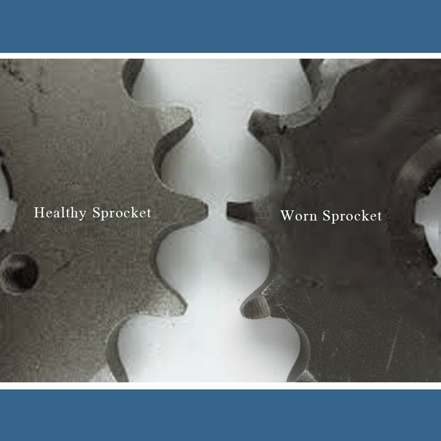
While much attention is often given to chain wear, the sprocket is equally critical.
A worn sprocket acts like a saw, quickly destroying even the highest-quality new chain.
Understanding how to manage sprocket wear isn’t just about maintenance.
Managing sprocket wear goes beyond routine maintenance.
It protects your bottom line, prevents unplanned downtime, and extends the life of your drive systems.
Waiting for a sprocket to lose a tooth is not a maintenance strategy; it’s a recipe for disaster.
Professional inspectors look for specific geometric changes in the sprocket tooth profile.
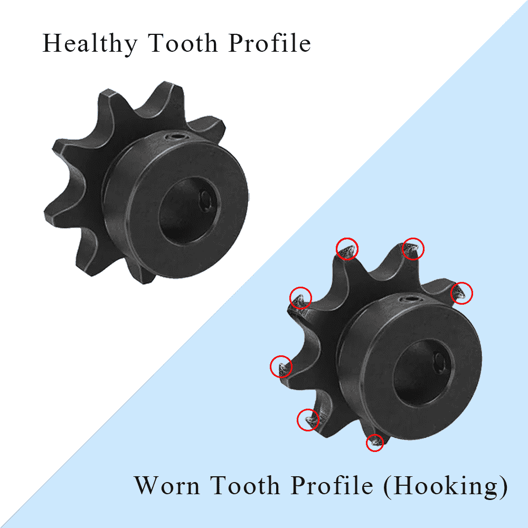
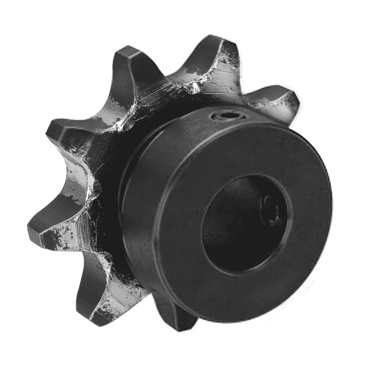
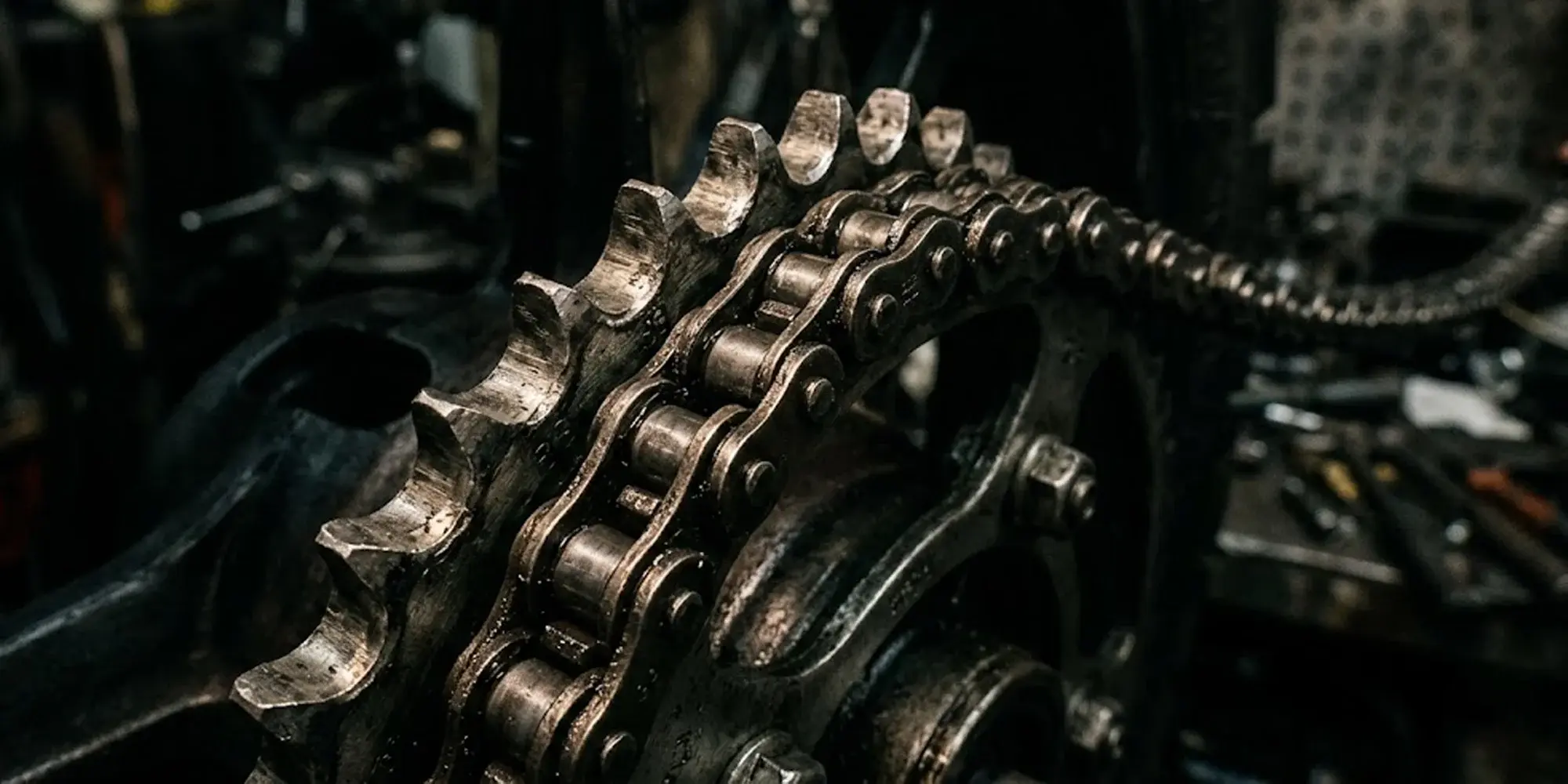
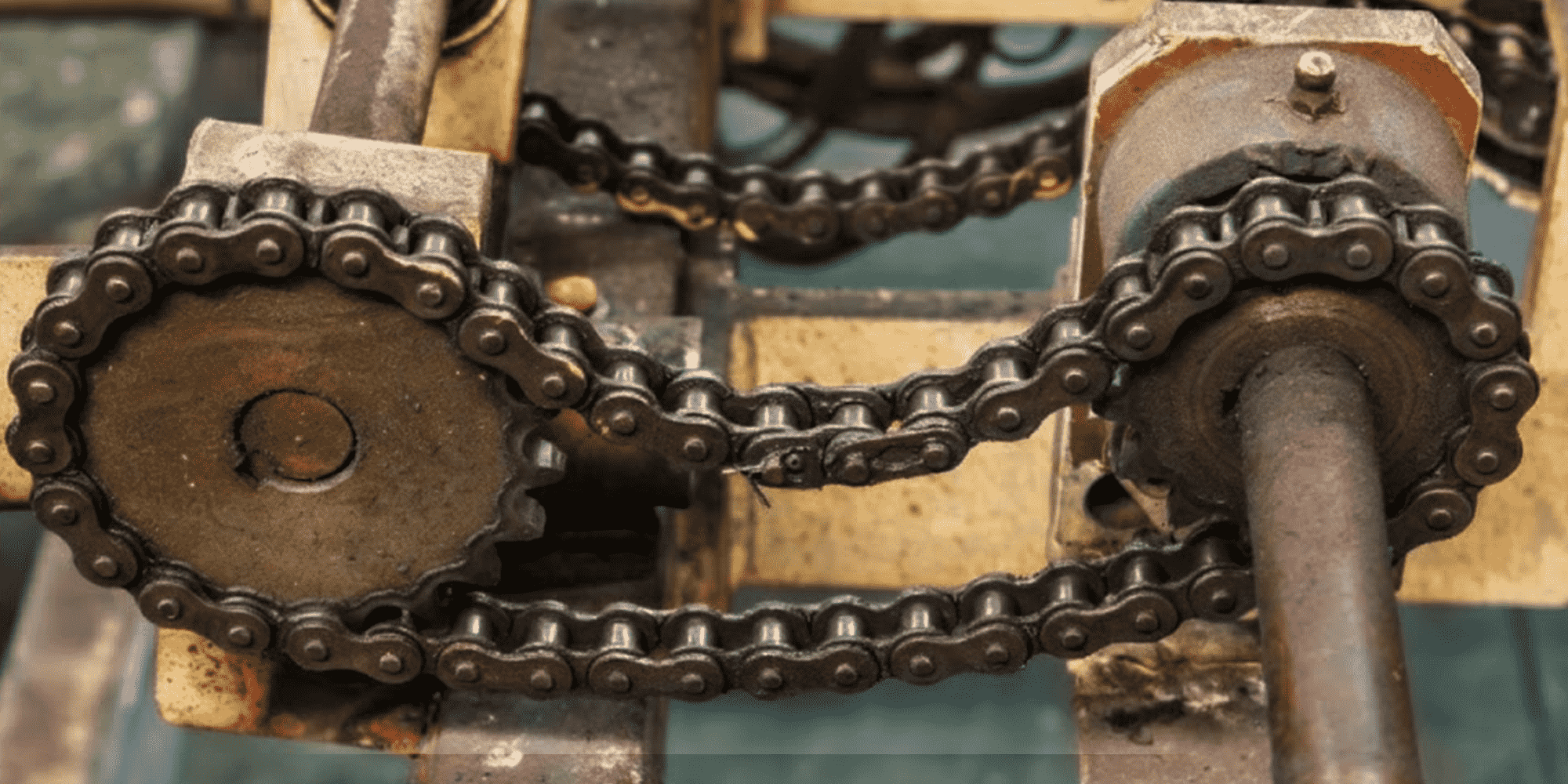
Hooking (The Shark Fin): This is the most obvious sign of wear. As the chain roller pulls against the tooth, it carves out the metal, leaving a hooked or "shark fin" shape. If the teeth look sharp or curved on the drive side, the sprocket needs replacement.
Side Wear on Tooth Faces: Inspect the faces of the sprocket teeth. If you see gouges or polished metal on the sides of the teeth (rather than the tips or roots), your sprockets are likely misaligned. This lateral friction generates heat and wastes energy.
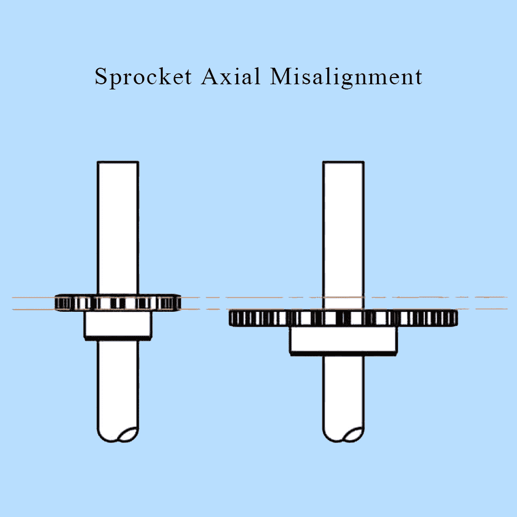
Figure: Axial misalignment occurs when sprockets on parallel shafts are not in the same plane, leading to the "Side Wear" described above.
Bottoming Out: Look at the "root" (the valley between teeth). Polishing or scarring in this spot is a warning sign. It means the teeth are too short, so the chain rollers are hitting the hub instead of riding on the teeth.
A reliable industry benchmark is the 10% Rule.
Measure the thickness of the tooth at the pitch line.
If the wear on the faces of the sprocket teeth has reduced the original thickness by 10% or more, you must replace the sprocket.
Beyond this point, the pressure on the chain increases sharply.
To fix a problem, you must understand its origin.
Rapid sprocket wear is rarely a result of poor metal alone; it is usually a symptom of system issues.
As a chain ages, its "stretch" (pitch elongation) causes the chain roller to no longer sit perfectly in the sprocket's root.
Instead, the roller rides higher up the sprocket tooth, grinding away the metal as it exits the seat.
Without a consistent film of oil between the chain roller and the tooth face, you have metal-on-metal contact.
This creates high-frequency vibration and abrasive wear that can turn a year-long lifespan into a month-long failure.
In industrial environments, dust, grit, and metal shavings act as an abrasive paste.
When these particles get trapped between the chain and the sprocket, they accelerate erosion on the tooth faces.
Prevention is significantly cheaper than replacement. Here is how to extend the life of your components.
Even a fraction of a degree in misalignment can cause lopsided wear.
Use laser alignment tools to ensure the sprockets are perfectly parallel.
This spreads the load evenly across the full width of every tooth face.
Chain tension must be right.
Too tight stresses the sprocket with radial overload; too loose and the chain whips, battering the teeth on every pass.
Check your tensioning schedules weekly.
For high-torque or abrasive environments, standard carbon steel may not suffice.
Opting for sprockets with induction-hardened teeth can double or triple the service life.
These sprockets maintain their profile much longer against the constant strike of the chain roller.
When you’ve determined that a sprocket is past its prime, the "fix" must be handled correctly to avoid repeating the cycle.
Never run a new chain on worn sprockets.
Worn sprocket teeth have an elongated profile.
Put a new chain on them, and that profile starts pulling the chain out of shape from the first rotation.
Always replace the sprocket and chain as a matched set for maximum ROI.
In complex drive systems, removing a sprocket often requires dismantling long shafts and bearings.
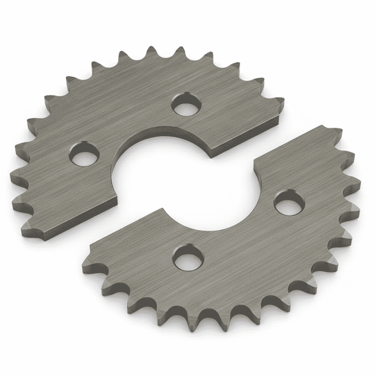
To "fix" the downtime issue, consider switching to split sprockets.
These allow for replacement in a fraction of the time, as they can be bolted around the shaft without disturbing the rest of the assembly.
The quality of the replacement determines your next maintenance interval.
High-precision industrial sprockets, built to tight tolerances, give you optimized tooth-to-roller contact right from the start.
Identifying sprocket wear is about observation; preventing it is about precision; and fixing it is about quality.
Two habits — monitoring tooth faces and keeping everything aligned — will make your machinery quieter, smoother, and far longer-lived.
Are your drive systems running at peak efficiency?
Explore our range of high-performance sprockets to find the right fit for your industrial application.
 Robert : May 18, 2026 2:37:07 AM
If you've been riding for a while, you've probably heard someone say "go smaller on the sprocket for more speed" — and walked away wondering: smaller
 Richard : Feb 5, 2026 4:33:30 AM
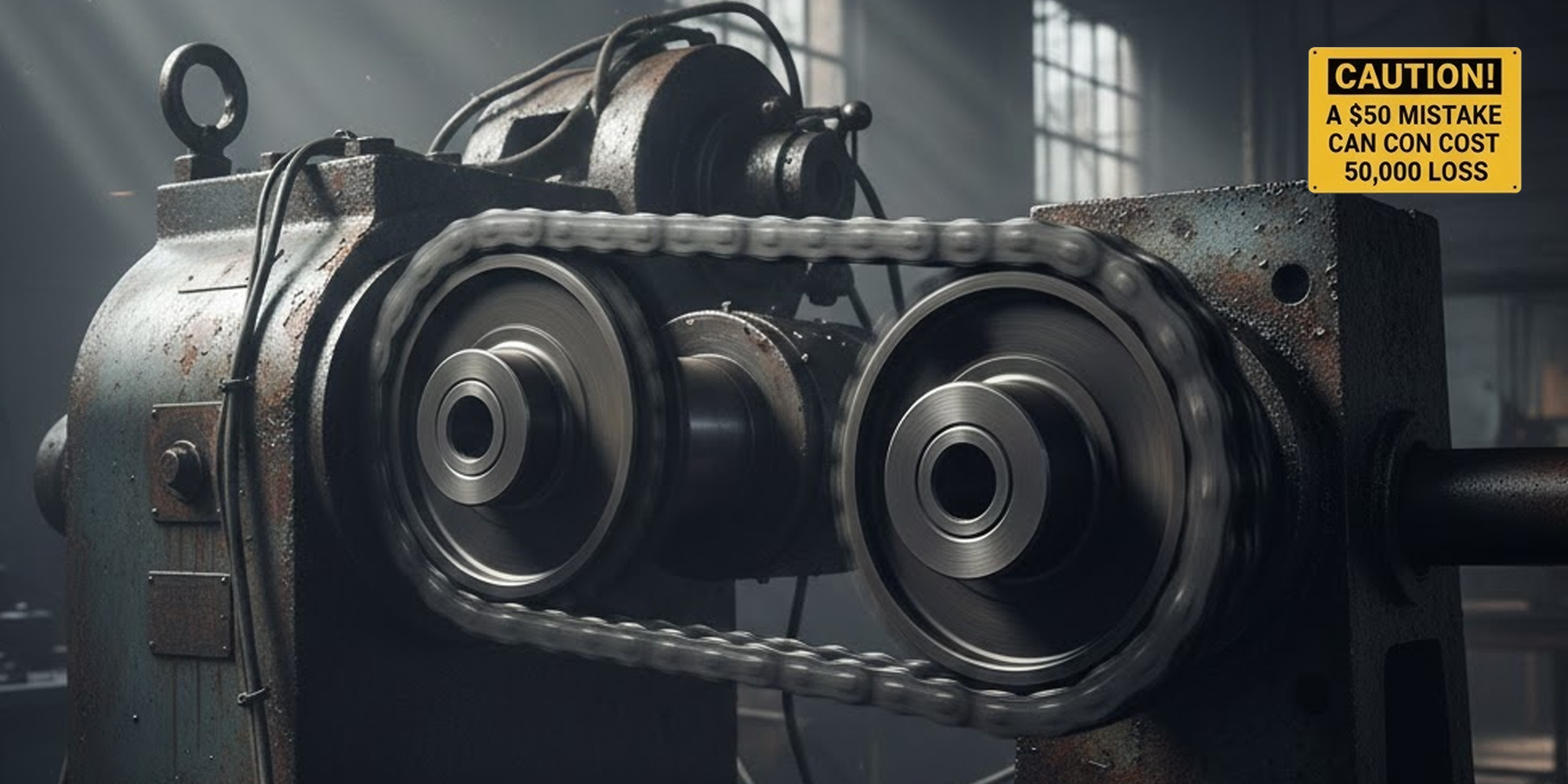
A $50 sprocket mistake can cost you $50,000 in downtime. Incorrect sprocket selection is the leading cause of premature chain failure. This single...
 Richard : Feb 12, 2026 4:59:59 AM
I've spent enough time around manufacturing floors to know that when a chain drive fails, everything stops. And trust me, explaining to management...