

 Robert
SKF Bearings: Types & Buyer’s Guide (2026)
 William : Aug 5, 2025 11:25:31 PM
SKF bearings power critical applications from wind turbine gearboxes to EV powertrains, robotics, and medical systems. As a global leader in...
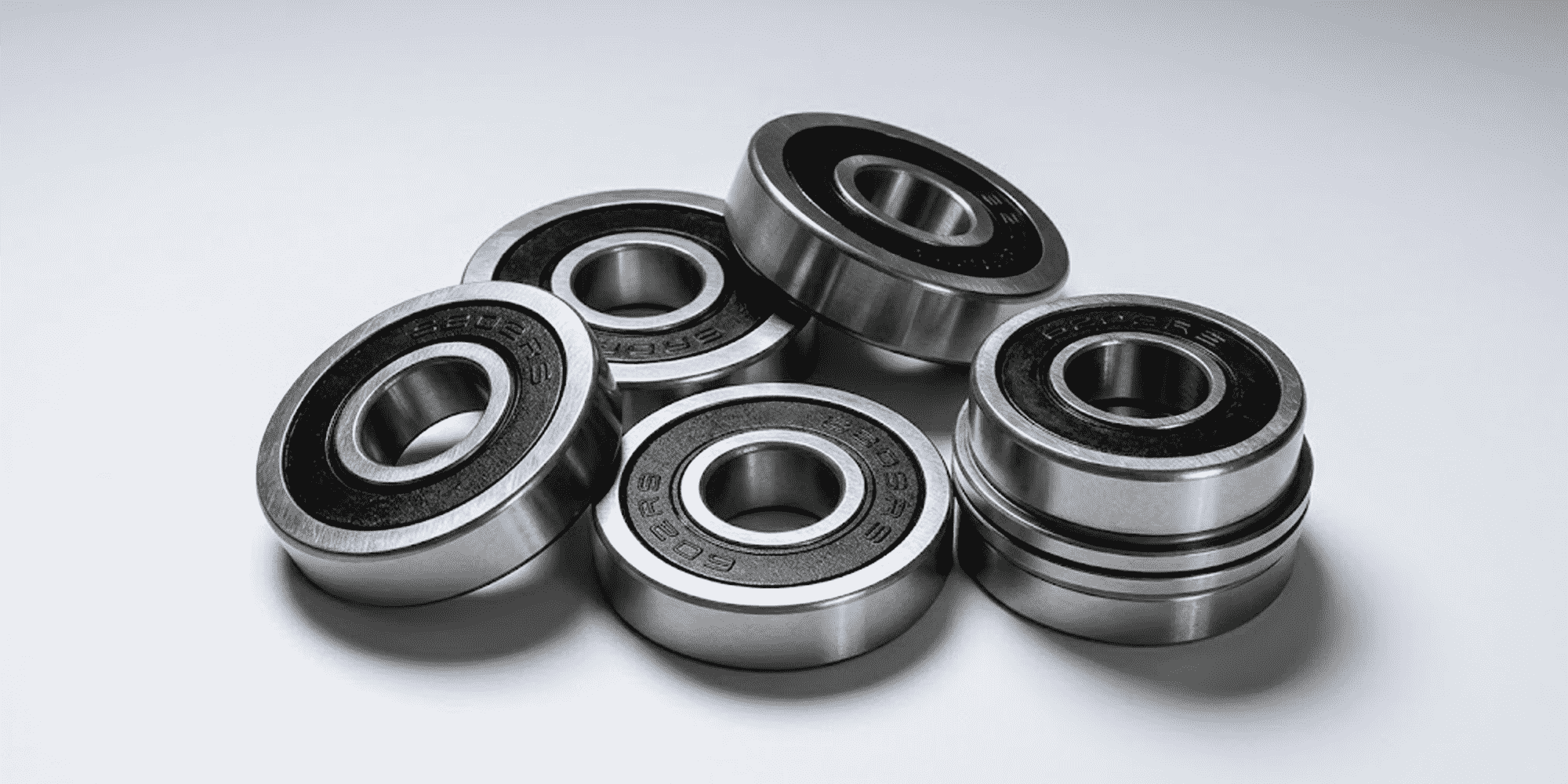
SKF bearings have earned their reputation.
Over a century of Swedish engineering, global manufacturing across 100+ facilities, and a product catalog that covers virtually every industrial application — there's a reason they became the default specification on countless OEM drawings.
But here's what many procurement managers already know: specifying SKF doesn't always mean you need SKF.
The global bearing market is worth tens of billions of dollars annually (estimates range from $50B to $150B+ depending on how broadly you define "bearings"), and SKF — despite being the world's largest bearing manufacturer with €8.9 billion in 2024 revenue (per its annual report) — is one player among many.
The rest of the market is served by hundreds of qualified manufacturers building to the exact same ISO dimensional standards.
This guide walks you through how bearing interchangeability actually works, what to check before switching, and how to source equivalents without compromising your equipment.
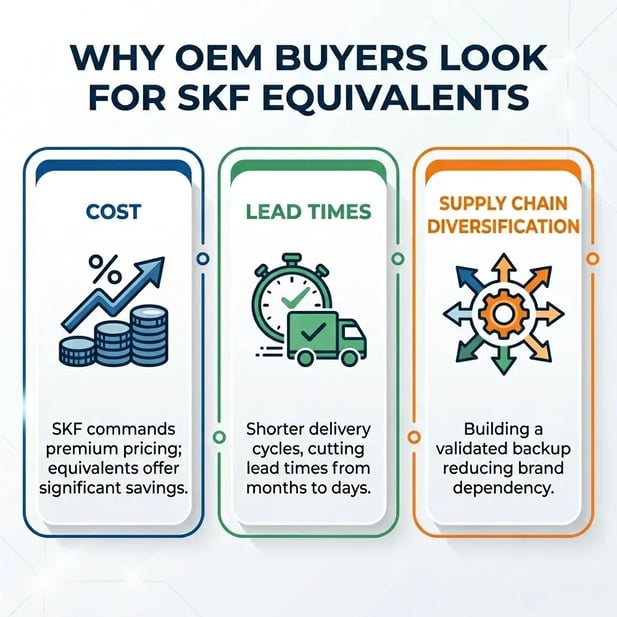
The reasons vary, but a few keep coming up.
SKF commands premium pricing — often 30% or more above comparable equivalents, depending on series and volume.
(We see this consistently across our own quotation comparisons on common deep groove and tapered roller series.)
For an OEM buying thousands of 6205-2RS bearings a year, that gap compounds quickly.
Part of the premium covers SKF's R&D, global distribution network, and brand equity.
But the bearing inside the box often meets the exact same ISO specifications as its equivalent.
SKF's distribution is extensive, but during supply disruptions — like the post-2020 shortage cycles — lead times on standard catalog items have stretched to 12–16 weeks or more.
An equivalent from a manufacturer with dedicated stock can cut that to days.
Then there's supply chain diversification, which most procurement teams are actively pursuing regardless of brand loyalty.
Adding a qualified equivalent supplier doesn't mean dropping SKF.
It means having a validated backup ready when you need it.
Bearing interchangeability isn't guesswork — it's baked into the ISO standards that every serious manufacturer builds to.
ISO 15 governs boundary dimensions for radial bearings (bore diameter, outer diameter, width). ISO 355 does the same for tapered roller bearings. ISO 492 defines tolerance classes.
These standards ensure that a 6205 bearing — regardless of who manufactures it — has a 25 mm bore, 52 mm outer diameter, and 15 mm width.
That's why cross-referencing works.
The base designation system is universal. But dimensional match is only the starting point — what separates a safe swap from a costly mistake is everything beneath the part number.
Matching the part number is step one. Validating the engineering is where procurement gets it right or gets burned.
In short: match load ratings, clearance, precision grade, sealing, and material — in that order of priority.
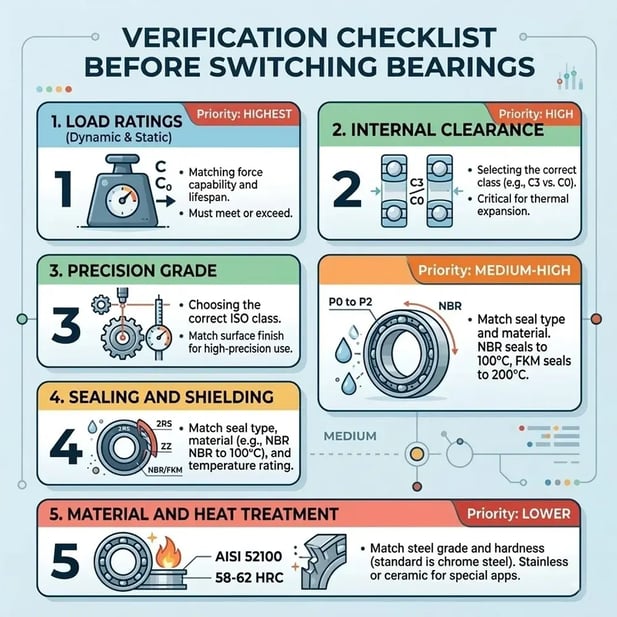
Here's what each one means in practice.
Every bearing has a basic dynamic load rating (C) and a basic static load rating (C₀).
These determine how much force the bearing can handle and how long it'll last under load.
An equivalent must meet or exceed the original's ratings.
Don't just match — verify against actual operating conditions.
A 6205 from one manufacturer might carry a C rating of 14.8 kN while another offers 14.0 kN.
Both work for a lightly loaded conveyor idler. In a high-cycle servo motor application, that 5% gap matters.
Check the manufacturer's catalog data directly.
Don't rely on cross-reference charts alone.
Clearance class affects how a bearing performs at operating temperature.
SKF's standard is C0 (Normal), but many industrial applications specify C3 for thermal expansion in motors, pumps, and gearboxes.
The suffix tells the story: C3 means C3 clearance, no suffix means Normal.
Make sure the clearance designation transfers exactly when cross-referencing.
Running C0 in a C3 application leads to preload, overheating, and premature failure.
ISO precision classes run from P0 (standard) through P6, P5, P4, and P2 (highest).
Most general industrial bearings ship as P0. Machine tool spindles typically require P5 or P4.
For standard precision, almost any ISO-compliant equivalent will match.
For high-precision applications, verify not just the tolerance class but the manufacturer's actual measured values — runout, bore tolerance, and raceway surface finish.
SKF uses specific suffix codes: 2RS for contact seals, 2Z for metal shields, -2RSHfor heavy-contact seals.
Other manufacturers use different suffixes for functionally identical components — 2RS, ZZ, DDU, LLU, depending on the brand.
Match these parameters: seal type (contact vs. non-contact), material (NBR, FKM/Viton, PTFE), and temperature rating.
Standard NBR rubber works to about 100°C.
If the application runs hotter, you need FKM seals rated to 200°C — regardless of whose name is on the bearing.
For a deeper breakdown of SKF seal configurations and suffix codes, see our complete SKF bearings guide.
Standard bearing steel is AISI 52100 (100Cr6) — this is what the vast majority of SKF catalog bearings use.
Any credible equivalent uses the same steel grade with comparable heat treatment to 58–62 HRC.
Material becomes critical in specialty applications: stainless steel (AISI 440C or 316L) for corrosion resistance, ceramic hybrid (Si₃N₄ balls with steel races) for electrical insulation or high speed.
If corrosion is your primary concern, our 440C vs. 304 vs. 316 stainless steel comparison breaks down which grade fits which environment.
If you're replacing a standard chrome steel SKF bearing with a standard chrome steel equivalent, material is rarely the differentiator.
Here's how the most commonly sourced SKF bearing series translate across manufacturers.
This covers dimensional equivalence — always verify load ratings and internal specifications independently.
Why the base numbers align:
Most standard rolling bearings follow ISO 15 and ISO 355, which standardize bore, OD, and width by series.
A 6205 is 25×52×15 mm from any manufacturer.
The real differences show up in suffixes — cage type, clearance, sealing, precision — and in load ratings.
To give you a concrete example: the SKF 6205 lists a basic dynamic load rating (C) of 14.8 kN, while the NSK and NTN 6205 both list 14.0 kN.
Same dimensions, same bearing type, but a ~5% gap in rated capacity.
For most applications that difference is negligible, but it's worth checking when loads are near the limit.
For a full interactive lookup, visit our bearing cross-reference tool.
If you're less familiar with bearing types and their applications, our comprehensive bearing types guide covers every major category.
SKF's suffix system is proprietary, and it trips up even experienced buyers. Here's a practical translation:
When specifying an equivalent, build the full designation: base number + seal/shield + clearance + cage + any special features.
Missing a suffix means getting the wrong bearing.
To understand how bearing designation codes work across manufacturers, our bearing number identification guide covers the full breakdown.
Not all SKF bearings are straightforward swaps. Two product lines deserve special mention.
SKF Explorer is a performance class, not just a label.
Explorer bearings use ultra-clean steel with proprietary heat treatment that increases hardness by up to 2 HRC while maintaining toughness.
The raceway surfaces undergo additional finishing beyond standard grinding, which reduces friction and improves lubricant film formation.
The result, according to SKF's own testing at their Engineering and Research Centre in the Netherlands, is up to twice the service life under contaminated or poor lubrication conditions compared to previous-generation SKF bearings.
If an OEM drawing specifies Explorer-class, your equivalent needs to demonstrate comparable metallurgical and surface finish performance — not just dimensional fit.
SKF INSOCOAT bearings feature a plasma-sprayed aluminum oxide coating on the outer or inner ring, providing electrical insulation up to 3,000V DC.
These are critical in VFD-driven motors where stray currents cause electrical erosion.
Equivalents exist, but they must match the coating thickness, insulation resistance (>50 MΩ at 1,000V DC), and the base bearing's mechanical specs simultaneously.
For standard catalog bearings — your 6205s, 6308s, 30205s — equivalence is straightforward.
For these premium lines, budget extra validation time.
Finding a dimensionally equivalent bearing is the easy part.
Finding a supplier you can trust for production volumes takes more work — and it's where the decision actually gets made.
ISO 9001 is table stakes.
For automotive OEMs, IATF 16949 is the benchmark.
For aerospace, AS9100.
These aren't wall plaques — they indicate documented quality systems, traceability, and process control that directly affect what ends up in the box.
A qualified manufacturer will provide dimensional inspection reports, hardness test results, and vibration/noise measurements (typically measured as Anderon values or Z-class ratings).
If they can't or won't share this data, that's your answer.
Before committing to volume, test samples in your actual application.
Measure dimensional fit, monitor operating temperature, track vibration levels, and compare against your SKF baseline.
A 500–1,000 hour bench test in representative conditions tells you more than any catalog spec.
Ask about stock levels on your most commonly ordered sizes.
Check minimum order quantities, standard lead times, and how they handle demand spikes.
A supplier who stocks your top 20 part numbers and can ship within 48 hours is worth more than one with a slightly lower unit price but 8-week lead times.
Counterfeit bearings are a documented problem across the industrial supply chain.
Your supplier should have clear traceability from raw material through finished product, and be willing to demonstrate it.
Laser marking, packaging security features, and batch-level documentation are all reasonable expectations.
For a broader framework on evaluating bearing suppliers beyond just the SKF-equivalent context, our guide to choosing a reliable bearing supplier covers the full evaluation process.
Two bearings with the same base number can differ in clearance, cage material, seal type, and lubrication.
Always compare the full designation.
Cage material and design affect speed limits and lubrication requirements.
A pressed steel cage and a polyamide cage have different maximum speeds and operating characteristics — this matters in high-speed spindle applications, less so in a conveyor roller.
Even with a qualified supplier, implement incoming quality checks — at minimum, dimensional spot checks, visual inspection for surface defects, and rotation feel.
A quick inspection catches problems before they reach the production line.
(For a refresher on what bearing damage looks like and what causes it, see our guide to bearing wear patterns.)
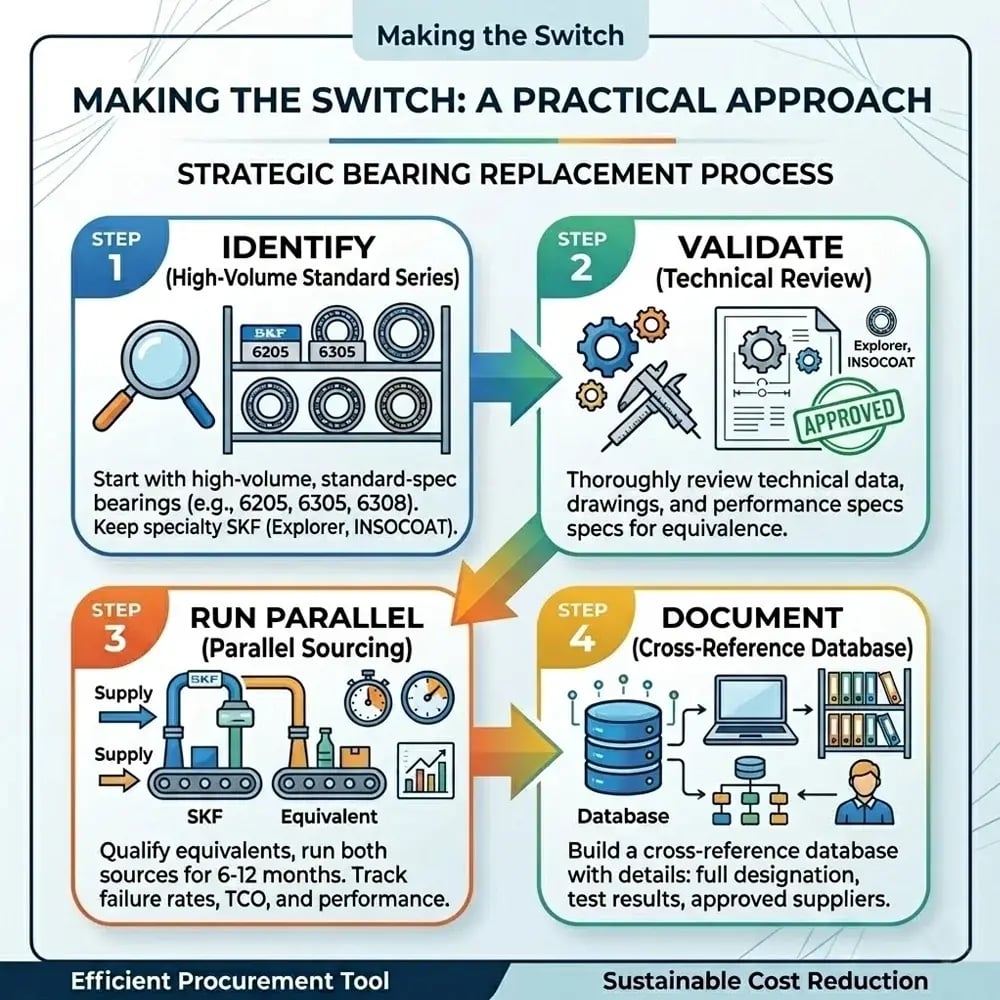
The smartest approach isn't replacing your entire SKF inventory overnight. Here's what actually works:
Yes — as long as the replacement matches on all critical specifications, not just dimensions.
Standard rolling bearings follow ISO dimensional standards (ISO 15 for radial, ISO 355 for tapered rollers), which means any ISO-compliant manufacturer produces bearings with identical boundary dimensions.
The key is verifying load ratings, clearance class, precision grade, sealing, and material beyond just the part number.
For standard catalog bearings, qualified equivalents are widely available and perform comparably.
It varies — and the answer depends almost entirely on who's making the equivalent.
SKF's quality is well-documented, but they're not the only company producing bearings from 52100 chrome steel to ISO tolerance standards.
Reputable equivalent manufacturers use the same base materials, similar heat treatment processes, and comparable quality control.
The way to verify is through test reports — dimensional inspections, hardness testing, and vibration measurements — plus real-world validation in your specific application.
Start with the base designation. A 6205 is universally a 25×52×15 mm deep groove ball bearing across all ISO-compliant brands.
Then translate the suffixes: SKF's 2RS1 (contact seal) maps to 2RS, DDU, or LLU from other brands.
Our bearing cross-reference tool lets you look up equivalents by part number, and our bearing number guide explains how the designation system works across manufacturers.
Exercise extra caution with SKF's premium product lines — particularly Explorer class (proprietary heat treatment and surface finishing), INSOCOAT (electrically insulated), and any bearings with custom internal geometry or non-standard materials specified on the OEM drawing.
These require equivalent-level engineering validation, not just dimensional matching.
Need help finding the right equivalent for your SKF bearing specification? Our engineering team can cross-reference your part numbers and provide detailed technical comparisons. Browse our bearing cross-reference charts or contact us for a custom sourcing consultation.
 William : Aug 5, 2025 11:25:31 PM
SKF bearings power critical applications from wind turbine gearboxes to EV powertrains, robotics, and medical systems. As a global leader in...

 Richard : Aug 26, 2025 5:59:20 AM
SKF's Ongoing Seal Business Restructuring SKF AB, a global leader in bearing and seal production, based in Stockholm, Sweden, is undertaking...
 Richard : Aug 26, 2025 9:11:33 PM
SKF Shifts Production to Mexico SKF AB has announced that it will accelerate the closure of its wheel bearing hub assembly plant in Glasgow,...