


Home/
Blog/
How to Choose a Custom Bearing Supplier for OEM Projects (And Avoid a 6-Month Delay)

9 min read

How to Choose a Custom Bearing Supplier for OEM Projects (And Avoid a 6-Month Delay)

How to Choose a Custom Bearing Supplier for OEM Projects (And Avoid a 6-Month Delay)
19:29

Off-the-shelf bearings solve most problems.

But when your application pushes the limits of standard geometry, material, or tolerance — you need a supplier who engineers alongside you, not just one who fulfills purchase orders.

60,000+  8–16 wks   4–6 months   20+ yrs 
Bearing types produced by LILY Bearing, from 1.5mm ID to 4,000mm OD Typical production lead time for a custom non-standard bearing design Typical full development timeline from first discussion to first production delivery LILY Bearing's experience supplying precision custom bearings to global OEMs
 LILY Bearing  Industry average LILY Bearing project data LILY Bearing


Most OEM procurement decisions start the same way: an engineer hands over a drawing, and someone in purchasing tries to find a part that fits.

With standard bearings, that process takes hours.

With custom requirements — non-standard bore, specialized material, tight tolerance, unusual environment — it can take months, and the wrong supplier choice can set a product launch back by a full quarter.

Custom Bearings

If you're reading this, you've probably already ruled out the catalogue.

What you need now is a realistic picture of how the custom development process actually works — and what separates a supplier who can execute from one who'll cost you a quarter.

Still deciding whether your application needs a custom bearing at all? Start with our guide to choosing a reliable bearing supplier first.


1. When does an OEM project actually need a custom bearing?

The default answer should always be: use a standard bearing if you can.

Standard bearings benefit from decades of manufacturing refinement, predictable pricing, short lead times, and global supply chain redundancy.

Specifying a custom bearing when a standard one would work is a procurement mistake, not an engineering achievement.

That said, there are clear situations where standard catalogues fall short:

Situation Why standard bearings fail Custom solution
Non-standard bore or OD dimensions Housing or shaft geometry doesn't match any standard series Custom-ground dimensions to exact fit
Extreme operating temperature Standard grease degrades above ~120°C or below -30°C High-temp or cryogenic lubricant + material spec
Corrosive or washdown environment Chrome steel corrodes; standard seals inadequate 440C stainless, ceramic hybrid, or custom seal design
Space-constrained design Thin-section geometry not available in required size Custom thin-section or miniature bearing
Ultra-high precision requirement ABEC-7 insufficient; ABEC-9 not available in required size Custom tolerance grade with precision grinding
Medical or food-grade compliance Standard lubricants not FDA/NSF approved H1-approved grease, PTFE seals, stainless construction
Vacuum or clean-room application Standard lubricants outgas or contaminate Dry-lubricated or low vapor-pressure lubricant spec


Practical rule:

If your application can tolerate a standard bearing series with only minor modifications — different seal, slightly different grease, surface treatment — that's a modified standard, not a full custom.

Modified standards cost far less and arrive far sooner.

Only commit to a full custom design when the application genuinely cannot be served any other way.


2. Understanding what your custom bearing supplier actually controls

The most common reason custom bearing projects stall isn't a design problem — it's discovering three months in that your supplier outsources the one step that matters most.

Before any drawing changes hands, map out exactly which capabilities are in-house and which aren't.

Capability What it covers What to verify
Application engineering Load calculation, bearing selection, life estimation (L10), material recommendation In-house engineers or outsourced? Response time on technical queries?
Custom geometry Non-standard bore, OD, width, flange, shoulder configurations Min/max size range; in-house grinding capability
Material options 52100 chrome steel, 440C stainless, M50, ceramic (Si₃N₄), PTFE-coated Which materials are processed in-house vs. sourced from sub-suppliers?
Precision grinding ABEC-5 through ABEC-9 tolerance grades What measuring equipment do they operate? CMM? Air gauge? Roundness tester?
Sealing & lubrication Custom seal profiles, FDA/H1 greases, dry lube, vacuum-rated lubricants Do they have in-house clean-room assembly?
Prototyping Low-volume first articles for validation before production tooling Minimum prototype quantity; lead time; NRE cost
Testing & documentation Dimensional reports, noise/vibration testing, MTCs, FAI, FMEA In-house test equipment or third-party lab? Critical for AS9100 and medical


The question that matters most:

Ask every candidate supplier directly — "What steps in this process happen in your facility?" A supplier who can't answer specifically is a supplier who doesn't control the process. When something goes wrong at month three, you'll be the one absorbing the delay.


3. The 5-stage OEM custom bearing development process

Most project delays aren't caused by manufacturing problems.

They're caused by teams that didn't know what the timeline actually looked like before they committed to a delivery date.

Here's what a well-run custom bearing development looks like at each stage.

Stage What happens Typical duration
1. Application review & spec definition

You share drawings and performance targets. Engineering reviews loads, environment, space, speed.

Output: agreed technical specification.

1–2 weeks
2. Design proposal & DFM review

Supplier proposes bearing configuration, geometry, material, tolerance, sealing.

Design for Manufacture review flags features that drive cost without adding function.

1–3 weeks
3. Prototype & first article inspection (FAI)

Low-volume first articles produced.

Full dimensional inspection, noise/vibration test, and material certificate issued.

You validate against your requirements.

4–8 weeks
4. Design iteration (if required)

Prototype feedback drives design changes. Most projects need one iteration cycle.

A well-specified project sometimes skips this stage entirely — projects that do typically share one thing: the engineer arrived at Stage 1 with a complete load case, a confirmed L10 target, and a signed-off internal clearance spec.

2–4 wks per cycle
5. Production qualification & volume ramp Design frozen. Production tooling committed. First production lot inspected against FAI baseline. Ongoing supply terms established. 4–8 weeks


Reality check on total timeline:

A well-managed custom bearing development — from first technical discussion to first production delivery — typically runs 4–6 months.

Projects with multiple iteration cycles, special material sourcing, or third-party testing requirements can reach 9–12 months.

Build this into your product development schedule before you commit a delivery date to your customer.


Vertical timeline showing 5 stages from application review to production qualification 1 Application review & spec definition Share drawings and targets. Output: agreed technical specification. 1–2 weeks 2 Design proposal & DFM review Bearing configuration, geometry, material and tolerance proposed. 1–3 weeks 3 Prototype & first article inspection (FAI) First articles produced. Dimensional, noise and MTC checks. You validate. 4–8 weeks 4 Design iteration (if required) One cycle typical. Well-specified projects often skip this stage entirely. 2–4 wks / cycle 5 Production qualification & volume ramp Design frozen. First production lot inspected against FAI baseline. 4–8 weeks Typical total timeline 4–6 months · up to 9–12 months for complex projects


4. Key specifications OEM engineers need to define upfront

Suppliers can help you refine parameters — but they can't define your application requirements for you.

Show up to the first meeting without a complete specification and you've already added weeks to the project.

Parameter What to specify Why it matters
Bore & OD dimensions Nominal + tolerance (e.g., 25.000 +0.000/-0.005 mm) Determines fit class on shaft and in housing
Radial load (Fr) Maximum, average, and shock load values in N or lbf Drives internal geometry and rolling element size
Axial load (Fa) Direction (one-way or reversing) and magnitude Determines contact angle and bearing type
Speed Operating RPM + maximum RPM Affects cage design, lubrication type, heat generation
Operating temperature Continuous + peak temperature range (°C) Determines steel grade, heat stabilization, grease selection
L10 life target Required hours at stated load and speed Directly sizes the bearing — the single most critical input
Environment Moisture, chemicals, dust, pressure, cleanliness class Drives sealing specification and material selection
Internal clearance C2, C3 (standard), C4, or C5 — don't default to C3 without checking Tight-fit installations and high-temp applications often need C2; getting this wrong requires a full redesign
Compliance requirements FDA, NSF H1, RoHS, REACH, MIL-spec, AS9100 May restrict material and lubricant options significantly


5. How to evaluate a custom bearing supplier's engineering capability

Price and lead time are easy to compare. Engineering depth isn't — but it's what determines whether your project actually lands.

Use these questions to test whether the sales pitch matches the actual shop floor.


"Can you share a case study of a custom bearing you developed for a similar application?"

A supplier with real experience will name the client, the application challenge, and what they changed from the standard design.

If the answer stays vague — "we've done many custom projects" — treat it as a no.


"What software do you use for bearing life calculation?"

Credible suppliers name their tools — BEARINX, SKF BearingSelect, or their own validated FEA models.

If the answer is "our engineers have experience," that's not a calculation.

That's a guess. L10 life estimation requires ISO 281 methodology, and the math needs to be traceable.


"What is your tightest achievable tolerance, and what equipment measures it?"

ABEC-9 work requires sub-micron measurement capability.

Ask specifically what CMM, air gauge, or roundness tester they operate in-house — not what they have access to.

A supplier who sends ABEC-9 parts to a third-party lab for measurement adds lead time and a traceability gap to every batch.


"Who owns the tooling for my custom bearing design?"

Customer-owned tooling means you can move production if the relationship breaks down.

Supplier-owned tooling creates a switching cost that grows every time you reorder. Get this in writing before committing to a design, not after.


"Walk me through what happens when a first article fails inspection."

Any supplier worth working with has a written Non-Conformance Report (NCR) process with defined response times.

If the answer is "it won't happen" or "we'll figure it out," that tells you more than any certification document.


Certifications relevant to custom OEM work

Certification When it's required
ISO 9001:2015 All custom OEM projects — non-negotiable baseline
IATF 16949 Automotive OEM supply chains
AS9100 Rev D Aerospace, defense, and space applications
ISO 13485 Medical device applications
NADCAP Special processes (heat treatment, NDT) for aerospace


6. Real OEM projects: how LILY Bearing has solved custom bearing challenges

The best way to evaluate a custom bearing supplier is to look at what they've actually built. Here are four projects where a standard bearing wasn't an option.


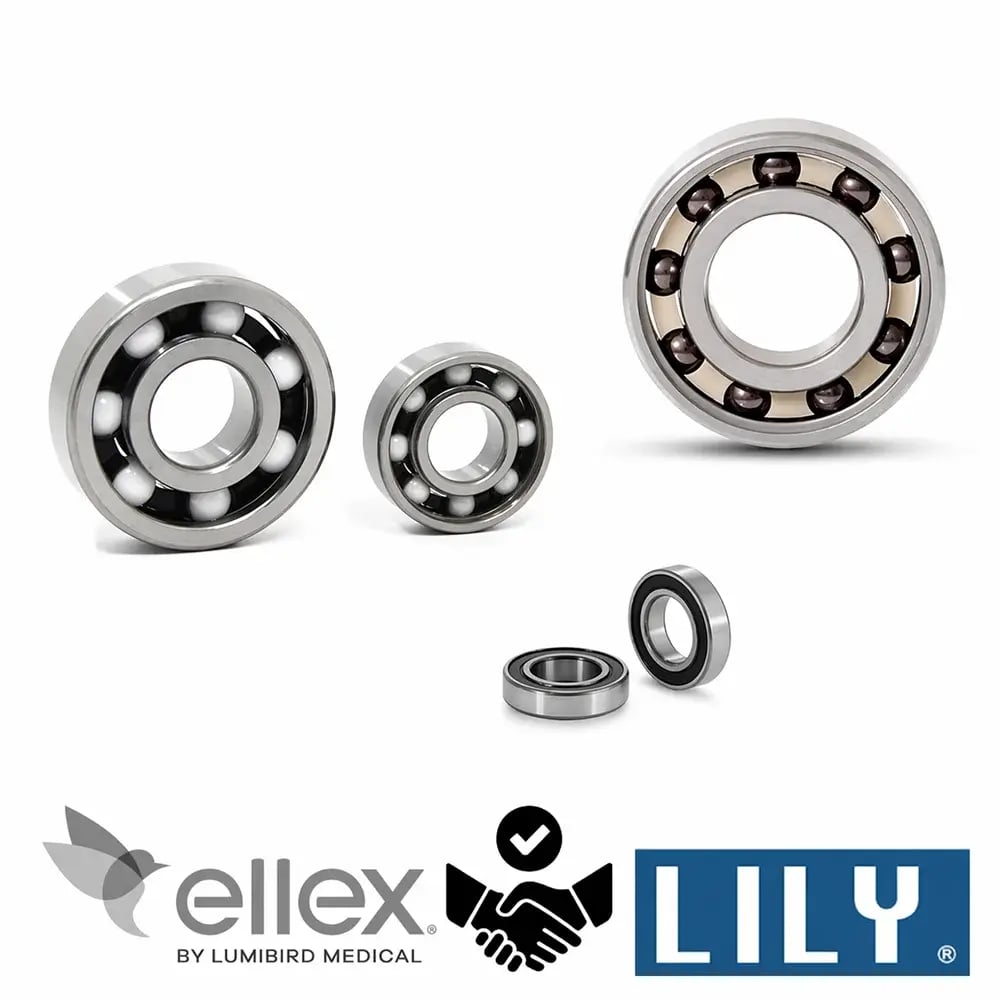
Ellex — Medical / Vacuum Equipment

In a vacuum environment, you can't replenish grease. Standard lubricants either outgas or fail at speed. Ellex needed high-speed miniature bearings that could run indefinitely without lubrication intervention.

The answer was hybrid ceramicceramic balls are self-lubricating by nature and generate significantly less friction at high speeds than steel. LILY Bearing developed a non-standard configuration with oil-free dry lubrication specifically for Ellex's vacuum application.

"Ellex is happy to be working with Lily Bearings for the past few years, and have always found the custom bearings supplied to be of the highest quality and excellent value." Full case study →

LILY Bearing custom ceramic bearings developed for Ellex medical vacuum equipment


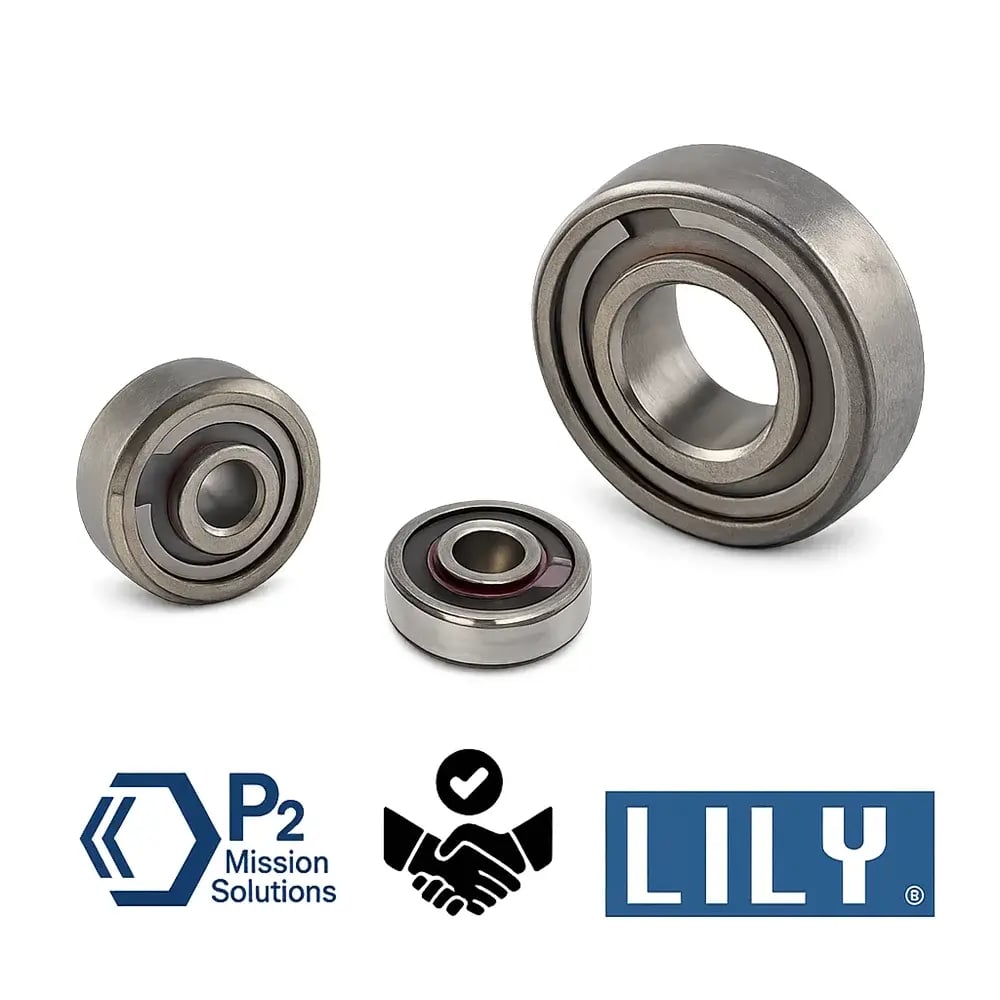
P2 Mission Solutions — Aerospace / Military Ground Support

1,170 units. That's how many KP4R16-2 bearings P2 Mission Solutions ordered after LILY Bearing replaced their existing RBC model with a solution built for the actual conditions: stainless inner and outer rings, full ball complement, PTFE retainer rated to 250°C, and aviation-specific grease.

The previous bearing couldn't handle the combination of corrosion, high temperature, and load. The replacement could — and the maintenance costs and downtime that came with the old solution dropped significantly.

"We received the bearings and they met all quality requirements." — President, Production Products Mfg & Sales Co., Inc. Full case study →

LILY Bearing custom airframe control ball bearings in stainless steel with PTFE retainer, supplied to P2 Mission Solutions for aerospace ground support equipment


Decathlon — Consumer Products / Sports Equipment

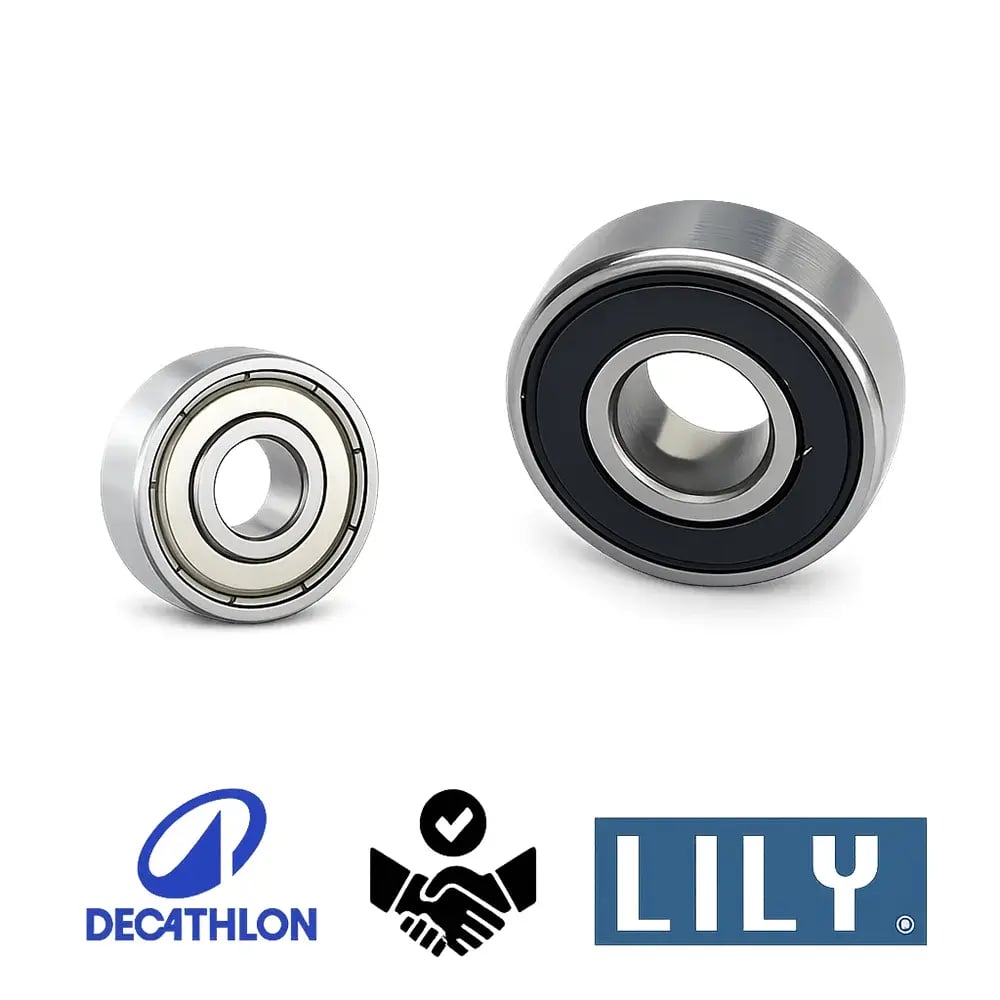
Six months to one month. That's the lead time improvement Decathlon achieved by switching to LILY Bearing for their 608ZZ scooter bearings — alongside a 20% reduction in procurement cost.

The previous supplier couldn't keep pace with Decathlon's volume or delivery requirements. LILY Bearing restructured production to match both, with consistent batch-level quality control at scale.

"It's easy and a pleasure working with LILY Bearing. They always respond promptly and deliver qualified products on time. There are no concerns when dealing with LILY Bearing." Full case study →

LILY Bearing 608ZZ deep groove ball bearings supplied to Decathlon for scooter application, showing both shielded and sealed variants


Food & Agricultural Analytics Client — Optical Precision Instruments

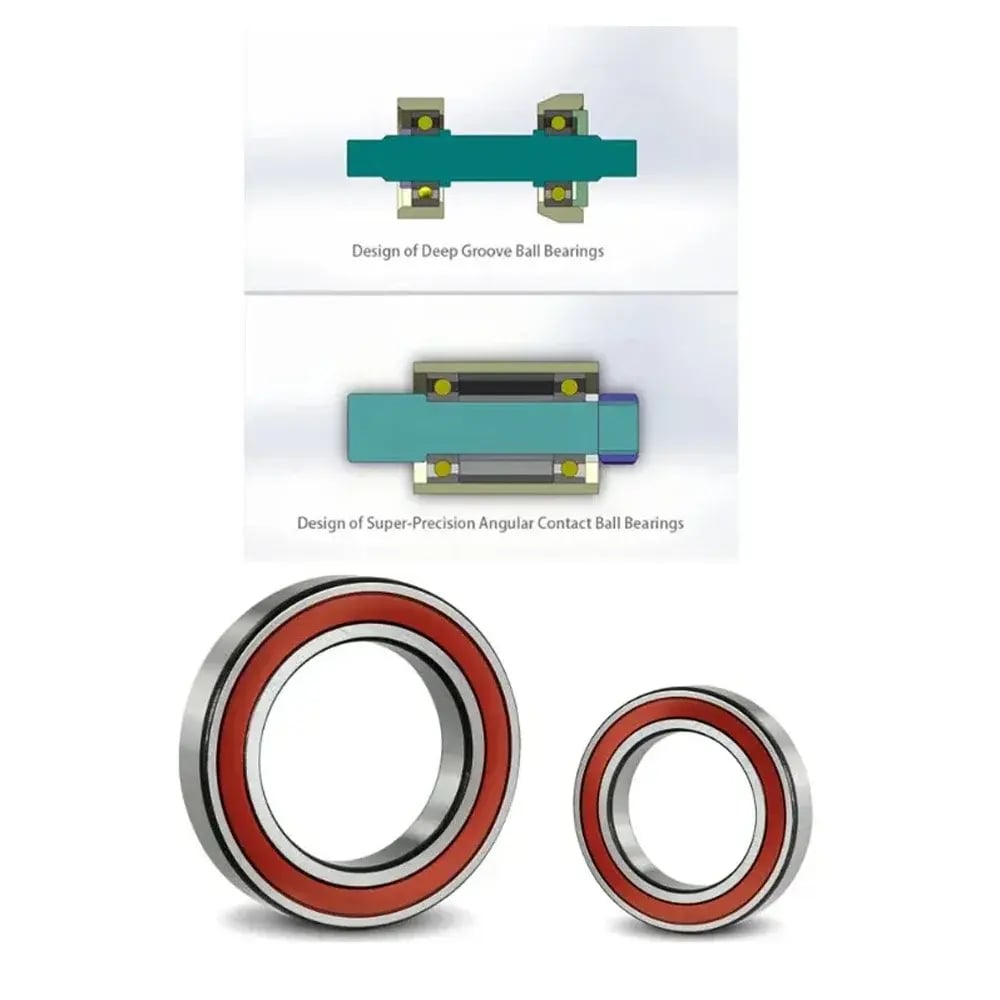
Comparison of deep groove ball bearing design vs super-precision angular contact ball bearing design, showing the difference in contact angle and load capacity for optical instrument applications

The constraint was fixed: the shaft couldn't be redesigned. But the deep groove ball bearings it had been built for couldn't deliver the precision the optical grade mirrors required.

LILY Bearing engineered super-precision angular contact ball bearings to fit the existing shaft geometry exactly — no surrounding design changes, higher precision achieved. Full case study →


7. LILY Bearing's custom OEM capabilities

LILY Bearing has supplied custom precision bearings to OEMs across 35 countries for over 20 years.

Every custom inquiry is handled by an application engineer — not a sales rep. The first response includes a technical feasibility assessment, not just a price.

Capability LILY Bearing specification
Size range 1.5mm ID to 4,000mm OD
Precision grades ABEC-5 to ABEC-7 standard; higher grades on request
Product types Deep groove ball, angular contact, cylindrical roller, tapered roller, thrust, thin-section, miniature, stainless, ceramic hybrid
Materials Chrome steel (52100), 440C stainless, ceramic (Si₃N₄ balls), PTFE-coated
Lubrication Standard, high-temp, low-temp, NSF H1 food-grade, dry/vacuum-compatible
Certifications ISO 9001:2015, IATF 16949, AS9100 Rev D
OEM documentation MTC, dimensional inspection report, PPAP (on request), FAI
Prototype lead time 4–8 weeks for first articles (application-dependent)
Annual output capacity 50 million units


Discuss Your Custom Bearing Project


Checklist: qualifying a custom bearing supplier for your OEM project

  • Application specification prepared: dimensions, loads, speed, temperature, L10 life target, environment, compliance
  • Supplier's in-house engineering capability confirmed — not outsourced
  • Size range and tolerance capability verified against your requirements
  • Relevant certifications confirmed (ISO 9001 minimum; AS9100 / IATF 16949 if applicable)
  • Material and lubrication options reviewed for your operating conditions
  • Prototype process, timeline, and NRE cost agreed in writing
  • Tooling ownership clarified — customer-owned or supplier-owned, in writing
  • First article inspection (FAI) scope and acceptance criteria agreed
  • Lot traceability and documentation requirements confirmed
  • Production lead time, MOQ, and supply terms agreed before design freeze


FAQ: custom bearings for OEM projects


What's the minimum order quantity for a custom bearing?

It varies by bearing size and complexity.

For small precision bearings (under 50mm OD), most suppliers work with prototype quantities of 10–50 pieces for first articles, with production MOQs typically from 500–2,000 pieces.

Negotiate prototype and production MOQs separately — they're different conversations, and a supplier who won't separate them is likely trying to avoid committing to low-volume prototype support.


How much does a custom bearing cost compared to a standard one?

Expect a 30–200% unit price premium over an equivalent-size standard bearing, depending on the degree of customization, tolerance grade, and volume.

Non-recurring engineering (NRE) and tooling costs add to the upfront investment.

The total cost of ownership picture is more nuanced — custom bearings often eliminate the need for adaptation hardware, reduce assembly labor, and extend service life in demanding applications.

Run the full calculation before deciding a standard bearing is cheaper.


Can I get a custom bearing with my own brand marking?

Yes — including shield engraving, custom packaging, and branded documentation.

Confirm the specifics with the application engineer at the time of quoting: minimum quantities for engraving, lead time implications, and documentation requirements vary by design.


What happens if my design needs to change after production starts?

Changes after production qualification trigger an Engineering Change Order (ECO) process.

Depending on the scope of change, a partial or full re-qualification — including new FAI — may be required.

This is why design freeze discipline matters: changes made before production tooling is committed cost weeks.

The same changes made after can cost months.


How do I protect my custom bearing design intellectually?

Get an NDA signed before sharing drawings or specifications — not after.

Make sure the contract explicitly states that all designs, drawings, and tooling developed to your specification are your intellectual property.

Any supplier who pushes back on a standard NDA is telling you something important about how they handle customer data.


Next steps: Request a custom bearing quote · Browse custom bearing capabilities · View all case studies


Tesla and its Gigafactory run with Lily Bearing

Tesla and its Gigafactory run with Lily Bearing

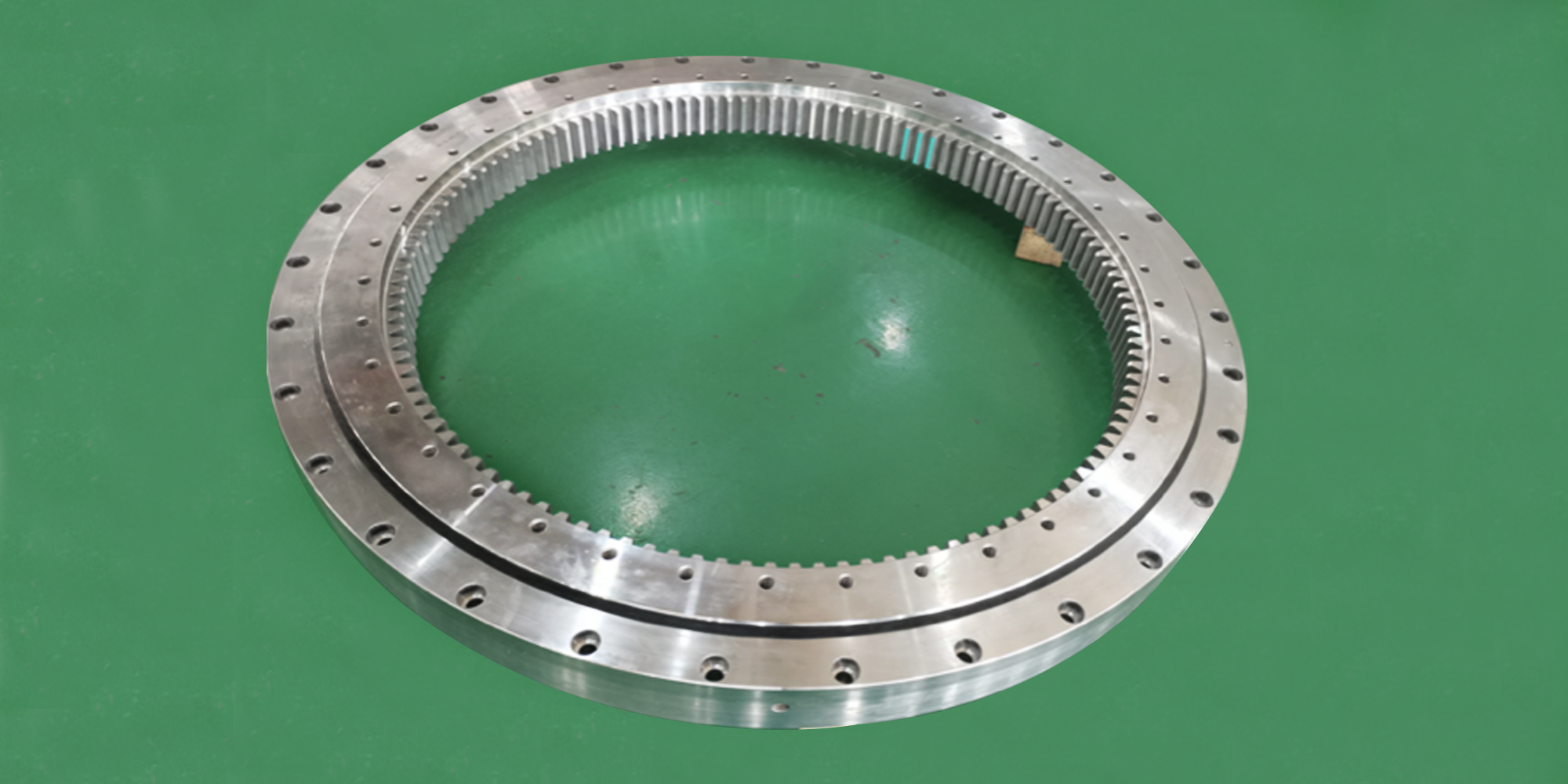
LILY has supplied assistance in Tesla’s create new products at the Gigafactory, a special custom slewing bearing made by Lily Bearing will soon start...
Read More
Bearing Suppliers Near Me: Find Reliable Bearing Manufacturers

Bearing Suppliers Near Me: Find Reliable Bearing Manufacturers

"Choosing the right bearing supplier isn't just about price — it's about finding a partner who can deliver consistent quality, technical support, and...

Read More
Characteristics, Uses and Advantages of Stainless Steel Bearings

Characteristics, Uses and Advantages of Stainless Steel Bearings

Compared with ordinary bearings, stainless steel bearings have stronger rust and corrosion resistance. They not only have obvious advantages in...

Read More