



Home/
Blog/
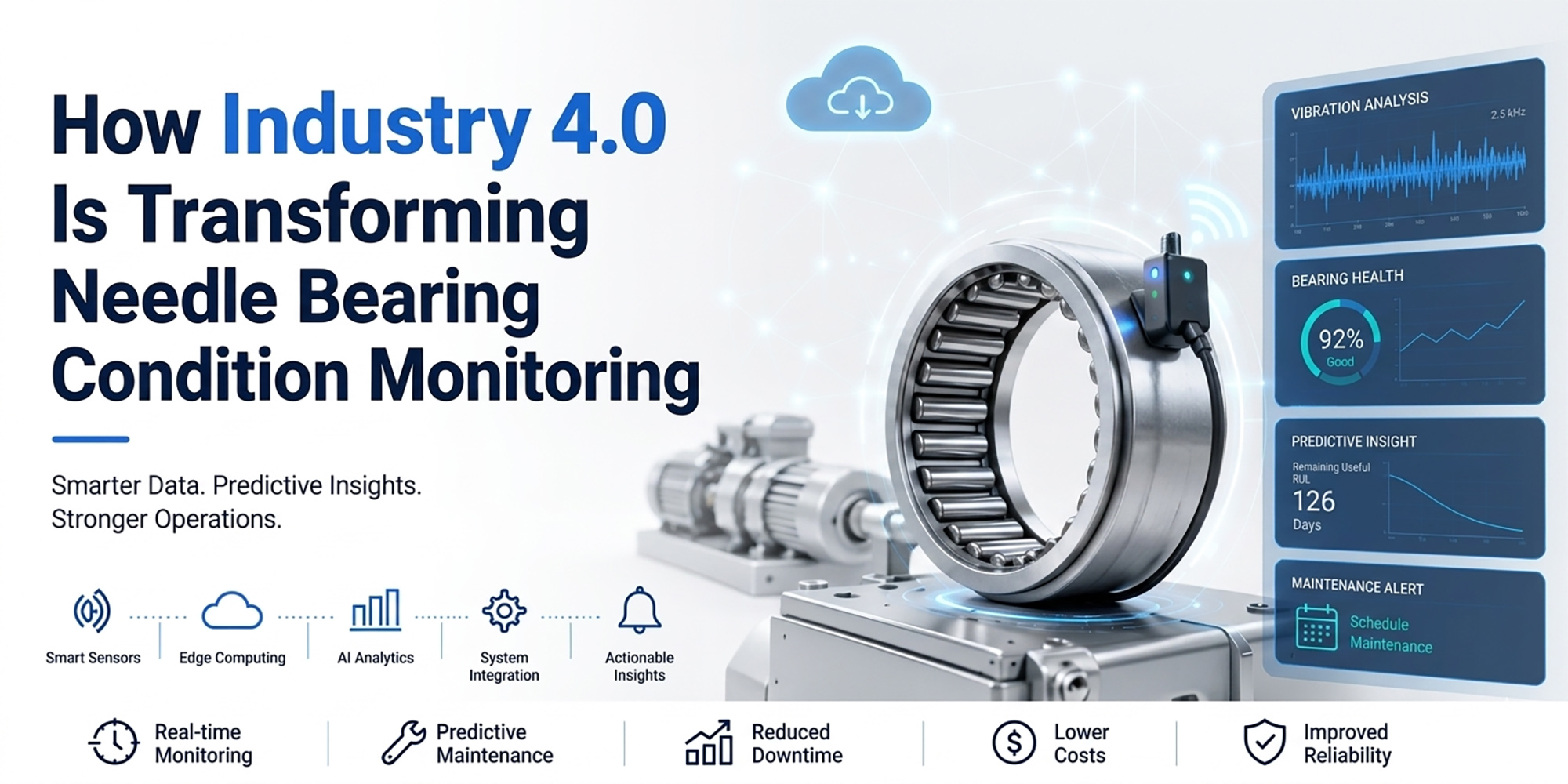
How Industry 4.0 Is Transforming Needle Bearing Condition Monitoring

6 min read

How Industry 4.0 Is Transforming Needle Bearing Condition Monitoring

How Industry 4.0 Is Transforming Needle Bearing Condition Monitoring
12:24


The Hidden Cost of Needle Bearing Failures

A single unplanned bearing failure in a large manufacturing facility can cost anywhere from $50,000 to over $500,000 in lost production, emergency labor, and secondary damage. Yet for decades, monitoring the health of a needle bearing — one of the most compact and highly loaded bearing types in engineering — was largely guesswork.

Maintenance teams would listen for unusual noises, measure temperature with an infrared gun, or simply rely on scheduled replacement intervals. This approach worked in simpler times. But in today's high-speed, high-precision production environments, it's simply not good enough.

42%

of unplanned downtime caused by bearing failure

cost difference: reactive vs. predictive maintenance

$300B

annual global cost of industrial downtime

70%

of bearing failures are preventable with early detection


Industry 4.0 — the fourth industrial revolution — is changing this entirely. By integrating IoT sensors, artificial intelligence, machine learning, and cloud computing directly into the condition monitoring process, manufacturers can now detect the earliest whispers of needle bearing degradation, often weeks or months before catastrophic failure.


Why Needle Bearings Demand Special Attention

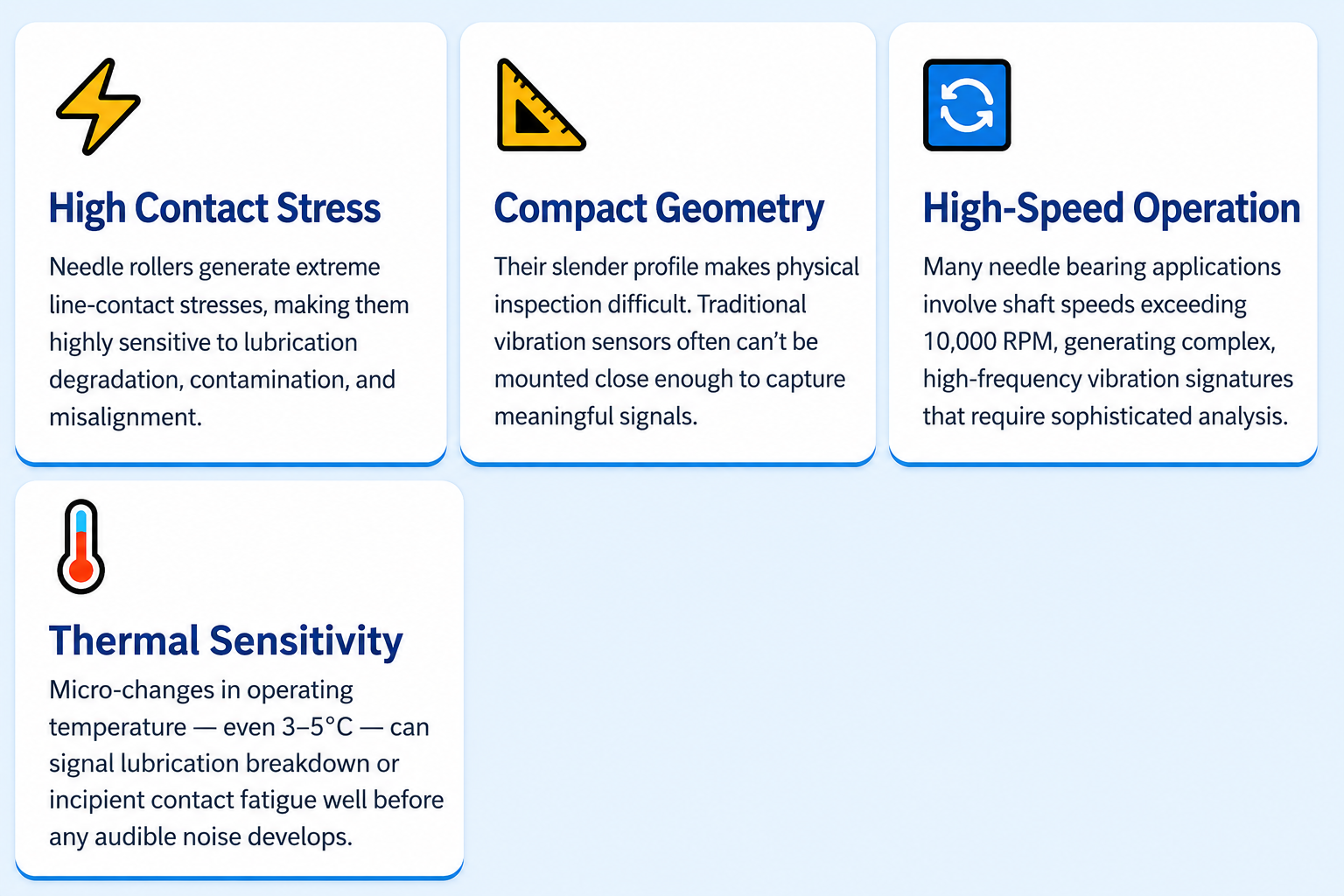
Needle bearings are a unique member of the rolling element bearing family. Their cylindrical rollers have a high length-to-diameter ratio — typically 3:1 or greater — giving them an exceptional load capacity relative to their radial footprint. This makes them indispensable in applications where space is at a premium: automotive transmissions, connecting rod assemblies, hydraulic pumps, robotics joints, and aerospace actuators.

ChatGPT Image May 19, 2026, 11_05_43 AM

These characteristics mean needle bearings fail differently than ball bearings or cylindrical roller bearings. Their failure signatures are more subtle, more complex, and more difficult to interpret without advanced analytical tools. This is precisely where Industry 4.0 technologies deliver their greatest value.


Traditional Condition Monitoring: Understanding Its Limits

To appreciate the transformation Industry 4.0 brings, it's worth understanding where conventional condition monitoring falls short.

Monitoring Approach

Method

Limitation

Era

Time-Based Replacement

Replace at fixed intervals regardless of condition

Wastes serviceable bearings; misses rapid degradation

Legacy

Manual Vibration Analysis

Route-based handheld data collection

Infrequent snapshots; high skill dependency

Legacy

Infrared Thermography

Periodic thermal scanning

Only detects advanced problems; not continuous

Legacy

Oil Analysis

Periodic oil/grease sampling

Lags behind real-time condition; labor-intensive

Legacy

Continuous IoT Monitoring

Embedded smart sensors + cloud analytics

Initial setup cost; requires data infrastructure

Industry 4.0

AI-Powered Prediction

Machine learning on multivariate data streams

Requires training data; model maintenance needed

Industry 4.0


 The fundamental flaw of traditional monitoring is that it captures the state of a bearing, not its trajectory. Industry 4.0 flips this: continuous data streams reveal the rate of change, enabling intervention before the failure curve steepens.


Industry 4.0: The Architectural Shift in Condition Monitoring

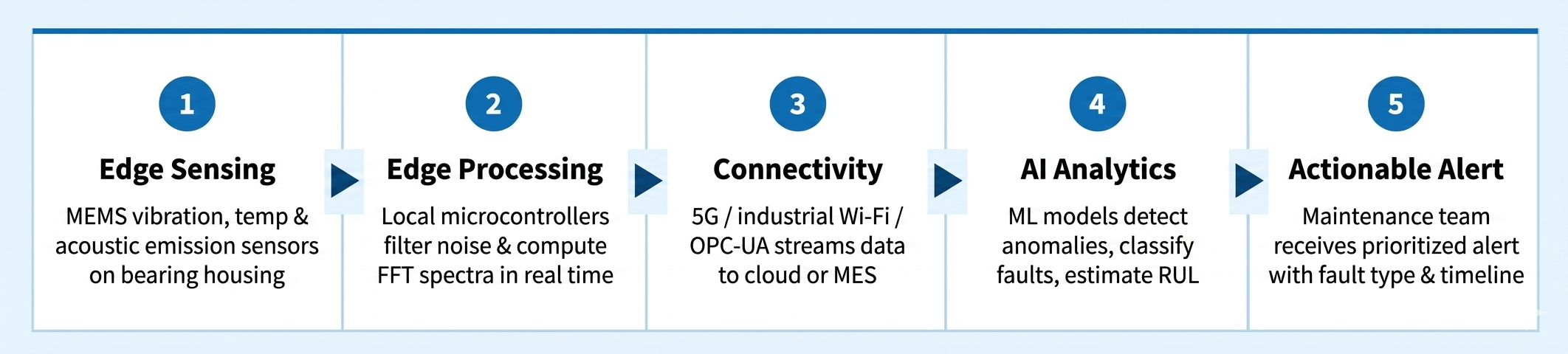
Industry 4.0 is not a single technology. It's an interconnected ecosystem of physical and digital systems that transform how machines communicate, learn, and act. For needle bearing condition monitoring, this means a radical change in monitoring architecture.

Gemini_Generated_Image_erjcsuerjcsuerjc

This five-layer architecture creates a continuous digital feedback loop. Unlike legacy systems where a technician might check a bearing once a month, an Industry 4.0-enabled system may sample vibration data 10,000 times per second and update health indices every few minutes.

Gemini_Generated_Image_7xul6y7xul6y7xul


Key Technologies Driving the Transformation


IoT Sensors: The Digital Nervous System

Modern MEMS (Micro-Electro-Mechanical Systems) accelerometers can be embedded directly into bearing housings or even into the bearing cage itself. These thumb-sized sensors continuously capture vibration in multiple axes, allowing analysts to isolate bearing defect frequencies (BPFI, BPFO, BSF, FTF) with pinpoint accuracy even in complex assemblies like automotive transmissions.

Acoustic emission (AE) sensors go even further, detecting ultra-high-frequency stress waves (100 kHz–1 MHz) that propagate through the material the instant a micro-crack initiates on a needle roller or raceway. This provides detection capability 5–10 times earlier than conventional vibration analysis.


Machine Learning & AI: Turning Data Into Decisions

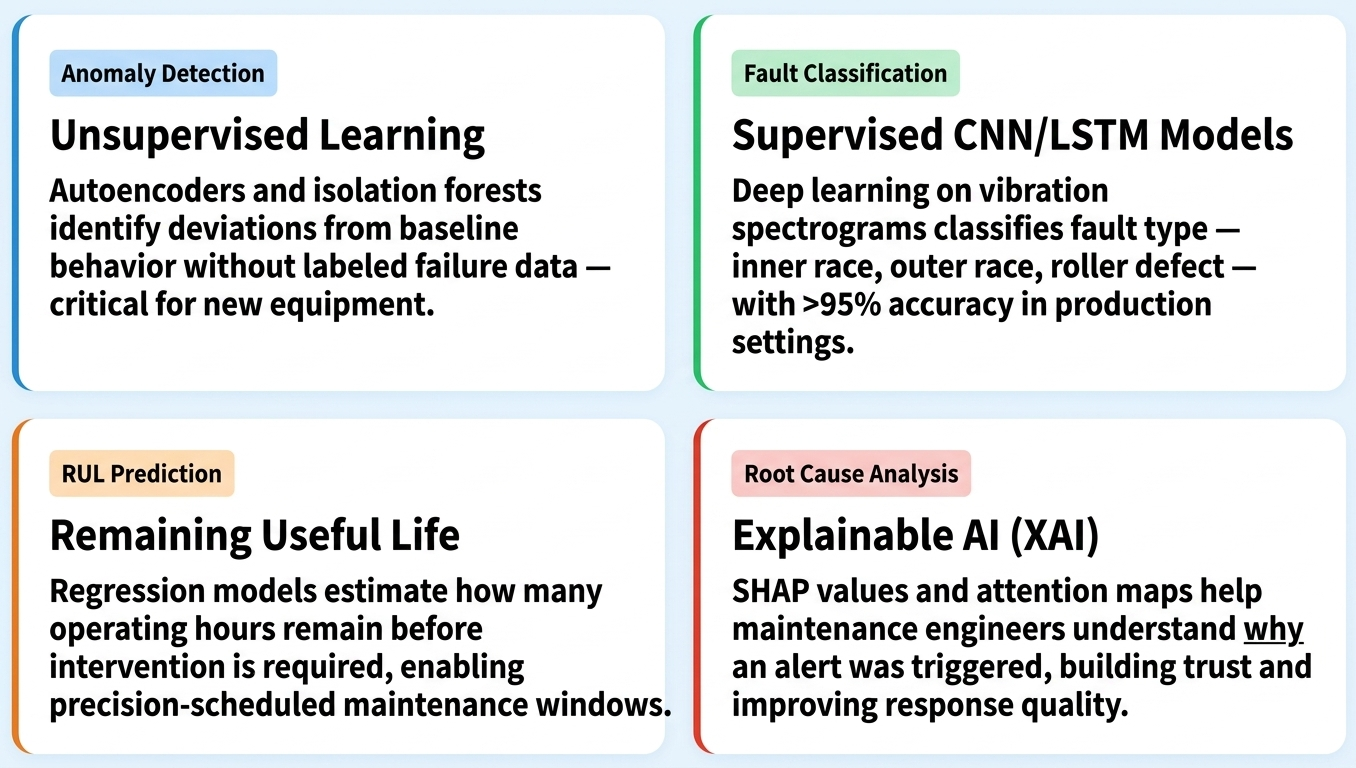
The raw data from IoT sensors is only as valuable as the intelligence applied to it. This is where machine learning transforms condition monitoring from a reporting function into a predictive decision engine.

Gemini_Generated_Image_pey7unpey7unpey7


Cloud-Based Condition Monitoring Platforms

Platforms such as SKF Enlight, Schaeffler OPTIME, NSK Condition Monitoring Pro, and third-party industrial IoT platforms like PTC ThingWorx and Siemens MindSphere have made enterprise-grade needle bearing monitoring accessible to small and mid-sized manufacturers. These platforms aggregate data from hundreds of bearing measurement points, apply AI analytics, and deliver actionable insights through browser-based dashboards accessible from any device.


5G and Industrial Wireless: Eliminating the Cable Constraint

One of the historical barriers to continuous bearing monitoring was cabling — running data cables from sensors on rotating machinery is costly and impractical. The rollout of 5G private networks in industrial environments (Industry 4.0 factories) and low-power protocols like Bluetooth 5.0 and Wireless HART now enable truly wireless bearing monitoring at scale, with latency under 10 milliseconds — fast enough for real-time control.


Digital Twins: The Virtual Mirror of Your Bearings

 Perhaps the most profound application of Industry 4.0 in bearing condition monitoring is the emergence of digital twins — physics-based virtual replicas of physical bearing systems that are continuously synchronized with real-world sensor data.

A needle bearing digital twin integrates:

  • Finite element analysis (FEA) models of roller-raceway contact stress under actual operating loads
  • Tribological models of lubricant film thickness and degradation rate
  • Real-time sensor feeds (vibration, temperature, speed, load)
  • Historical failure data from comparable applications in the fleet
  • Environmental context (ambient temperature, contamination exposure)

The result is a dynamic, continuously-updated health model that goes far beyond what sensors alone can provide. The digital twin can simulate "what-if" scenarios — what happens if lubrication interval is extended by 500 hours? What is the bearing life impact of operating 15% above rated load? — giving reliability engineers unprecedented visibility into risk tradeoffs.

Companies deploying digital twin-based bearing monitoring have reported up to 40% reduction in maintenance costs and 25% improvement in bearing service life through optimized operating parameters informed by twin simulations.


The Business Case: ROI of Industry 4.0 Bearing Monitoring

The technology is compelling, but for plant managers and CFOs, the question is always the same: what's the return on investment? The data from early adopters is increasingly clear.

Benefit Category

Metric

Typical Improvement

Unplanned Downtime

Hours of unscheduled stops per year

↓ 50–75%

Maintenance Labor

Man-hours on reactive repairs

↓ 30–45%

Bearing Replacement Cost

Annual bearing consumption

↓ 20–35%

Secondary Damage

Shaft, housing, gear collateral damage events

↓ 60–80%

Energy Efficiency

Drive system power consumption

↓ 5–12%

OEE

Availability × Performance × Quality

↑ 8–15%

Payback Period

Months to recover monitoring investment

12–24 months typical


A major automotive component manufacturer that deployed wireless IoT monitoring across 1,200 needle bearing positions in its transmission assembly line reported elimination of six major production line stoppages in the first year — representing approximately $2.4 million in saved production value against a system investment of under $400,000.


Implementation Roadmap: Where to Start

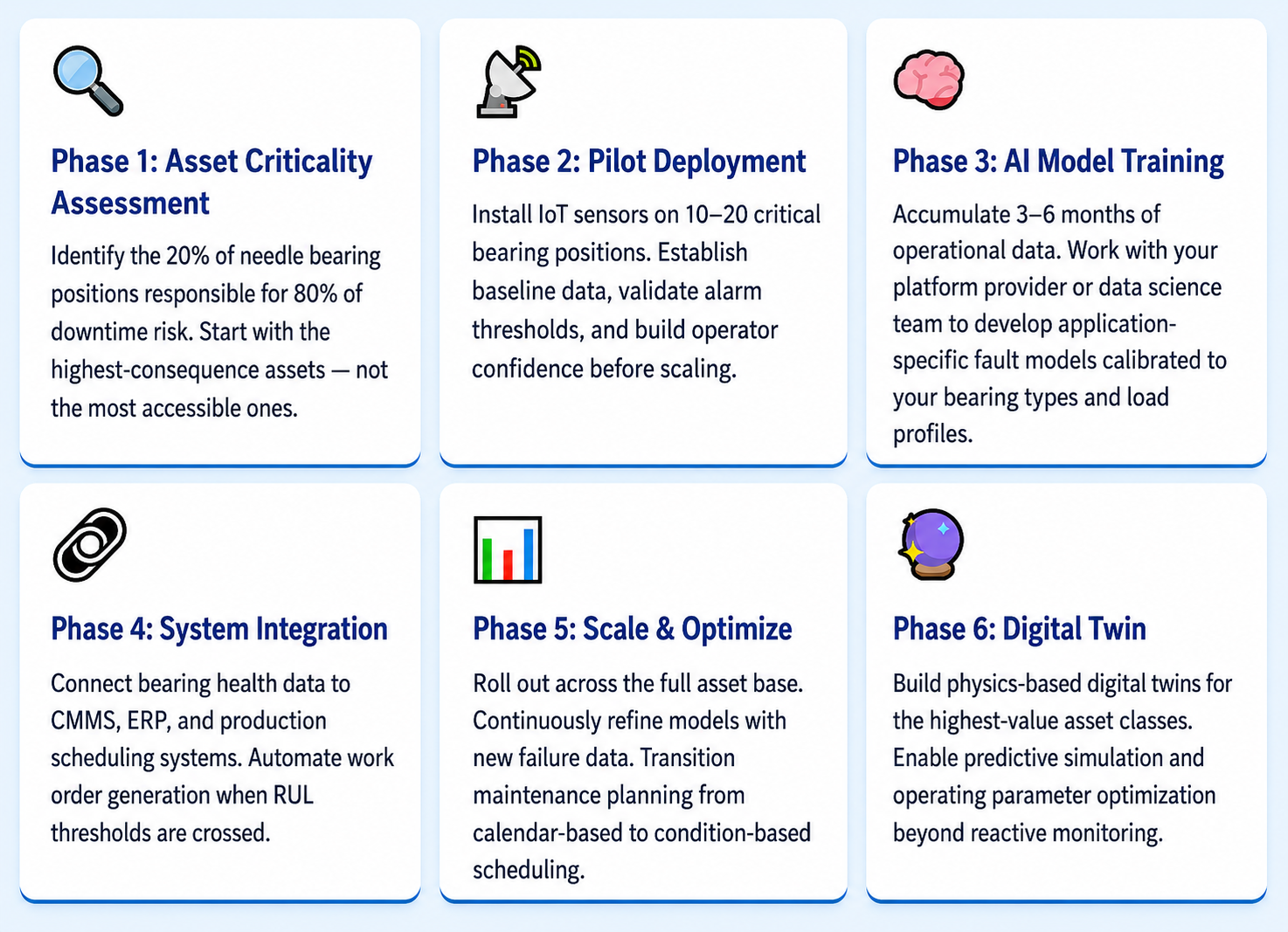
For manufacturers considering the transition to Industry 4.0-enabled needle bearing monitoring, a phased approach reduces risk and accelerates time to value.

ChatGPT Image May 19, 2026, 02_02_18 PM


Key success factor: Technology is the enabler — but the real transformation happens through people. Invest equally in sensor hardware and in training your maintenance team to interpret and act on the insights these systems deliver.


The Future Outlook: What's Coming Next

Industry 4.0 in bearing condition monitoring is still in its early innings. The technologies being developed and deployed today will look primitive compared to what is on the horizon over the next five years.


Embedded Intelligence in Bearings

Leading bearing manufacturers are already prototyping "smart bearings" — assemblies with micro-sensors, energy harvesters, and wireless transmitters embedded directly in the bearing ring or cage during manufacturing. By 2028, it is expected that a significant share of premium needle bearing shipments will include factory-integrated sensing capability, eliminating the retrofit challenge entirely.


Generative AI for Fault Diagnosis

The next generation of bearing AI platforms will leverage large language models (LLMs) trained on global bearing failure databases, maintenance records, and engineering literature. A maintenance engineer will describe a symptom in plain language and receive an instant, evidence-backed diagnostic report — combining vibration FFT analysis, historical fleet data, and manufacturer knowledge base content in a single coherent answer.


Autonomous Maintenance Robots

When condition monitoring identifies a bearing approaching its intervention threshold, the work order of the future may be dispatched not to a human technician, but to an autonomous mobile robot (AMR) equipped with bearing replacement and re-lubrication tools. Pilot programs are already underway in automotive and chemical processing plants.


Federated Learning for Cross-Fleet Intelligence

Privacy-preserving federated learning will enable bearing manufacturers and end-users to pool failure pattern knowledge across global fleets without sharing proprietary operational data. This collective intelligence will dramatically accelerate AI model accuracy, particularly for rare failure modes that individual facilities would never accumulate enough data to learn from alone.


Conclusion: The Competitive Imperative

 The question for manufacturers in 2026 is no longer whether Industry 4.0 condition monitoring is technically feasible or economically justified. Both have been comprehensively demonstrated. The question is how quickly organizations can make the transition — because in increasingly competitive global markets, the gap between early adopters and laggards in predictive maintenance capability translates directly into production uptime, product quality, and cost per unit.

Needle bearings, precisely because of their demanding operating conditions and critical applications, represent one of the highest-return entry points for Industry 4.0 condition monitoring investment. Their compact size, high speed, and sensitivity to lubrication and alignment make them ideal candidates for AI-powered surveillance — and the technology is now mature, affordable, and proven at scale.

The bearings in your machines have always been trying to tell you something. Industry 4.0 gives you the ability to finally listen.

Si3N4 Ceramic Bearings & Electric Vehicle Industry

Si3N4 Ceramic Bearings & Electric Vehicle Industry

For the sake of environmental protection, the electric vehicle industry has been growing rapidly in recent years. The electric vehicles in China...
Read More
What is a Thrust Bearing?

What is a Thrust Bearing?

Thrust bearings play a pivotal role in the industrial sector, managing axial loads while ensuring efficient, smooth operation across diverse...

Read More
A Brief History of Ceramic Bearings: From Lab Curiosity to Industry Standard

A Brief History of Ceramic Bearings: From Lab Curiosity to Industry Standard

Introduction: Why Ceramic Bearings Matter Few components in modern machinery are as quietly essential — or as technically fascinating — as the...

Read More