

Home/
Blog/
Drawn Cup vs. Machined Needle Roller Bearings: Choosing the Right Type

7 min read

Drawn Cup vs. Machined Needle Roller Bearings: Choosing the Right Type

Drawn Cup vs. Machined Needle Roller Bearings: Choosing the Right Type
14:09

The choice between a drawn cup needle roller bearing and a machined-ring design rarely gets the attention it deserves.

Engineers often default to whichever type they have used before, and procurement teams order whatever the catalog lists first.

In practice, selecting the wrong type for your application does not always cause immediate failure — but it consistently produces suboptimal outcomes: premature wear, over-engineered housings, unnecessary cost, or performance ceilings that limit the machine's potential.

This guide explains how drawn cup and machined needle roller bearings are built, where each type genuinely excels, and how to make a confident selection for your specific operating conditions.


What Distinguishes the Two Designs


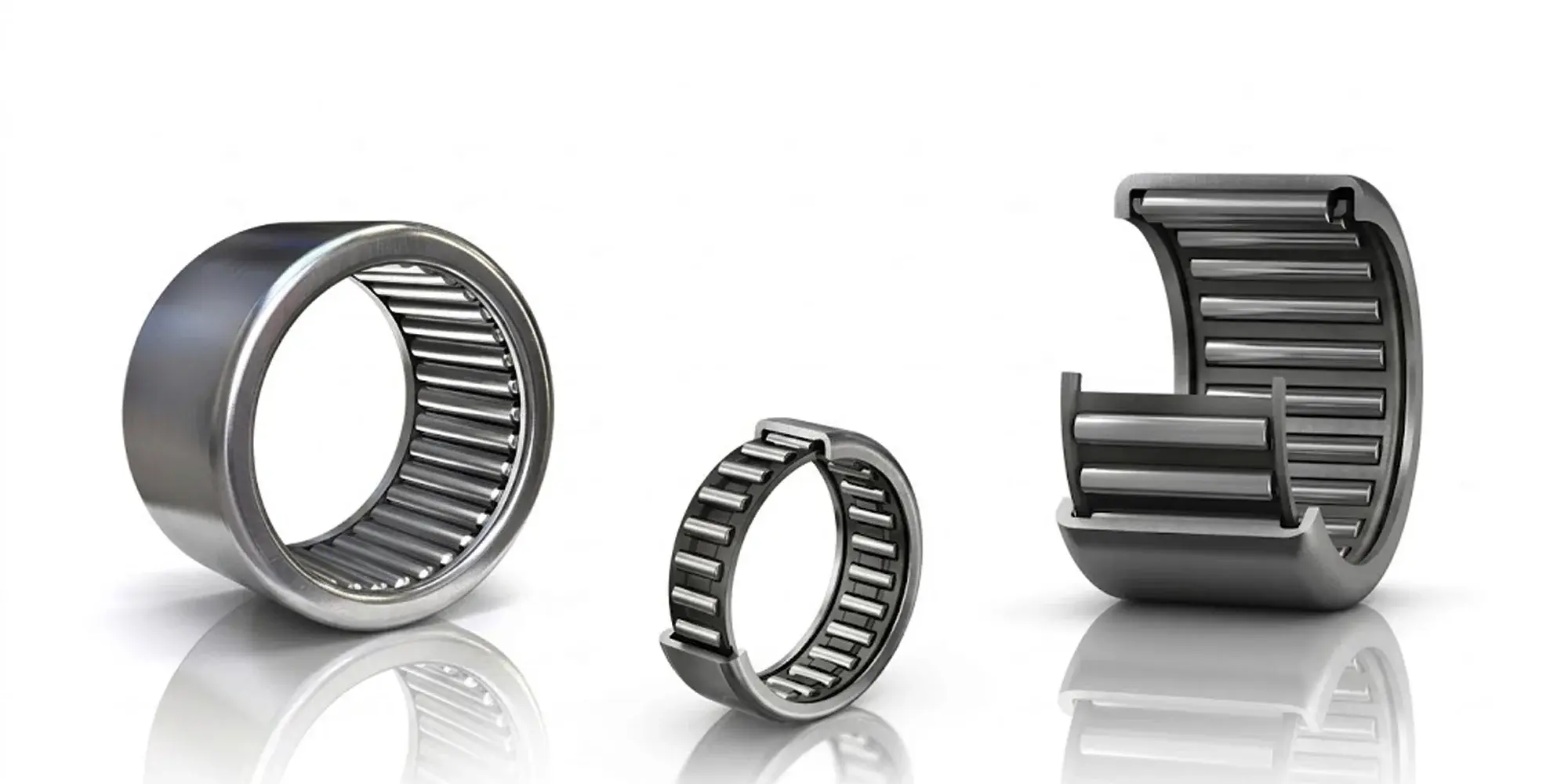
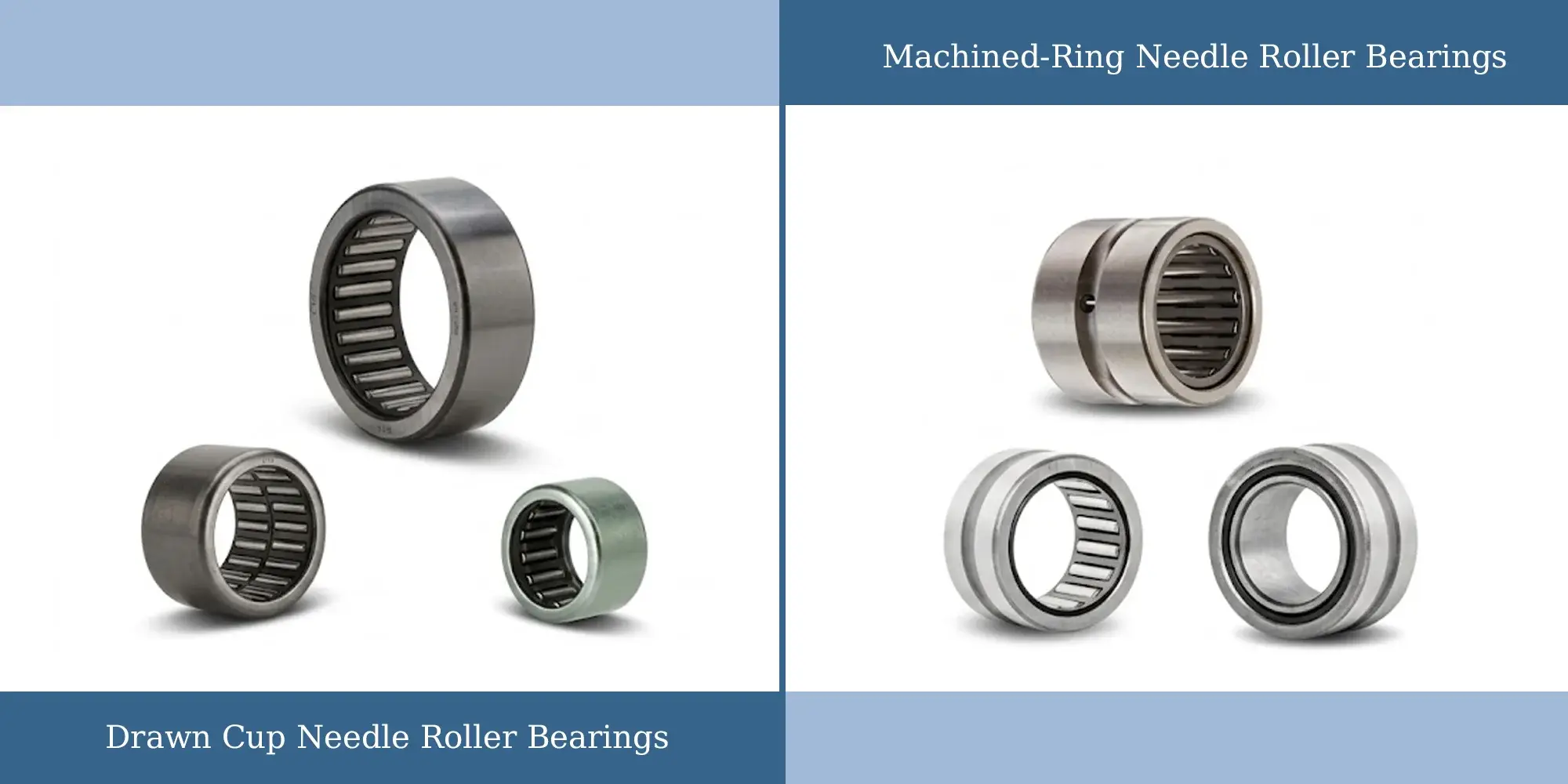
Drawn Cup Needle Roller Bearings

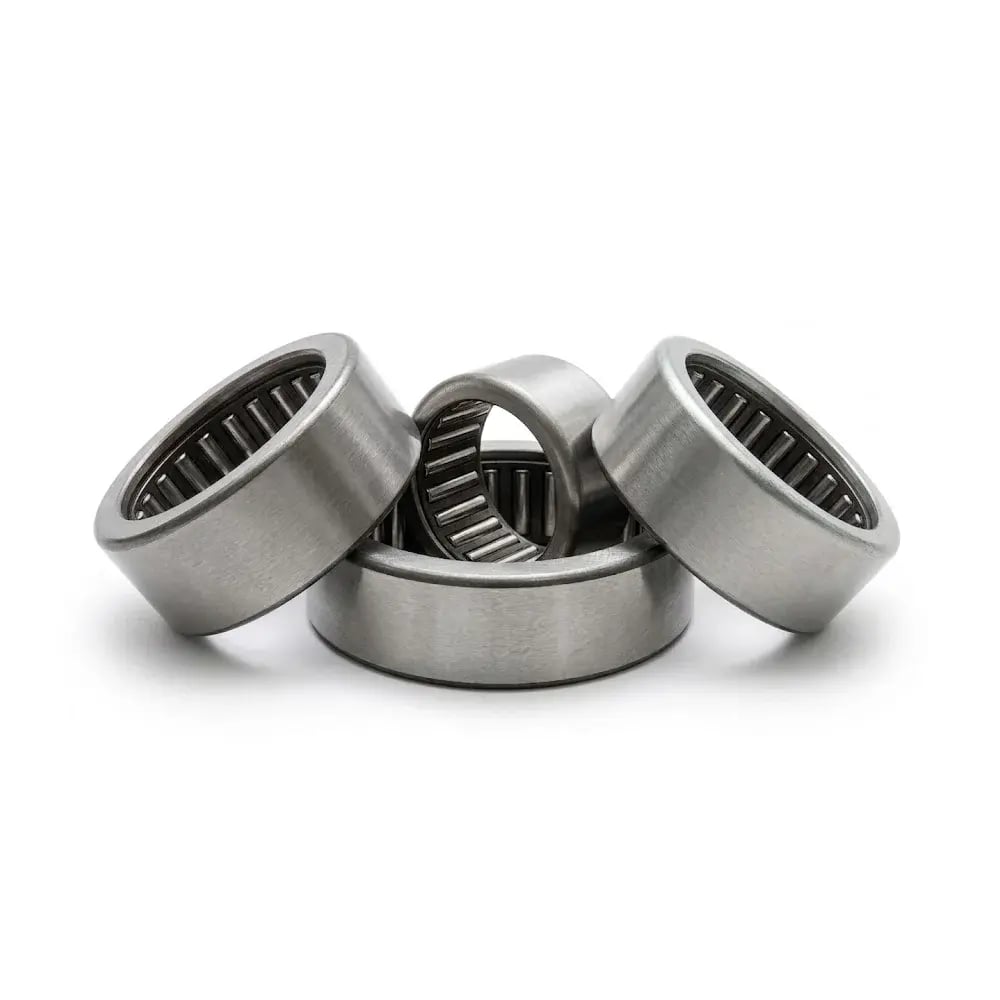
Drawn cup needle roller bearings are formed by deep-drawing a thin strip of low-carbon steel — typically AISI 1010 or 1012 — into a cup shape, then case-hardening the outer ring to achieve a surface hardness of HRC 60–65.

No subsequent machining of the raceway is performed.

The outer ring's final dimensional accuracy is achieved through the drawing process itself, and its roundness is completed only after press-fitting into the housing bore.

This is a critical point: the housing bore becomes part of the bearing system.

A drawn cup bearing installed in a soft, thin-walled, or out-of-round housing will not perform to its rated specification.

Drawn Cup Needle Roller Bearings

Machined-Ring Needle Roller Bearings

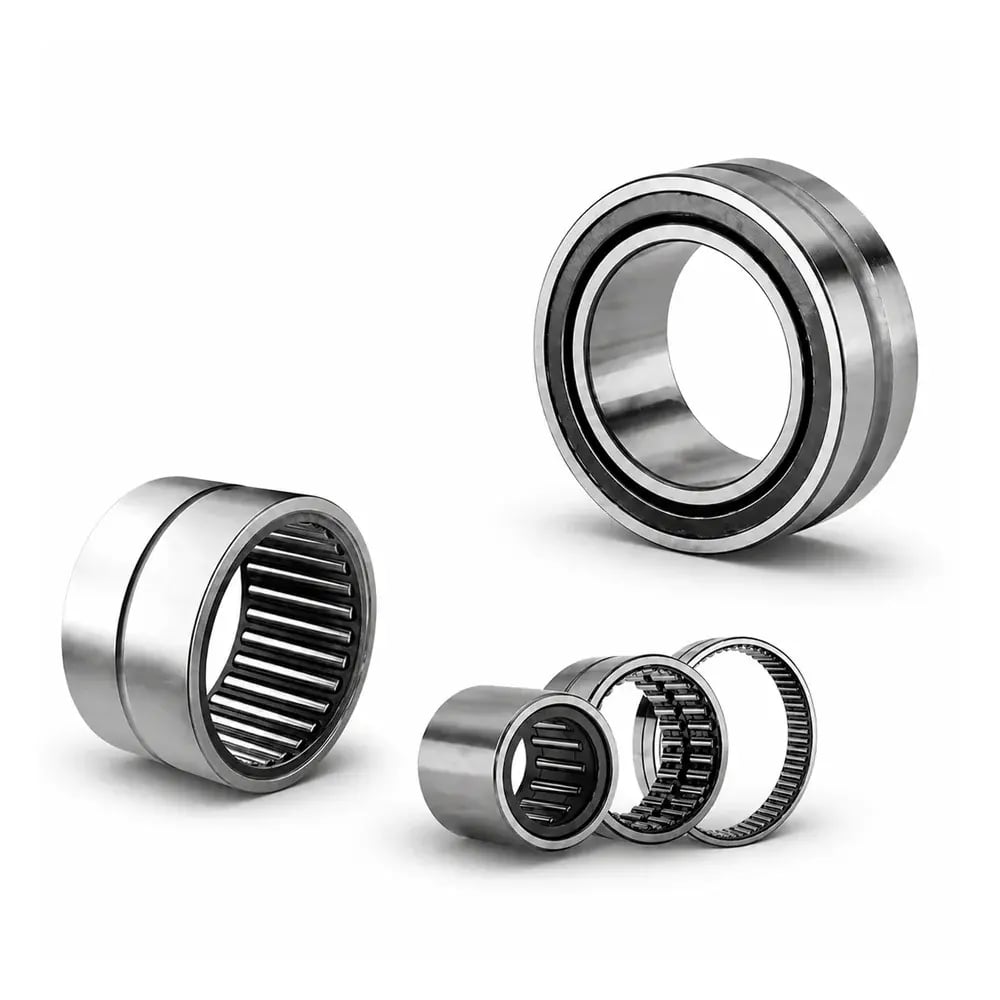
Machined-ring needle roller bearings — also called heavy-duty needle roller bearings or solid-ring designs — are manufactured from steel bar stock using precision turning and grinding operations.

The result is a thick-walled outer ring with dimensional accuracy per ISO 492, significantly tighter tolerances, and structural rigidity that is independent of the housing.

The raceway is ground to final geometry before installation.

Machined-Ring Needle Roller Bearings

These bearings can be fitted into housings that would be entirely unsuitable for drawn cup designs.

The manufacturing difference produces two fundamentally different structural profiles:

Side-by-side cutaway diagrams showing the structural difference between a thin-walled drawn cup bearing and a thick-walled machined-ring bearing. Drawn cup needle roller bearing Housing bore Hardened shaft (inner raceway) ~1.5 mm wall Drawn cup type Machined-ring needle roller bearing Hardened shaft (inner raceway) ~8 mm wall Machined-ring type Wall thickness: ~1–2 mm (drawn cup) vs ~5–12 mm (machined ring) · Standard: DIN 618 vs ISO 492

Cutaway cross-section showing the structural difference between drawn cup (thin-walled, housing-dependent) and machined-ring (thick-walled, self-contained) needle roller bearings.

  Drawn Cup Machined Ring
Outer ring wall thickness 0.5–2.5 mm (typical) 3–10 mm (typical)
Dimensional standard DIN 618 ISO 492
Raceway accuracy Housing-dependent Self-contained
Radial section height Minimum possible Moderate to large
Unit cost Low–moderate Moderate–high


Where Drawn Cup Bearings Perform Best

The drawn cup design was developed specifically for high-volume, space-constrained applications where minimizing radial envelope is the primary constraint.

It has dominated automotive and power tool applications for decades for good reason.


Space Efficiency

Space efficiency is the drawn cup's defining advantage.

Because the outer ring wall is formed from sheet steel rather than machined bar stock, the radial cross-section between shaft and housing OD is as small as physically achievable.

In applications like automotive transmission shafts, rocker arm pivots, or universal joint crosses, this difference translates directly into a lighter, more compact assembly — or into the ability to use a larger shaft diameter within the same housing bore.


High-Volume Cost Efficiency

High-volume cost efficiency is the second major advantage.

The deep-drawing process is highly suitable for mass production.

Tooling costs are significant upfront, but per-unit costs at volume are substantially lower than machined-ring equivalents of comparable size.

For OEMs producing millions of units annually, this difference is material.


Common Drawn Cup Series

Common drawn cup needle roller bearings include the HK series (metric, with cage), BK series (metric, closed end), SCE and BCE series (inch, with cage), and FC/FC closed-end inch series.

Lily Bearing's drawn cup catalog covers 1,878 inch-series designs and metric equivalents across this full range, with open-end, closed-end, and sealed configurations.


Ideal Operating Conditions

  • Rigid steel or cast iron housing with a properly toleranced bore
  • Moderate radial loads with limited shock or vibration
  • Continuous rotation at moderate-to-high speeds (caged designs particularly suited to high speed)
  • High-volume applications where unit cost is a primary constraint
  • Applications where the shaft can serve as the inner raceway (hardened and ground to appropriate tolerance)


Where Drawn Cup Is Not Appropriate

  • Thin-walled housings in aluminum, plastic, or composite materials — the outer ring will distort
  • Split housings — the drawn cup cannot maintain roundness without a continuous bore
  • Applications with sustained shock loads or severe impact
  • High misalignment conditions — the drawn cup has no self-aligning capability and is sensitive to shaft-to-housing misalignment


Where Machined-Ring Bearings Perform Best

The machined-ring design sacrifices the drawn cup's minimum radial envelope in exchange for structural integrity that does not depend on housing quality.

This makes it the correct choice for a different, and often more demanding, set of conditions.


Housing Independence

Housing independence is the machined ring's primary structural advantage.

Because the outer ring is thick-walled and ground to final geometry before installation, it maintains its dimensional accuracy regardless of whether the housing is rigid steel, soft aluminum, or even split.

The raceway geometry does not change on installation.

This is what makes machined-ring bearings the default choice in heavy industrial machinery, agricultural equipment, and construction applications where housing materials and tolerances are less controlled than in automotive environments.


Shock and Impact Resistance

Shock and impact resistance is the machined ring's second distinguishing capability.

Compared with case-hardened drawn-cup bearings, the through-hardened, one-piece, channel-shaped outer ring can handle much more shock and overload.

The substantial outer ring cross section permits mounting in a split housing.

In applications involving impact loads — a hydraulic hammer, an agricultural drive shaft, a press mechanism — the drawn cup's thin outer ring is at meaningful risk of deformation.

The machined ring is not.


Dimensional Precision

Dimensional precision for demanding applications is another area where machined rings lead.

Tolerances per ISO 492 are tighter than the DIN 618 standard applicable to drawn cup designs, and the ground raceway provides a more accurate running surface for applications requiring controlled clearance or preload.


Common Machined-Ring Series

Common heavy-duty machined needle roller bearings include the NK series (without inner ring), NA series (with inner ring), NKI and NAO series, and RNA series (without inner ring, metric).

For inch-dimensioned applications, the MR and MRE series cover the major size ranges.


Ideal Operating Conditions

  • Aluminum, plastic, thin-walled, or split housings
  • Sustained shock loads, impact loads, or high vibration
  • Heavy radial loads requiring maximum structural rigidity
  • Lower-volume applications where unit cost is secondary to reliability
  • Applications where tighter dimensional tolerances or controlled running clearance are required
  • Environments where the shaft cannot be hardened and a separate inner ring is needed


The Selection Decision: A Practical Framework

When specifying between drawn cup and machined-ring designs, the decision reduces to five questions:

1. What is the housing material and wall thickness?

Steel or rigid cast iron → drawn cup is feasible. Aluminum, plastic, thin-walled, or split → machined ring required.

2. What is the load character?

Steady radial loads → drawn cup. Shock loads, impact, or high vibration → machined ring.

3. What is the production volume?

High volume → drawn cup economics are compelling. Low-to-medium volume → machined ring's higher unit cost is usually justified.

4. Can the shaft serve as the inner raceway?

If the shaft is hardened and ground to h5 or h6, a drawn cup without inner ring simplifies the assembly. Otherwise, specify either design with a separate inner ring — better supported in the machined-ring catalog.

5. What are the speed requirements?

Caged drawn cup → handles high speeds well. Full-complement drawn cup → speed-limited by inter-roller friction. Machined-ring caged → correct choice when combining high load with moderate-to-high speed.


A Common Misapplication — and How It Fails

The most frequent misapplication is installing a drawn cup bearing in an aluminum housing.

The scenario: a machine designer selects a drawn cup bearing to minimize the housing OD in an aluminum gearbox cover. At room temperature, the press-fit interference is correctly specified. Under operating temperature, the aluminum housing expands at roughly twice the rate of the steel outer ring. The interference fit loosens. The outer ring begins to rotate in the bore — a condition called "creep" — which generates fretting corrosion, accelerates wear, and eventually causes the housing bore itself to enlarge. The bearing fails not because the bearing was defective, but because the application required a machined ring in the first place.

The fix is straightforward: specify a machined-ring bearing with an NK or NA series outer ring, which maintains its geometry regardless of differential thermal expansion.

The radial envelope increases, but the assembly remains functional under operating conditions.

Sequential diagram showing four stages: correct press-fit at room temperature, differential thermal expansion at operating temperature, interference fit loosening, and outer ring creep with fretting corrosion. 1 Al housing Room temp Press-fit correct 2 ▲ heat Operating temp Al expands 2× faster 3 gap gap Fit loosens Interference lost 4 Creep failure Ring rotates fretting corrosion bore enlarges Fix: specify a machined-ring bearing (NK or NA series) — self-contained geometry, unaffected by differential thermal expansion

Drawn cup bearing creep failure sequence in an aluminum housing. The fix is specifying a machined-ring bearing whose geometry is independent of housing material.


Specifying the Right Series: Quick Reference

For US engineers and procurement teams working with common series designations:

Drawn Cup — Metric
  • HK series: open end, with cage — general purpose, automotive, industrial
  • BK series: closed end, with cage — shaft end applications, excludes contamination
  • HK...LL: sealed variant for grease retention in demanding environments
Drawn Cup — Inch
  • SCE series: open end, with cage — standard US industrial and automotive
  • BCE series: open end, full complement — higher load, lower speed
  • B series: closed end — shaft-end applications in inch dimensions
Machined Ring — Metric
  • NK series: without inner ring — requires hardened shaft
  • NA series: with inner ring — for soft or unhardened shafts
  • RNA series: without inner ring, no flanges — space-constrained applications
Machined Ring — Inch
  • MR/MRE series: standard inch machined-ring bearings for US industrial applications

Lily Bearing: Both Types, Full Range

Lily Bearing manufactures and supplies both drawn cup and machined needle roller bearings across the full range of metric and inch series.

Our catalog covers HK, BK, SCE, BCE, B, NK, NA, RNA, and MR series, with open-end and closed-end configurations, caged and full-complement designs, and standard or sealed variants.

For US procurement teams and design engineers, we offer complete cross-reference support against IKO, Schaeffler (INA), Koyo, McGill, Nadella, and RBC designations — so identifying the Lily Bearing equivalent for an existing BOM is straightforward.

Both product lines are manufactured to HRC 60–65 surface hardness, with mill certificates and heat treatment records available on request.

For initial qualification orders, CMM reports confirming raceway geometry are available on request.

We are ISO 9001 certified, with IATF 16949-compliant processes for automotive supply.

For more on needle bearing types and their structural features, or how to maintain needle bearings in demanding environments, see our related guides.

If you are evaluating drawn cup or machined needle roller bearings for a specific application, our application engineering team is available to assist based on your load, speed, housing material, and dimensional constraints.


Summary

Drawn cup bearings deliver minimum radial envelope and high-volume cost efficiency — in rigid, well-toleranced housings.

Machined-ring bearings deliver housing independence, superior shock resistance, and tighter dimensional precision where mounting conditions are variable or demanding.

The misapplication that causes the most field failures is not specifying the wrong load rating — it is selecting a drawn cup for a housing that cannot support it.

Getting that distinction right at the design stage costs nothing. Discovering it in the field costs considerably more.

Needle Bearings vs Roller Bearings: 2026 Selection Guide

Needle Bearings vs Roller Bearings: 2026 Selection Guide

Can you fit a bearing with 35,000N load capacity in a 30mm radial envelope? The answer is no for cylindrical roller bearings, but yes for needle...
Read More
Polyurethane Rollers with Bearings: Features and Uses

Polyurethane Rollers with Bearings: Features and Uses

Polyurethane rollers with bearings are crucial for enhancing machinery efficiency and performance. They provide durability, low friction, and high...

Read More
How to Evaluate a Needle Roller Bearing Supplier for US Buyers

How to Evaluate a Needle Roller Bearing Supplier for US Buyers

Four hundred hours into service — well short of its rated life — a conveyor drive assembly goes down. The maintenance team traces it back to a...

Read More