


Home/
Blog/
Calculating Bearing Life for Spherical Roller Bearings: L10, Dynamic Load Ratings & More

6 min read

Calculating Bearing Life for Spherical Roller Bearings: L10, Dynamic Load Ratings & More

Calculating Bearing Life for Spherical Roller Bearings: L10, Dynamic Load Ratings & More
13:41


What Is a Spherical Roller Bearing?

 Gemini_Generated_Image_zhihjdzhihjdzhih

Spherical roller bearings (SRBs) are double-row rolling-element bearings equipped with barrel-shaped (asymmetric) rollers and a common sphered outer raceway. Their hallmark feature is self-alignment: the curved outer ring allows the shaft to deviate up to ±3° from its nominal centerline without inducing catastrophic edge loading on the rollers.

This makes SRBs the preferred choice for heavy industrial machinery where shaft deflection, housing misalignment, and thermal expansion are facts of life — not exceptions. Think: paper mill rolls, mining conveyor drives, large gearboxes, wind turbine main shafts, and rolling mill equipment.

 💡  Key Engineering Insight

Unlike cylindrical roller bearings, spherical roller bearings can handle both radial and axial loads simultaneously — a critical advantage in real-world machinery where forces rarely act in a single direction.


Why Bearing Life Calculation Matters

Bearing selection is not a guessing game. Undersized bearings fail early, causing unplanned downtime, production losses, and safety hazards. Oversized bearings waste money, add mass, and may not even fit. Accurate bearing life calculation is the bridge between those two costly extremes.

For spherical roller bearings — which are often deployed in the heaviest, most demanding applications in industry — the stakes are especially high. A single failed main bearing on a cement kiln or a wind turbine can cost hundreds of thousands of dollars in repairs and lost production.

⚠️ Engineering Rule

Always calculate bearing life before finalizing a design. Retrofitting a larger bearing after a field failure typically costs 10–50× more than getting the selection right the first time.


Understanding L10 Basic Rating Life

The L10 life is the cornerstone of modern bearing life calculation. It is defined as the number of revolutions at which 90% of a group of identical bearings, operating under identical conditions, will still be running without fatigue failure. Conversely, 10% of bearings will have failed before this point — hence the term "basic rating life at 90% reliability."
L10 is expressed in millions of revolutions (10⁶ rev), or more practically in operating hours (L10h):

CONVERSION: MILLIONS OF REVOLUTIONS TO HOURS

L10h = (L10 × 10⁶) / (60 × n)

L10h = Life in hours n = Rotational speed [RPM]


Application

L10h Target

Reliability

Notes

Household appliances

1,000–3,000 h

Standard

Short product life

Agricultural machinery

3,000–5,000 h

Standard

Seasonal use

Industrial gearboxes

10,000–25,000 h

High

3-shift continuous

Paper & steel mills

40,000–60,000 h

High

Critical; hard to replace

Wind turbine main shaft

100,000+ h

Very High

~20-year design life

Mining conveyor drives

50,000–80,000 h

High

Remote locations


The ISO 281 Life Formula: Step-by-Step

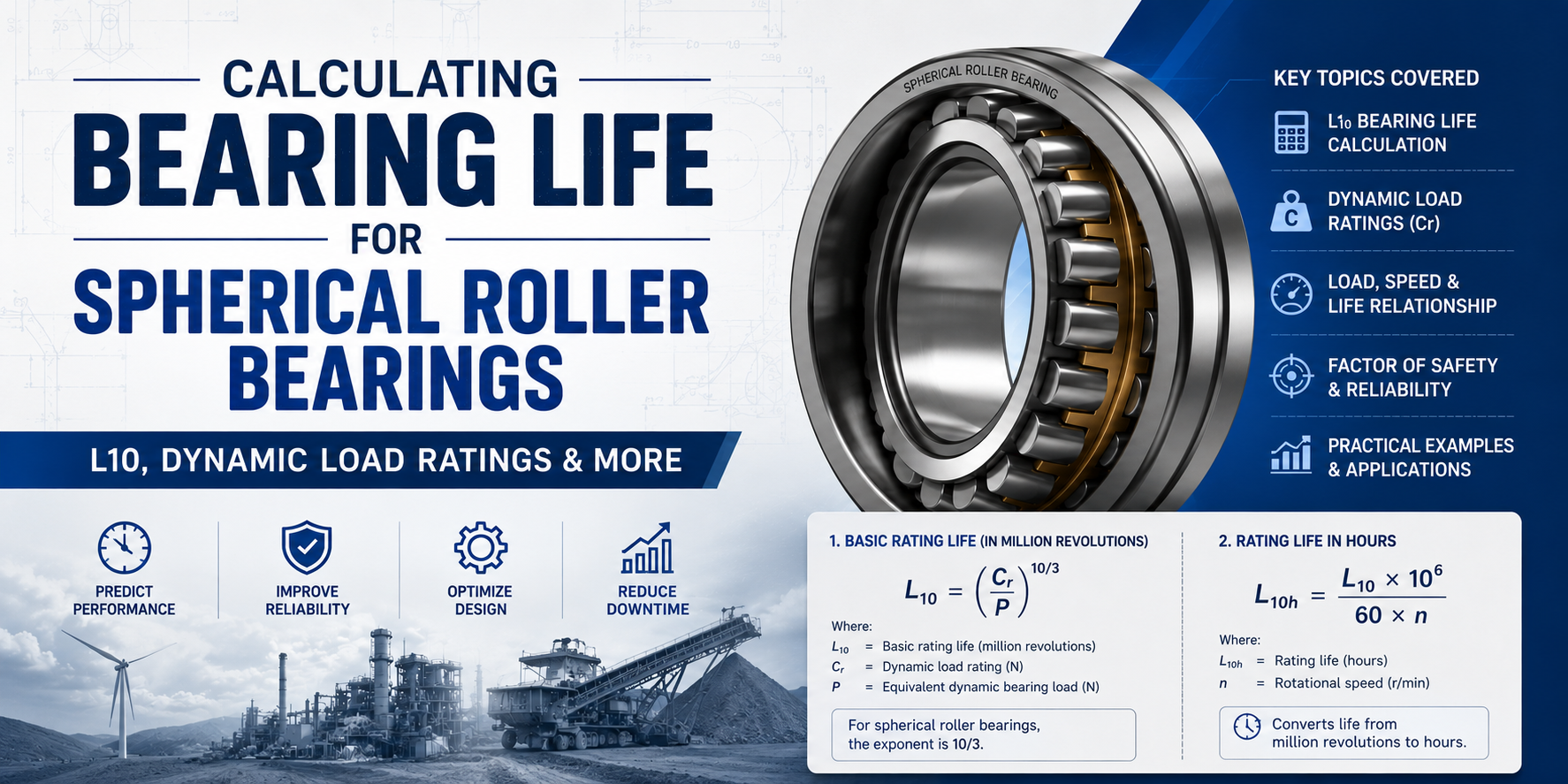
The internationally recognized standard for bearing life calculation is ISO 281. For spherical roller bearings, the exponent n = 10/3 applies (unlike ball bearings which use n = 3), reflecting their line-contact geometry:

ISO 281 — BASIC RATING LIFE (ROLLER BEARINGS)

L10 = (Cr / P)^(10/3)

L10 = Basic rating life [10⁶ rev] Cr = Dynamic load rating [kN] P = Equivalent dynamic load [kN]


Calculating Equivalent Dynamic Load (P)

Before applying the L10 formula, radial and axial forces must be combined into a single equivalent dynamic load P:

EQUIVALENT DYNAMIC BEARING LOAD

P = X · Fr + Y · Fa

Fr = Radial force [kN] Fa = Axial force [kN] X = Radial factor (from catalog) Y = Axial factor (from catalog)


�� Important

The X and Y factors are not constant — they depend on the ratio Fa/Fr and the contact angle of the specific bearing series. Always obtain them from the manufacturer's catalog for the exact model being used.


Dynamic Load Ratings (Cr) Explained

The dynamic load rating Cr is a standardized value calculated per ISO 281. It represents the constant radial load a bearing can theoretically endure for exactly one million revolutions at 90% reliability. It is the single most important number in a bearing catalog.

Designation

Bore (mm)

Cr (kN)

C0r (kN)

Mass (kg)

Typical Application

22208 E

40

71

85

0.42

Small gearboxes

22215 E

75

230

270

2.05

Industrial fans

22228 E

140

630

850

14.0

Conveyor drives

23238 CC/W33

190

1,320

1,900

48.0

Steel mill rolls

23260 CC/W33

300

3,350

5,000

250

Wind turbine shafts

24192 ECAK30

460

7,100

11,800

1,050

Mining crushers


⚠️ Warning

Always use the Cr value from the specific manufacturer's catalog for the bearing model you are using. Values vary between manufacturers due to internal geometry differences. Do not mix catalog data across brands.


Modified Rating Life (Lnm): Going Beyond Basic L10

The basic L10 formula assumes ideal conditions: perfect lubrication, no contamination, normal temperature, and standard steel. Real applications rarely meet all of these. The modified rating life Lnm accounts for real-world operating conditions:

MODIFIED RATING LIFE — ISO 281

Lnm = a1 · aISO · L10

a1 = Reliability factor aISO = Life modification factor (lubrication, contamination, fatigue limit)


Reliability (%)

Failure Prob. (%)

a1

Life vs. L10

Use When

90% (L10 Standard)

10%

1.00

1.0×

Standard industrial

95%

5%

0.62

0.62×

Higher reliability needed

97%

3%

0.44

0.44×

Critical machinery

98%

2%

0.33

0.33×

Safety-critical systems

99%

1%

0.21

0.21×

Aerospace, nuclear


The Lubrication Factor: κ (Kappa)

The viscosity ratio κ compares the actual kinematic viscosity of oil at operating temperature (ν) to the required reference viscosity (ν₁):

VISCOSITY RATIO

κ = ν / ν₁

ν = Actual viscosity at operating temp [mm²/s] ν₁ = Reference viscosity from catalog [mm²/s]


κ Value

Condition

Effect on aISO

Action

κ < 0.4

Severely Starved

aISO drastically reduced

Increase viscosity or reduce speed immediately

κ = 0.4–1.0

Marginal Film

aISO < 1.0

Consider EP additives or higher-viscosity oil

κ = 1.0–4.0

Good Lubrication

aISO ≥ 1.0

Optimal zone — maintain conditions

κ > 4.0

Full EHD Film

aISO maximized

Ideal — watch viscous drag at low temps


Worked Example: Real-World L10 Calculation

 📐  Scenario

An industrial conveyor drive shaft runs at n = 480 RPM. Radial force Fr = 85 kN; axial force Fa = 18 kN. Selected bearing: 22228 E (Cr = 630 kN; X = 1, Y = 2.8 for this Fa/Fr ratio). Target life: 40,000 hours. Does this bearing meet the requirement?


Step

Calculation

Result

1. Equivalent load P

P = 1 × 85 + 2.8 × 18

P = 135.4 kN

2. Load ratio Cr/P

630 / 135.4

= 4.653

3. L10 (millions of rev)

L10 = (4.653)^(10/3)

≈ 148 million rev

4. Convert to hours

L10h = (148 × 10⁶) / (60 × 480)

≈ 5,139 hours

5. Compare to target

5,139 h vs. 40,000 h target

❌ Does NOT meet target

6. Recommendation

Upgrade to 23238 CC/W33 (Cr = 1,320 kN)

✔ Recalculate with new bearing


 📊  Lesson

A bearing that looks large enough by bore size can fall far short of required life when actual loads are applied. Always run the calculation — never rely on intuition alone.


Selection Guide by Application


Application

Speed (RPM)

Load Type

L10h Target

Key Consideration

Preferred Series

Wind turbine main shaft

10–20

Very high radial + variable axial

100,000+

Fatigue, contamination

232xx, 241xx

Paper mill rolls

200–600

High radial, shock

50,000–80,000

Water contamination

222xx CC/W33

Mining crushers

100–400

Extreme radial + shock

30,000–50,000

Heavy dirt, impact

240xx, 241xx

Industrial gearboxes

300–1,500

Moderate radial + axial

20,000–40,000

Speed, oil viscosity

222xx E, 223xx E

Centrifugal pumps

1,000–3,000

Moderate radial

20,000–30,000

Misalignment, deflection

222xx E

Steel mill roll necks

50–300

Very high radial + shock

40,000–60,000

High load, water cooling

230xx, 232xx


Common Causes of Premature Failure

Even a correctly selected and calculated bearing can fail early if installed or maintained improperly. Understanding failure modes prevents costly surprises.

Failure Mode

Visual Signs

Root Cause

Prevention

Surface fatigue / spalling

Pitting, flaking on raceways

Exceeding Cr; incorrect L10

Recalculate with actual loads; upsize bearing

Smearing

Torn, shiny raceway patches

κ < 0.4; oil starvation

Increase oil viscosity; pre-lube at startup

False brinelling

Dents at roller pitch spacing

Micro-vibration while stationary

Anti-fretting grease; lock shaft during storage

True brinelling

Deep indentations in raceway

Shock load exceeding C0 static

Verify C0 against peak shock loads

Corrosion

Red/brown staining, pitting

Water or acid ingress

Sealed variants; corrosion-inhibiting grease

Cage fracture

Broken cage, seized roller

Overspeeding; impact loads

Observe speed ratings; correct lubricant spec


Maintenance Best Practices

  • Establish a scheduled relubrication program based on speed, load, and temperature — not calendar time alone
  • Monitor bearing temperature continuously; a rise of >10°C above baseline is an early warning sign
  • Use vibration analysis (ISO 10816) to detect fatigue, imbalance, and misalignment before failure
  • Always use an induction heater for mounting — never strike the bearing with a hammer
  • Verify interference fits on both shaft (typically k5/m5) and housing (typically H7/K7) before installation
  • Check shaft hardness (min. 58 HRC) when using the shaft as an integral inner raceway
  • Store bearings horizontally in original packaging; never stack heavy packages on top


Frequently Asked Questions


What is the difference between L10 and L10h?

L10 is expressed in millions of revolutions — it is the raw output of the ISO 281 formula. L10h converts that to operating hours using the running speed (RPM). Both represent the same 90% reliability threshold; L10h is simply more practical for maintenance planning.
 

Can I use the ball bearing exponent (n=3) for spherical roller bearings?

No. Spherical roller bearings use the exponent n = 10/3 (≈ 3.333) because of their line contact geometry. Using n = 3 will overestimate bearing life and potentially lead to premature failure. Always use the correct exponent for the bearing type.
 

How does contamination affect L10 life?

Contamination is captured in the aISO factor through the contamination factor eC. In heavily contaminated environments (e.g., mining), eC can reduce aISO to 0.1 or lower, cutting theoretical life by up to 90%. Effective sealing and filtration are among the highest-leverage interventions available to improve actual bearing life.
 

Is a higher Cr always better?

A higher Cr extends theoretical life under the same load, but comes with increased size, weight, and cost. The goal is to select the smallest bearing that meets the required L10h with an appropriate safety margin — not the largest one available. Oversized bearings can introduce problems such as reduced clearance, higher operating temperatures, and compatibility issues.
 

What is the W33 suffix in bearing designations like 22228 E/W33?

The W33 suffix indicates that the bearing outer ring has a circumferential lubrication groove and three lubrication holes. This facilitates relubrication through the housing, making it ideal for applications where the bearing cannot be easily accessed but must be periodically regreased in service.
 

How do temperature and speed affect bearing life?

Elevated temperatures degrade lubricant viscosity, reducing the κ ratio and therefore lowering aISO. They also accelerate grease oxidation and reduce material yield strength at extreme levels. High speeds require caged designs and are factored into the reference viscosity ν₁ — higher speeds require higher base viscosity oils to maintain an adequate lubricant film.


L10 Fatigue Life and Internal Clearance: What Every Spindle Engineer Must Know

L10 Fatigue Life and Internal Clearance: What Every Spindle Engineer Must Know

Key Takeaways → The ISO 281 L10 formula assumes zero internal clearance — an assumption no real spindle meets → Three factors consume initial...
Read More
Linear Bearings vs Rotary Bearings — Key Differences Explained

Linear Bearings vs Rotary Bearings — Key Differences Explained

Linear Bearings vs Rotary Bearings — Key Differences Dimension ▶ Linear Bearing ▶ Rotary Bearing Motion type TranslationBack-and-forth...

Read More
Bearing Static vs Dynamic Load: C, C0, L10 Explained + Free Calculator

Bearing Static vs Dynamic Load: C, C0, L10 Explained + Free Calculator

Bearings play a vital role in machinery by ensuring smooth motion and reducing friction. Understanding load capacities, specifically static load vs...

Read More