

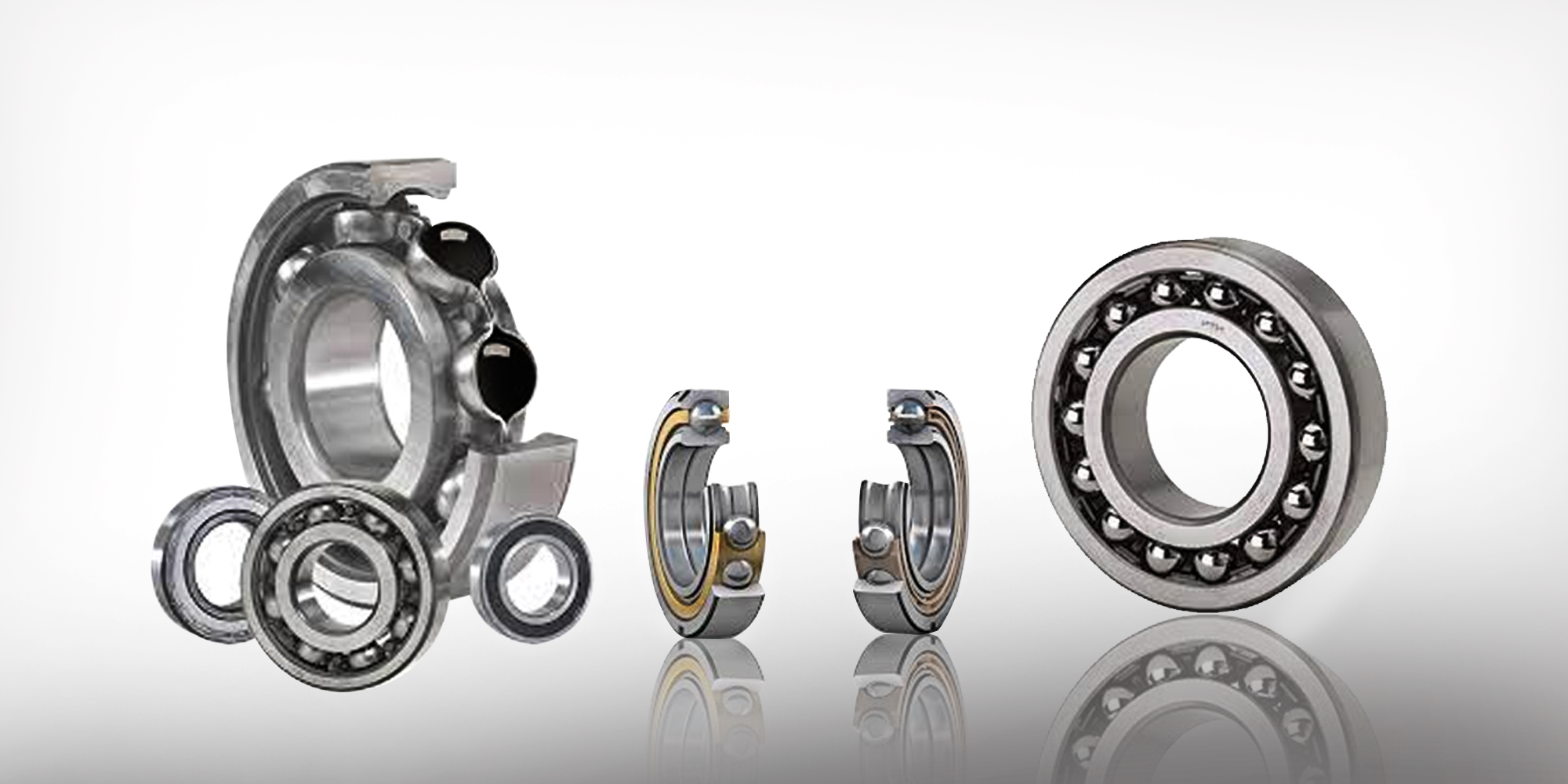
6204 Bearing: 20mm X 47mm X 14mm Deep Groove Design
The deep groove 6204 bearing is a staple in the machinery world, prized for its versatility and reliability. This blog post delves into the specifics...
5 min read
Robert
:
Mar 12, 2026 9:57:32 PM
KEY NUMBERS AT A GLANCE
|
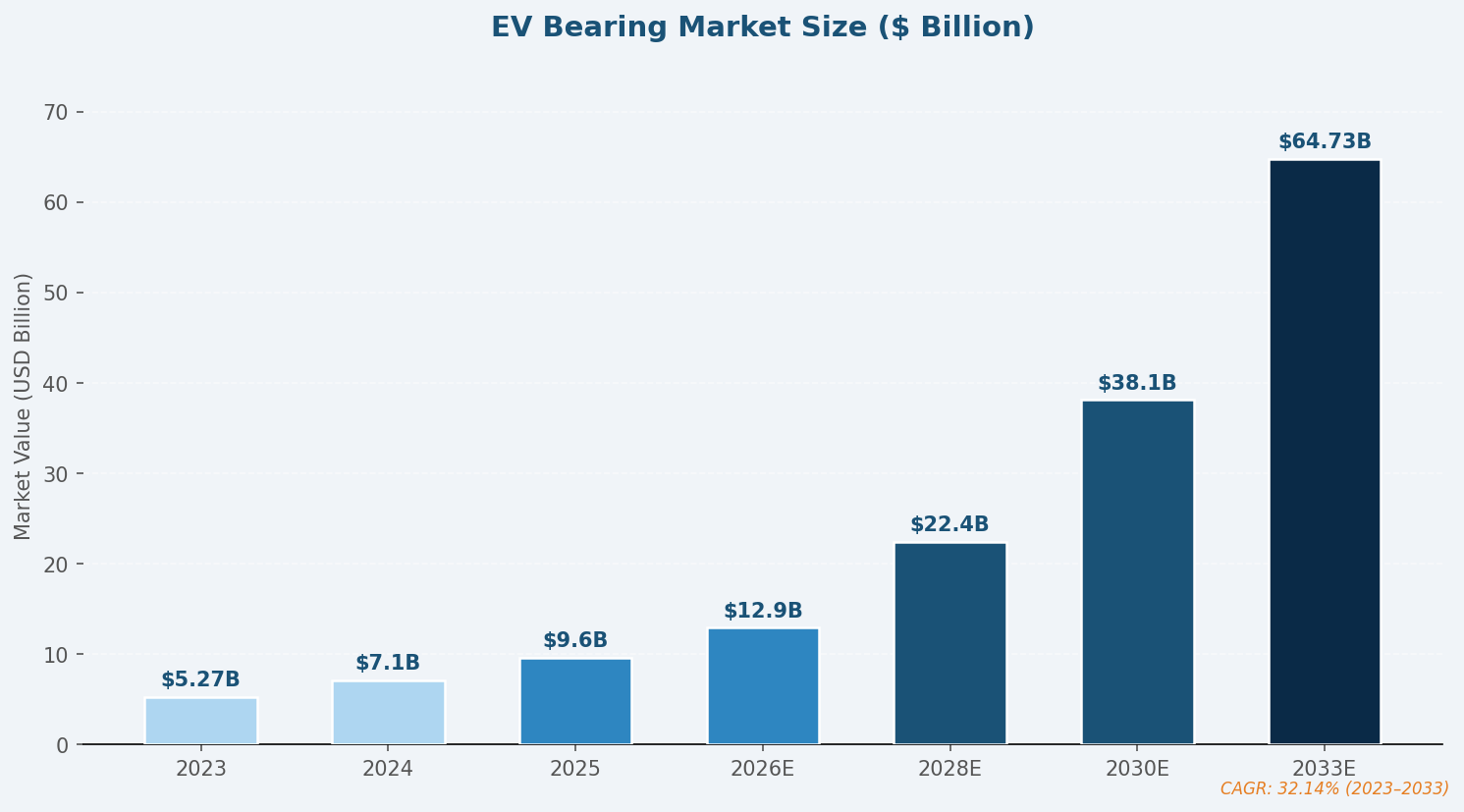
�� $64.73 Billion EV Bearing Market (2033) |
�� 32.14% Market CAGR 2023–2033 |
|
⚙️ $693 Million Si₃N₄ Market Value (2026) |
�� 70% EV Mfrs Using Ceramics |
|
⚡ 22,000 RPM Max EV Motor Speed |
��️ 60% Lighter Weight vs Steel |
The electric vehicle revolution is not just about batteries and software. Beneath the sleek exteriors and quiet motors lies an engineering transformation happening at the micro level — inside the bearings that spin millions of times a day in every EV on the road.
In 2026, ceramic bearings have moved from niche industrial component to essential EV technology.
Silicon Nitride (Si₃N₄) bearing balls are now considered mission-critical for high-performance electric drivetrains — and the market data confirms it.
|
�� Why This Matters: A conventional EV contains at least 16 bearings across the drivetrain and motor assemblies. Each bearing choice directly impacts range, reliability, maintenance costs, and product lifespan. |

Figure 1: EV Bearing Market Size Growth Trajectory, 2023–2033 (USD Billion)
Internal combustion engines and electric motors are fundamentally different machines — and those differences place radically different demands on every bearing in the drivetrain.
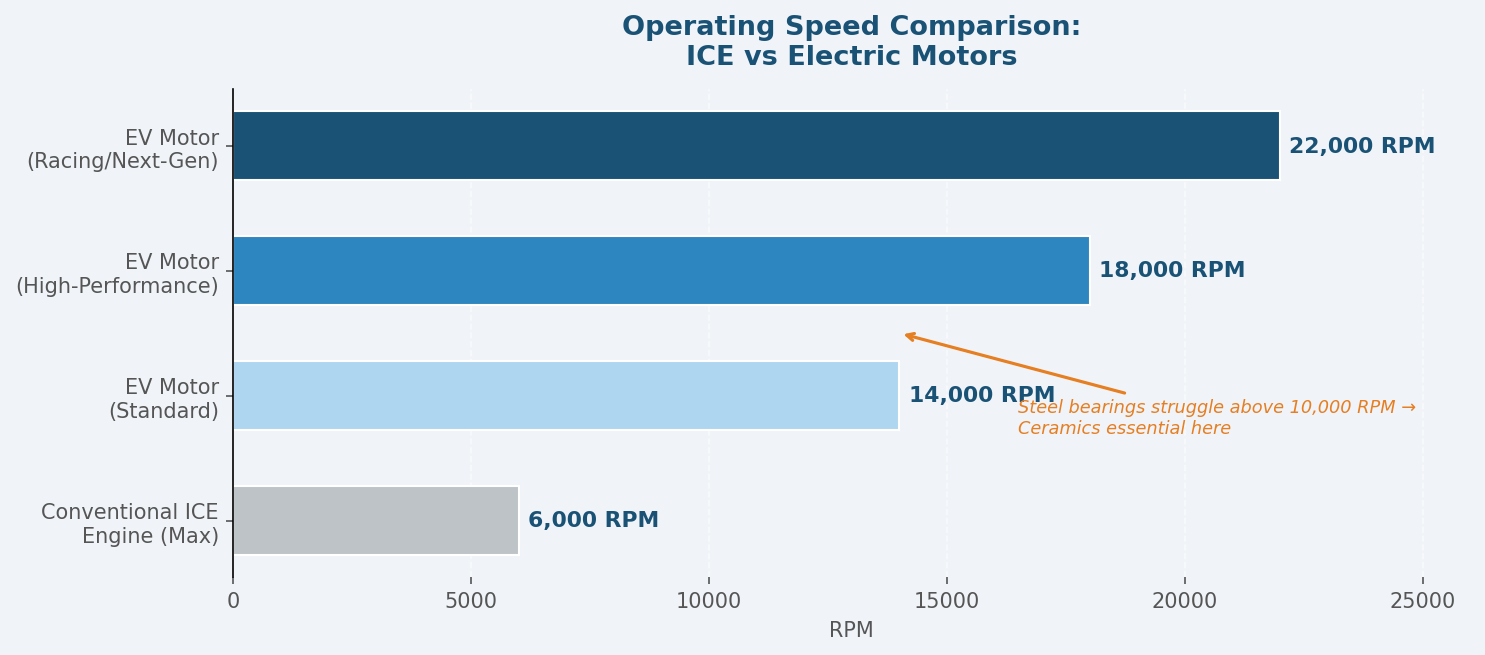
Traditional combustion engines operate at 1,500–6,000 RPM. Electric motors are a different beast entirely.
As the chart below shows, modern EV motors routinely spin between 10,000 and 22,000 RPM — speeds where conventional steel bearings suffer rapid fatigue and thermal degradation.

Figure 2: Operating Speed Comparison — ICE vs Electric Motor Types
|
⚠️ Critical Insight: Steel bearings deployed in EV settings exhibit a 30% decline in expected lifespan due to unique operational stresses — high RPM, torque reversals, and electromagnetic fields. |
High-voltage EV traction motors generate strong electromagnetic fields. In steel bearings, stray electrical currents find the path of least resistance — through the bearing itself.
This phenomenon (electrical pitting / electro-corrosion) causes microscopic craters on bearing surfaces, rapidly degrading performance.
Ceramic bearings solve this at the material level. Silicon Nitride is non-conductive — current simply cannot pass through it. No insulating coatings, no workarounds. Problem eliminated.
|
⚡ Steel vs Ceramic Bearings: The Core Problem |
|
|
✗ Steel Bearings in EVs |
✓ Si₃N₄ Ceramic Bearings |
|
✗ Degrades rapidly above 10,000 RPM |
✓ Rated for up to 22,000+ RPM in EVs |
|
✗ Electrically conductive → pitting damage |
✓ Non-conductive → zero electrical pitting |
|
✗ High friction → heat buildup → shorter life |
✓ Low friction → cooler operation → long life |
|
✗ Heavy → reduces EV range |
✓ 60% lighter than steel equivalent |
|
✗ Requires frequent lubrication |
✓ Requires less lubricant (self-lubricating properties) |
|
✗ 30% shorter lifespan in EV environments |
✓ 3–5× longer lifespan vs steel alternatives |
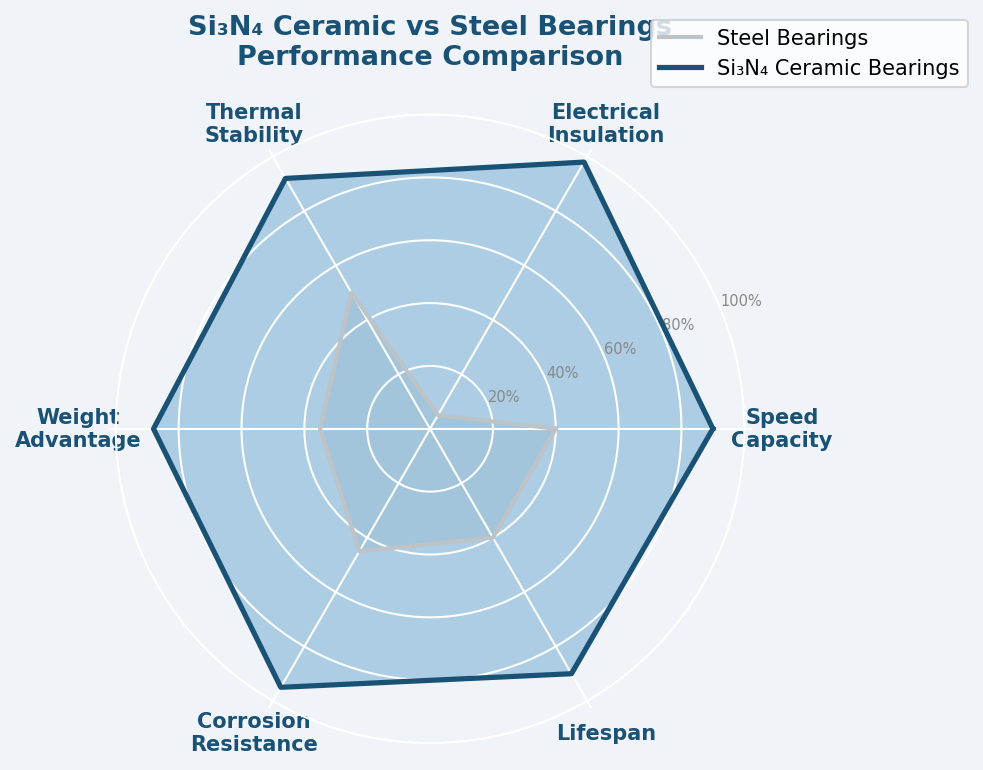
Not all ceramics are equal. Zirconia, alumina, and silicon carbide all have applications, but for EV bearings specifically, Silicon Nitride (Si₃N₄) has emerged as the dominant material. The radar chart below illustrates why.

|
Property |
Steel Bearings |
Si₃N₄ Ceramic Bearings |
Ceramic Advantage |
|
Density |
7.8 g/cm³ |
3.2 g/cm³ |
~60% lighter |
|
Hardness (Vickers) |
~700 HV |
~1,600 HV |
2× harder |
|
Electrical Resistance |
Conductive |
Non-conductive |
Eliminates pitting |
|
Max Temp (Operating) |
~200°C |
>1,000°C |
5× higher |
|
Friction Coefficient |
0.10–0.15 |
0.04–0.07 |
50–60% lower |
|
Lifespan (EV use) |
Baseline |
3–5× baseline |
Significantly longer |
|
Corrosion Resistance |
Moderate |
Excellent |
No special coating needed |
|
Manufacturing (2026) |
Mature/low cost |
Advanced, improving |
Cost gap narrowing |
Hot isostatic pressing now reduces Si₃N₄ porosity to just 0.02% — addressing historical brittleness concerns
Nanocomposite enhancements have improved fracture toughness to 7.5 MPa·m½ — closing the gap with steel
Magnetic levitation polishing enables nanoscale surface finishes impossible five years ago
Bearing balls rated to 22,000 RPM now commercially available for EV powertrain integration
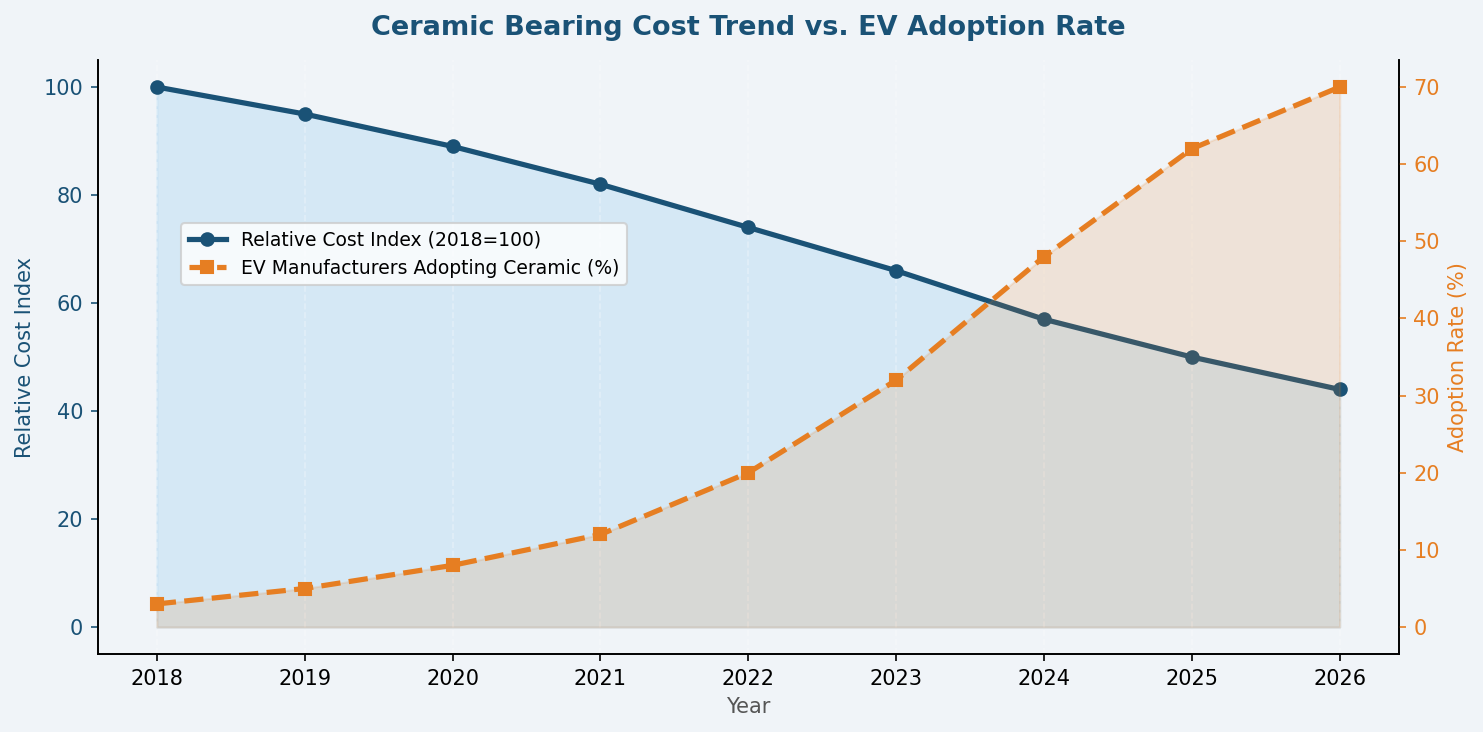
The shift to ceramic bearings in EVs is not a future possibility — it is happening now, at scale. The cost and adoption trends shown below tell the full story.

Figure 4: Ceramic Bearing Cost Index vs. EV Adoption Rate (2018–2026)
|
Company |
Action |
Focus |
|
SKF |
Launched new-gen hybrid ceramic bearings for EV drive units |
E-motor lifespan & efficiency |
|
Schaeffler |
Expanded ceramic bearing production capacity for European EV demand |
Automotive electrification |
|
NSK |
Record automotive sales driven by EV ceramic bearing portfolio |
Asia-Pacific EV market |
|
Timken |
Strategic deal with Ford for electric F-150 Lightning bearings |
Commercial EV trucks |
|
JTEKT |
Partnership with EV powertrain OEM for next-gen bearing solutions |
Next-gen powertrain co-dev |
|
�� Market Milestone: The Si₃N₄ ceramic ball market for EVs was projected to reach $584 million by 2025, growing at 18.9% CAGR — with further growth to $693 million estimated for 2026. |

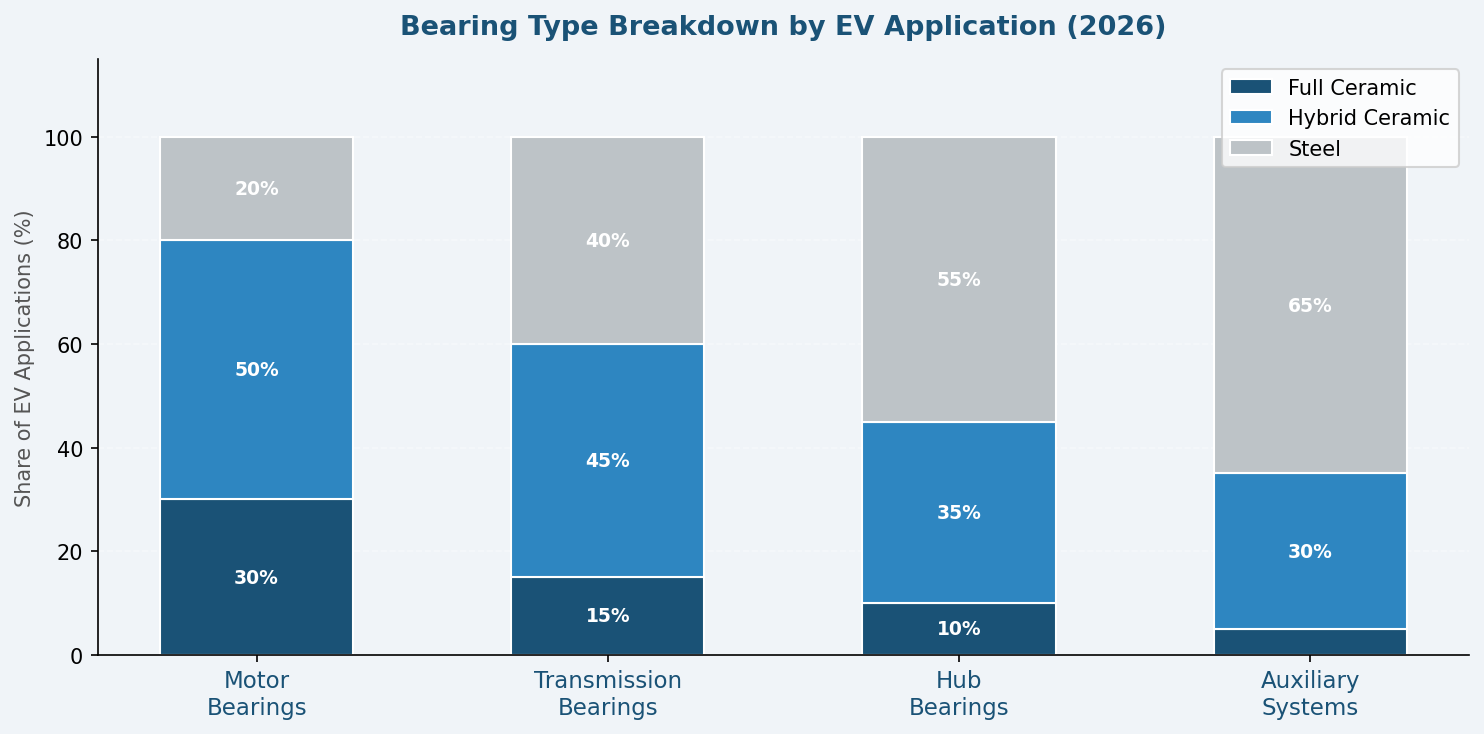
Figure 5: Bearing Type Distribution by EV Application Area (2026)
|
EV Location |
Why Ceramics? |
Key Benefit |
|
Electric Motor Shaft |
Operates at 10,000–22,000 RPM in high EMF environment |
Prevents electrical pitting; handles extreme speed |
|
Transmission / Gearbox |
High torque, continuous high-speed rotation |
Reduced friction loss → improved range |
|
Wheel Hub Bearings |
Extra weight from battery pack + instant EV torque |
Handles higher load; quiet operation in cabin |
|
Coolant Pump (Thermal) |
Wet / corrosive environment in battery cooling systems |
Corrosion-proof; maintenance-free |
|
Power Steering Motor |
Precision-critical; compact packaging required |
Tight tolerances; lightweight |
|
AC Compressor |
High-speed auxiliary motor under hood |
Consistent performance across temperature range |
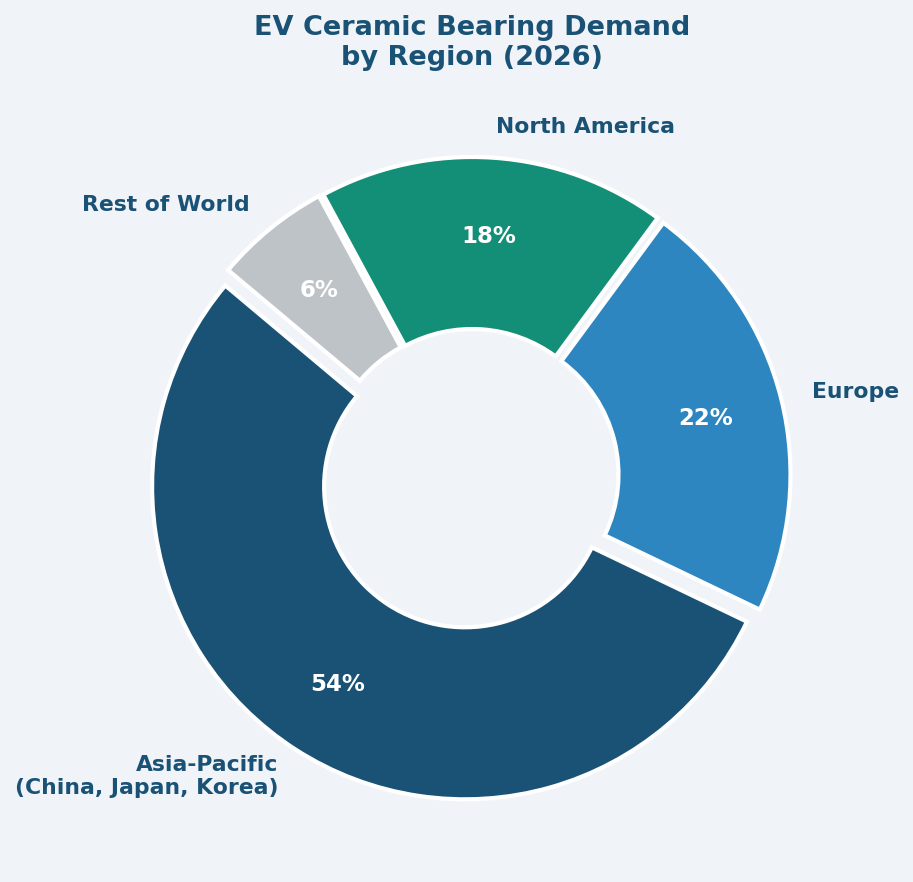
EV adoption is growing across all major regions, but ceramic bearing demand is not distributed evenly. Asia-Pacific leads by a significant margin.

Figure 6: EV Ceramic Bearing Demand by Region, 2026 Forecast
|
Region |
Market Share |
Key Driver |
|
Asia-Pacific (China, Japan, Korea) |
54% |
World's largest EV production volume; semiconductor overlap |
|
Europe |
22% |
Premium EVs, commercial vehicle electrification, EU regulation |
|
North America |
18% |
Electric trucks (F-150 Lightning), commercial fleet electrification |
|
Rest of World |
6% |
Emerging EV markets; growing industrial base |
|
�� China Dominance: China accounts for 30% of global ceramic bearing production capacity, with approximately 8 million units of annual output — and maintains an 18% cost advantage in high-volume applications. |
The industry-wide shift to 800-volt EV architectures is one of the most significant drivers accelerating ceramic bearing adoption.
800V systems enable ultra-fast charging and higher power outputs — but they also create far stronger electromagnetic environments inside the drivetrain.
|
Architecture |
Voltage |
Charge Speed (10–80%) |
Bearing Requirement |
Ceramic Necessity |
|
Gen 1 EVs (2012–2018) |
400V |
45–60 min |
Steel or hybrid OK |
⭐⭐☆☆☆ |
|
Gen 2 EVs (2019–2023) |
400V |
30–45 min |
Hybrid ceramic preferred |
⭐⭐⭐☆☆ |
|
Gen 3 EVs (2024–2026) |
800V |
15–20 min |
Full/hybrid ceramic needed |
⭐⭐⭐⭐⭐ |
|
Next-Gen (2027+) |
900V+ |
<12 min |
Full ceramic mandatory |
⭐⭐⭐⭐⭐ |
|
�� 800V Insight: Porsche Taycan, Hyundai IONIQ 6, Kia EV6, and Audi e-tron GT all use 800V architecture — making Si₃N₄ ceramic bearings essential, not optional, in these platforms. |
No technology story is complete without an honest assessment of challenges. Ceramic bearings face real obstacles to even broader adoption — though each is being actively addressed.
|
Challenge |
Current Status |
Outlook |
|
Cost Premium vs. Steel |
Si₃N₄ remains 3–5× more expensive than steel for equivalent bearings |
Cost gap narrowing 8–12% annually; scale manufacturing accelerates improvement |
|
Supply Chain Concentration |
High-purity Si₃N₄ powder sourced from limited global producers |
Leading manufacturers diversifying; upstream investment increasing |
|
OEM Qualification Time |
Automotive validation cycles require 2–3 years of durability testing |
Pipeline of qualified applications growing; certification frameworks maturing |
|
Brittleness Concerns |
Ceramic more brittle than steel under impact loads in some configurations |
Nanocomposite grades and hybrid designs largely address this concern |
The trajectory is clear. As EV adoption accelerates globally and 800V architectures become mainstream, ceramic bearings will become standard across an expanding range of applications.
|
2023 |
Market at $5.27B. Hybrid ceramic bearings become standard in premium EV motor assemblies globally. |
|
2024 |
Full ceramic crosses mainstream threshold. SKF, Schaeffler expand EV ceramic production; 800V platforms drive full ceramic adoption. |
|
2025 |
Smart bearing tech arrives. IoT-sensor-integrated ceramic bearings enter pilot programs; Si₃N₄ ball market reaches $584M. |
|
2026 |
Ceramic becomes default spec. 70% of EV manufacturers adopt ceramic or hybrid ceramic; Si₃N₄ market hits $693M. 800V is mainstream. |
|
2027 |
Commercial vehicles take off. Electric trucks, buses, delivery fleets adopt ceramic en masse; cost premium falls below 2×. |
|
2028+ |
Hydrogen vehicles join. Fuel cell vehicles create new ceramic bearing demand; all-ceramic market forecast at $2.1B by 2032. |
There is something almost counterintuitive about the idea that some of the most important components in the EV revolution are ceramic balls measuring just a few millimetres across. Yet that is precisely the reality of modern EV engineering.
Silicon Nitride ceramic bearings solve problems that steel simply cannot. They eliminate electrical discharge damage. They run cooler. They last longer. They weigh less. And in an industry where efficiency is measured in fractions of a percentage point and range is everything, these advantages compound into a compelling competitive necessity.
For bearing manufacturers, material scientists, EV engineers, and investors: the ceramic bearing revolution is not coming. It is already here — and it is being driven, quite literally, by the electric vehicles now filling roads around the world.
The deep groove 6204 bearing is a staple in the machinery world, prized for its versatility and reliability. This blog post delves into the specifics...
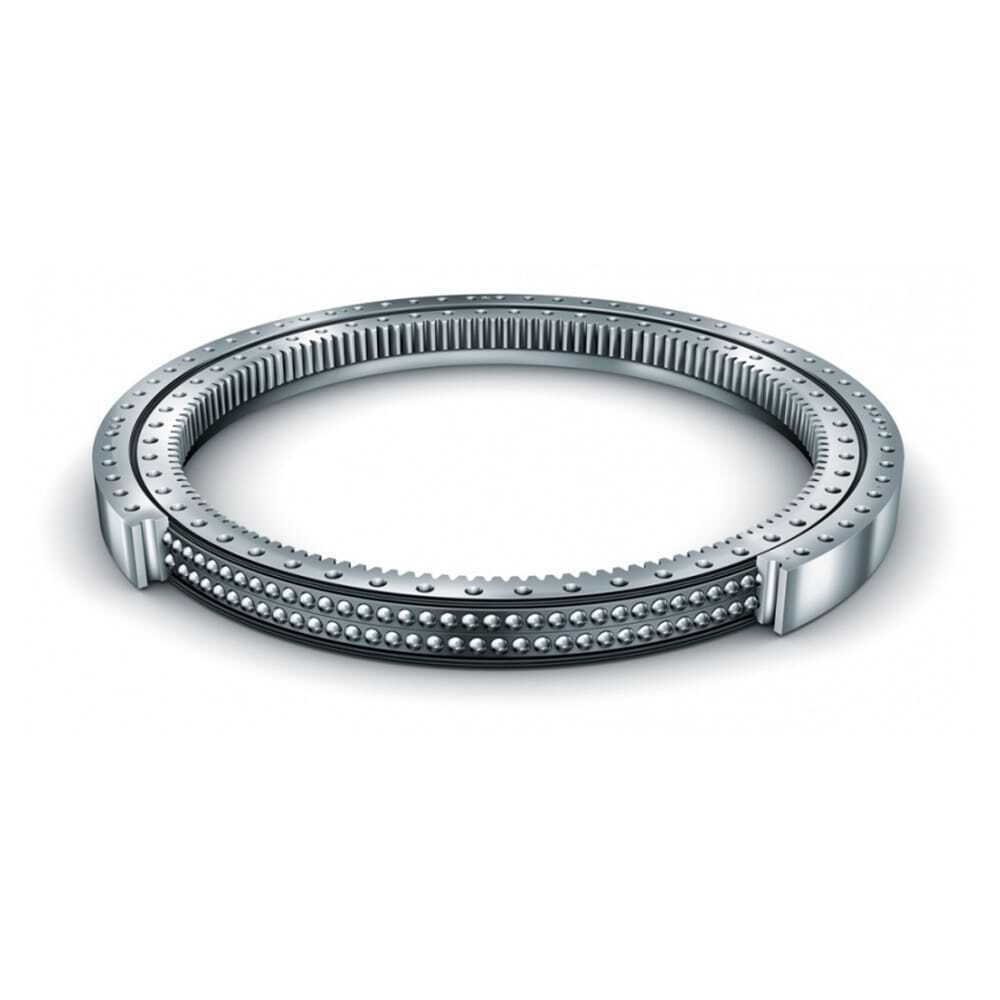
As a major bearing manufacturer in China bearing industry, Lily Bearing is well-known for developing all sorts of sophisticated slewing bearings, one...
In the realm of modern machinery, linear bearings stand out as pivotal elements. Their role is monumental, but it's the meticulous design behind them...