

What Are Springs? Focusing on Industrial Springs
Most spring failures we see at Lily Bearing trace back to the same root cause: the spring was treated as an afterthought. The bearing got carefully...
Here's something most people get wrong about torsion springs: despite the name, the wire inside one is never actually twisted. It bends.
Every coil in that helical body experiences bending stress — not torsional shear — and yet the spring delivers precise rotational force across millions of cycles, from mechanical watches to 400-lb commercial garage doors.
Here's how it works, and why it matters for your application.

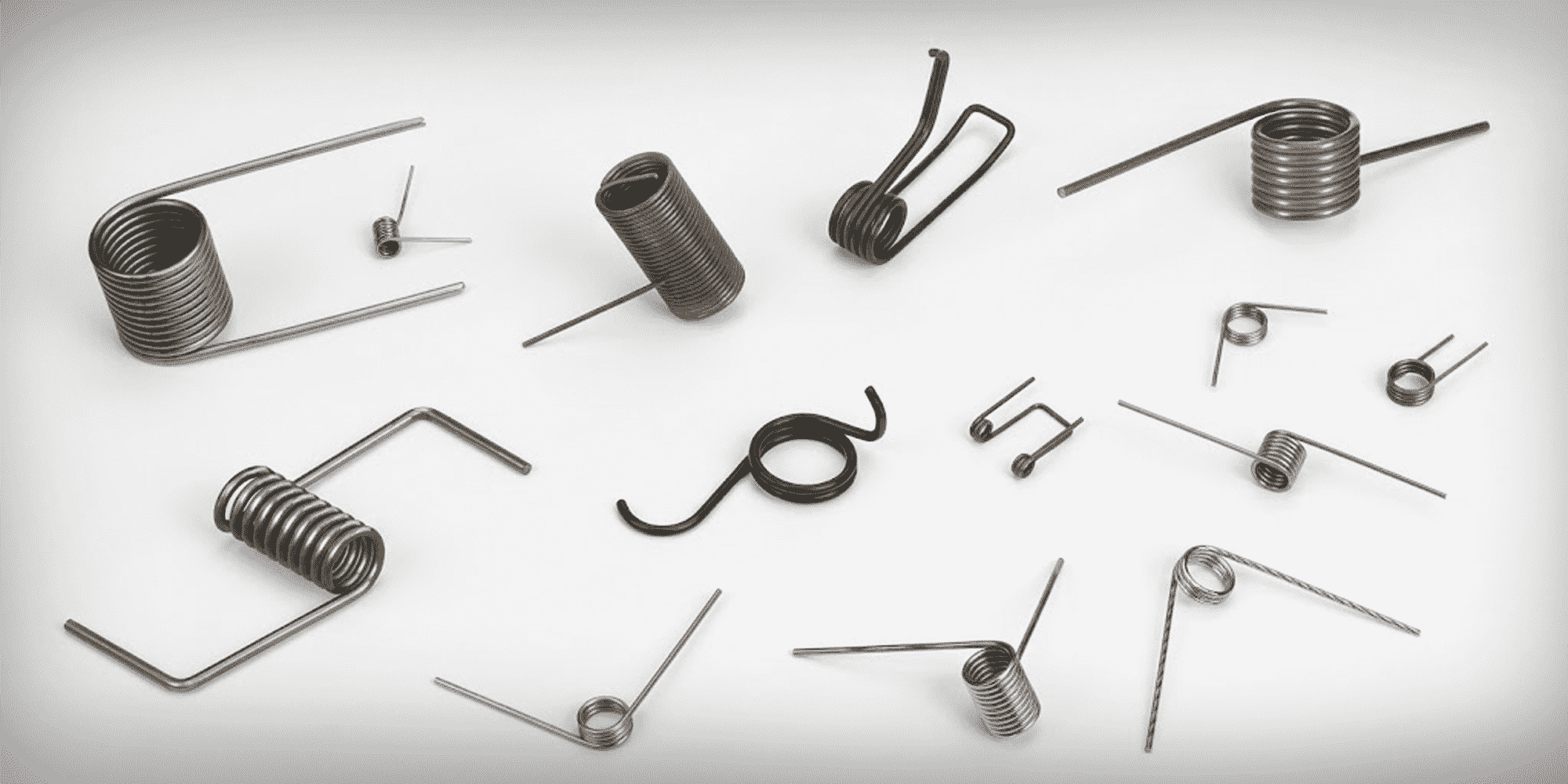
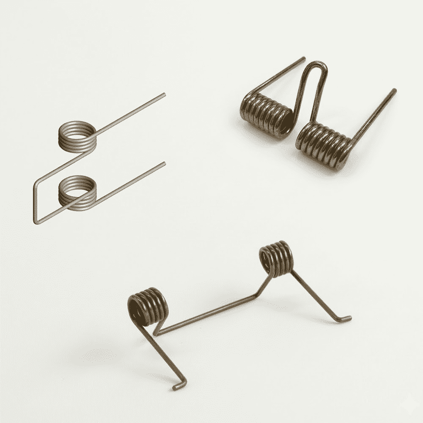
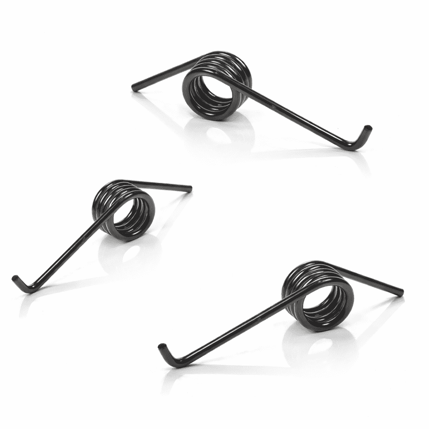
A torsion spring is a mechanical spring that stores and releases energy through a rotating or twisting force applied along its central axis.
When torque is applied to the spring's legs, the coiled body resists, stores mechanical energy elastically, and releases it when the force is removed — returning to its original free angle.
Torsion springs obey an angular form of Hooke's Law:
τ = −κθ
Where τ is torque (N·m), θ is the angle of twist from the equilibrium position (radians), and κ is the torsion spring constant (N·m/radian).
Stored energy equals U = ½κθ².
Six parameters define how a torsion spring performs.
Getting these right is the difference between a spring that lasts 20,000 cycles and one that fails at 5,000.
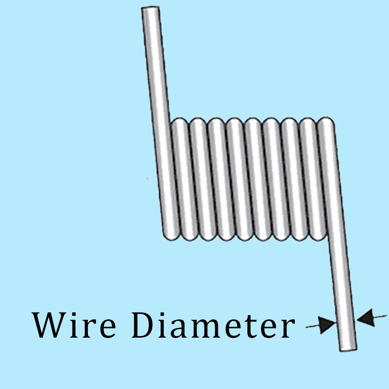
The single most influential parameter. Larger wire diameter increases spring rate and torque capacity.
Stock springs range from 0.018" to 0.156" wire diameter; custom springs extend beyond this range.

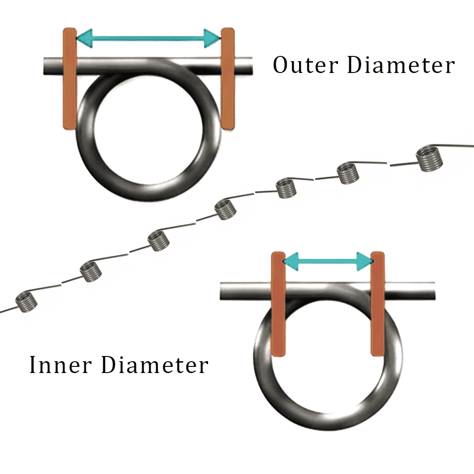
The outer diameter governs radial space.
The inner diameter determines mandrel fit — the shaft the spring operates on should be no larger than 90% of the spring's minimum inner diameter at full deflection to prevent binding.

More coils mean a lower spring rate and greater angular deflection capacity. Fewer coils produce a stiffer spring with less travel.
It’s worth distinguishing between total coils and active coils.
Total coils is the full count when the spring is unloaded.
Active coils are the ones actually doing the work under load — the end coils that contact a support structure don’t contribute to deflection and aren’t counted.
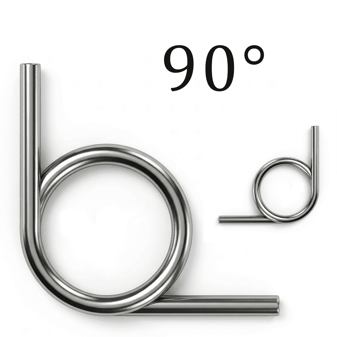
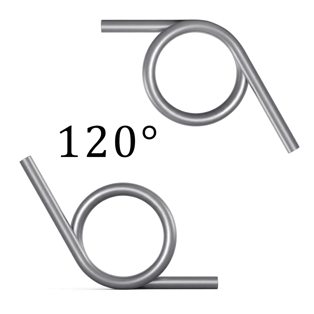
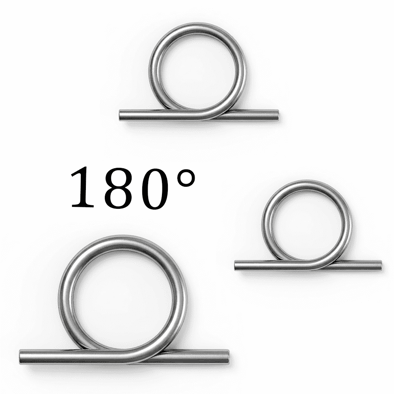
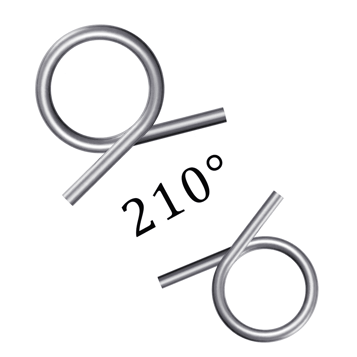
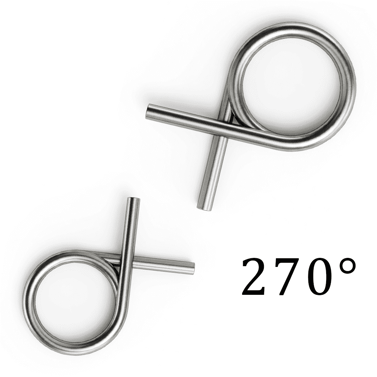
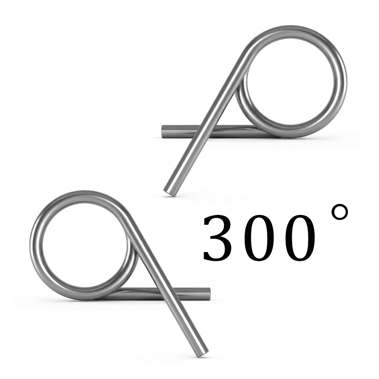
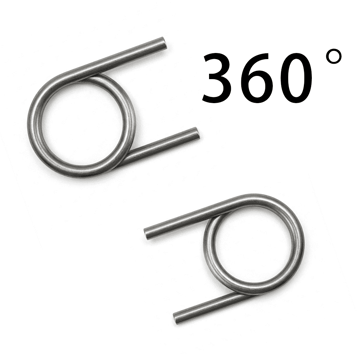
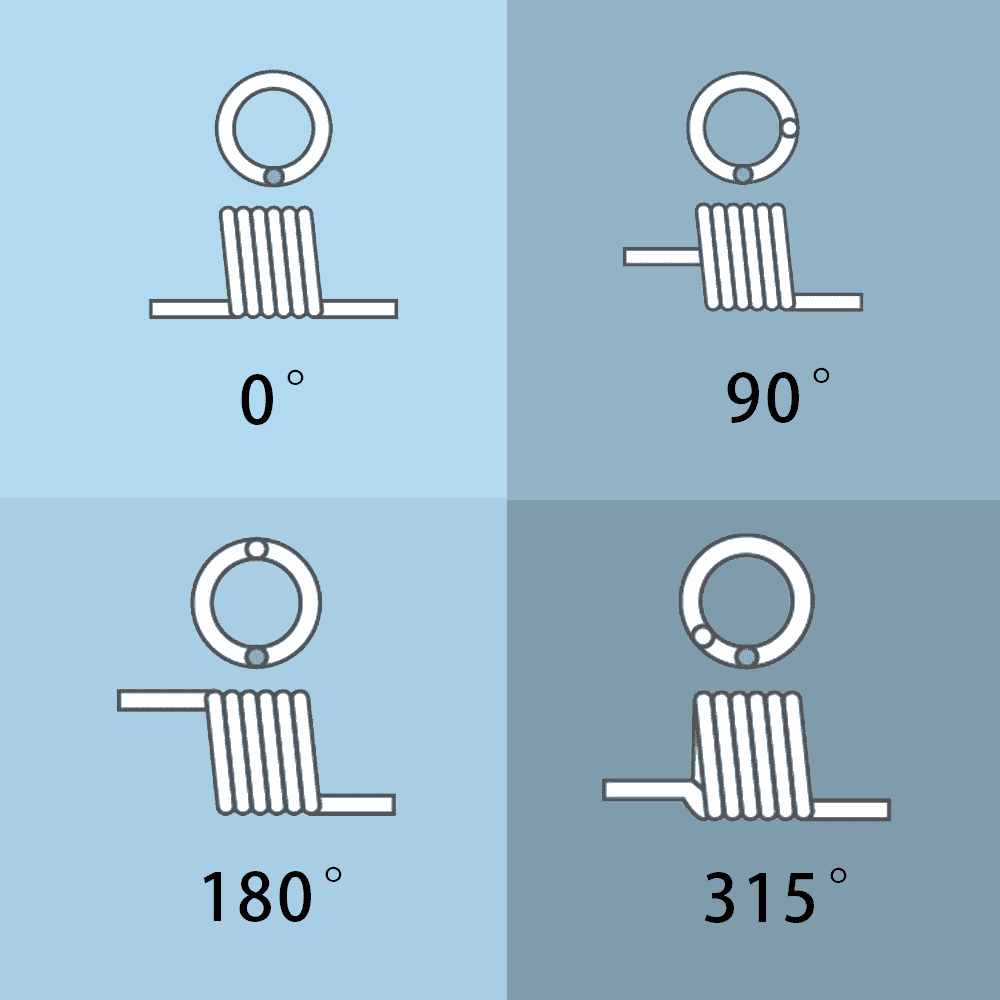
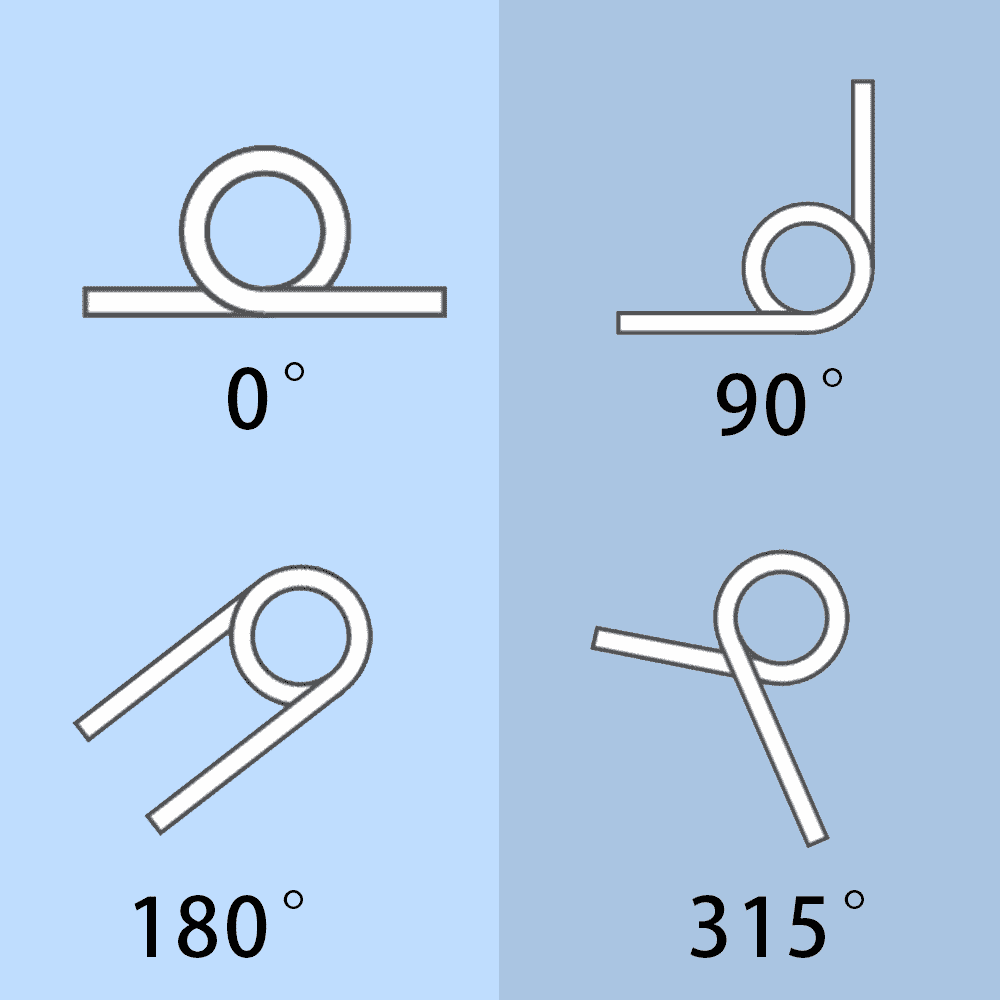
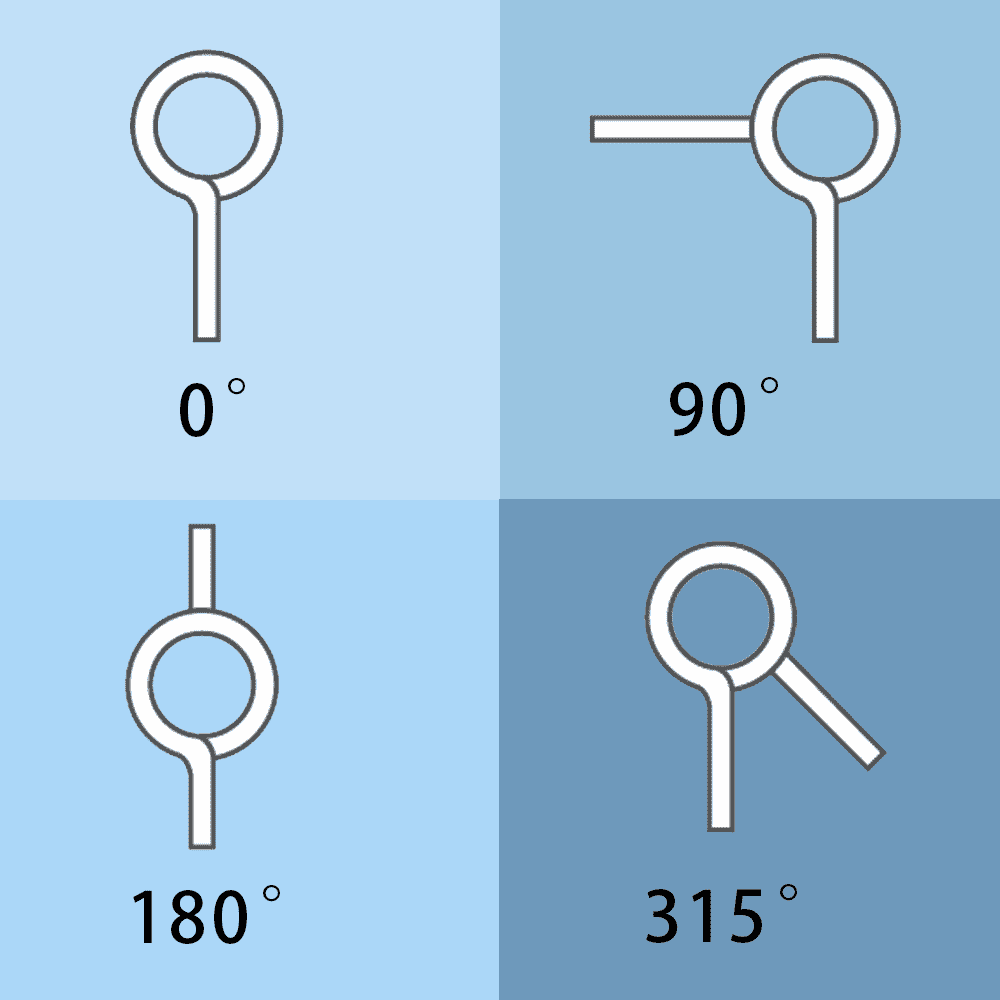
The angle between the spring's legs when unloaded. Common stock options: 90°, 120°, 180°, 210°, 270°, 300°, and 360°.


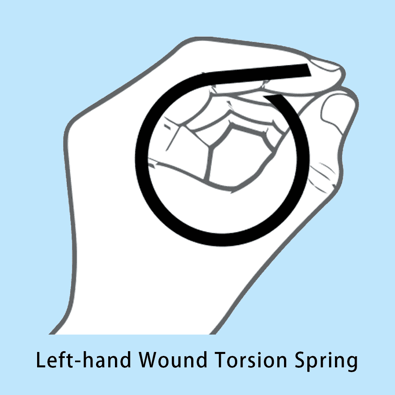
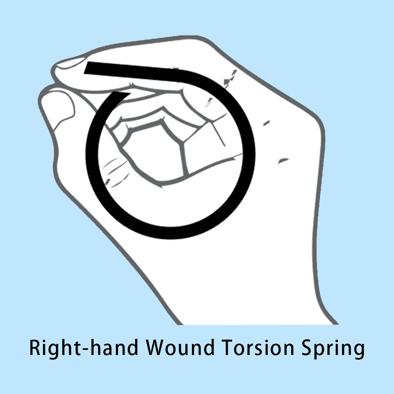
Either right-hand or left-hand — always required when specifying a torsion spring.
A spring must be loaded in the direction that decreases its coil diameter.
Loading in the opposite direction introduces unfavorable residual stresses and significantly shortens service life.
To identify wind direction: hold the spring with fingers around the outside and thumb pointing up.
If the last coil ends in the direction your fingers point, that's the hand of the spring.


Expressed as torque per degree or radian of angular deflection (e.g., N·m/degree or lb·in/radian).
Torsion spring loads must always be specified at a fixed angular position, not at a fixed deflection increment from the free angle.
Closely related is maximum deflection — the furthest the spring can twist before it hits its elastic limit and starts to take a permanent set.
Designing within this limit is non-negotiable; a spring pushed past it won’t return to its original free angle and will lose torque output over time.
The four main types differ in coil configuration and how they deliver torque:
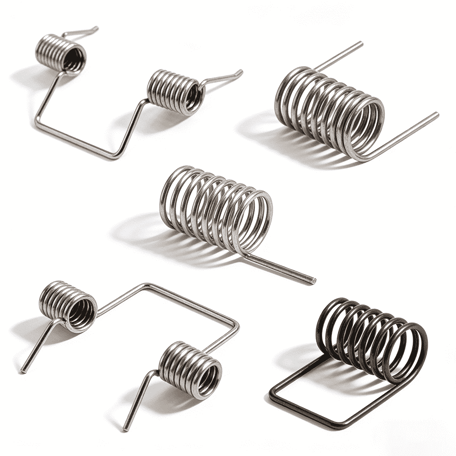
Single torsion spring — One helical coil wound in a single direction. The most common configuration across automotive, aerospace, and consumer applications.

Double torsion spring — Two coil sections wound in opposite directions, connected by a central unwound section. Total torque equals the sum of both sections. Used when counterbalancing is needed or torque must act in both rotational directions.
Close-wound — Coils in contact when unloaded. Compact but generates inter-coil friction during deflection.
Torque is introduced through the spring's legs. Four standard configurations cover most applications:
Axial legs — Project parallel to the spring's central axis. Best for compact assemblies where radial space is limited.
Tangential legs — Extend at a tangent to the outer diameter, producing gradual and controlled torque. Common in hinges and door mechanisms.
Radial external legs — Extend outward from the spring body. Provide robust attachment points for heavier mechanisms.

Radial over-centre legs — Pass over the spring's centre during operation, enabling balanced force distribution in precision applications.
.png?width=1000&height=1000&name=Tangential%20Torsion%20Spring%20Leg%20Configurations%20(Radial%20over-centre).png)
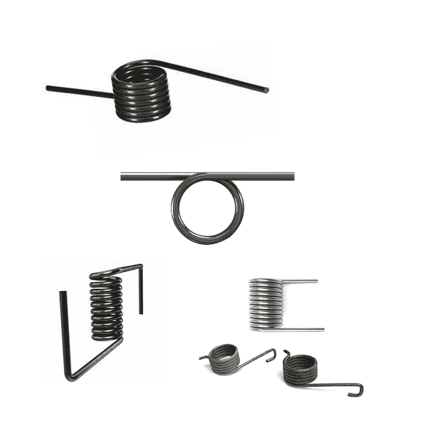
One important design rule: bends that decrease their radius of curvature under load carry favorable residual stresses.
Bends that open up under load do not — and spring performance is often limited by leg bend stress, not body stress.
Material selection directly affects strength, fatigue life, corrosion resistance, and suitability for specific environments.
| Material | Characteristics | Typical Use |
| Music wire (ASTM A228) | High tensile strength, good fatigue resistance | General-purpose indoor applications |
| Stainless steel 302/304 | Corrosion resistant | Food processing, medical, outdoor |
| Stainless steel 316 | Superior corrosion resistance | Marine, chemical environments |
| Chrome silicon | High stress tolerance, temperature resistant | Automotive, heavy industrial |
| Chrome vanadium | Strength + shock resistance | High-cycle industrial applications |
| Phosphor bronze / Beryllium copper | Electrically conductive, non-magnetic | Electronics, sensitive instruments |
Surface treatments — zinc plating, nickel plating, passivation, galvanizing — improve corrosion resistance or satisfy regulatory requirements such as RoHS and REACH.
Torsion springs store and release energy through rotational movement.
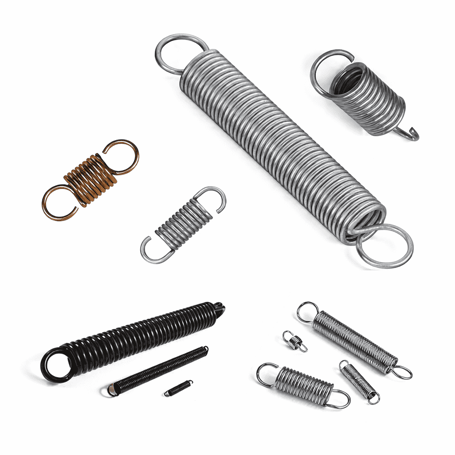
Extension springs resist pulling forces and store energy by stretching along a linear axis.

When your application requires angular movement or controlled torque, torsion springs are the natural choice.
For a detailed breakdown of how the two compare on lifespan, cost, and safety, see Torsion Springs vs. Extension Springs
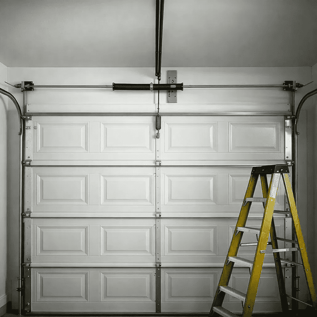
Torsion springs mounted above the door twist and store energy as the door closes, then release it to counterbalance the door's weight on opening.

A standard residential garage door weighs 130–200 lbs; commercial doors can exceed 400 lbs.
Well-maintained residential torsion springs typically last 10,000–20,000 cycles — roughly 7–14 years at one to two uses per day.
Torsion bar suspensions absorb road shocks through twisting rather than compression — used on vehicles ranging from passenger cars to military tanks including the M1 Abrams.

Anti-roll (sway) bars operate on the same principle. Torsion springs also appear in hood and trunk hinges, brake pedal return mechanisms, clutch assemblies, and seat recliner controls.
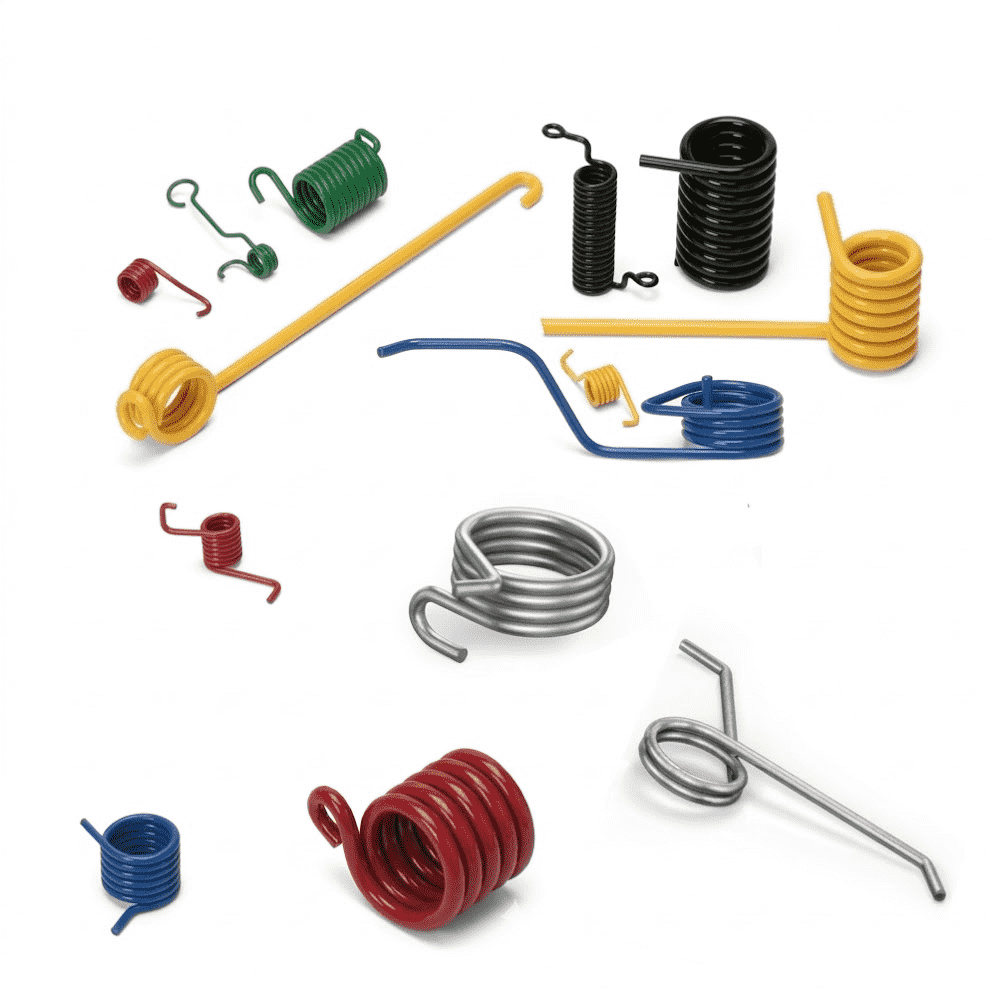
Clothespins, mousetraps, ballpoint pen mechanisms, pop-up doors on cameras and CD players, washing machine drum balancing systems, oven and refrigerator door hinges — torsion springs cover an extraordinary size range in everyday life, from springs under 10 mm outer diameter in small electronics to springs several centimeters across in appliance hinges.
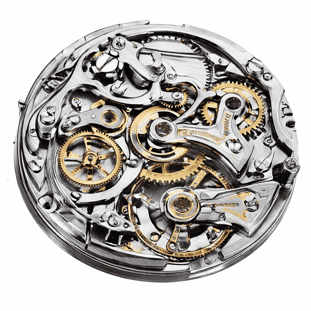
The hairspring in a mechanical watch is a spiral-wound torsion spring that controls oscillation of the balance wheel, directly governing accuracy.

Most modern mechanical movements run at 3–4 Hz — that’s 21,600–28,800 vibrations per hour, or the balance wheel swinging back and forth up to 8 times per second.
The D’Arsonval movement in analog meters uses a torsion spring to keep pointer deflection proportional to current — a direct application of Hooke’s Law in angular form.
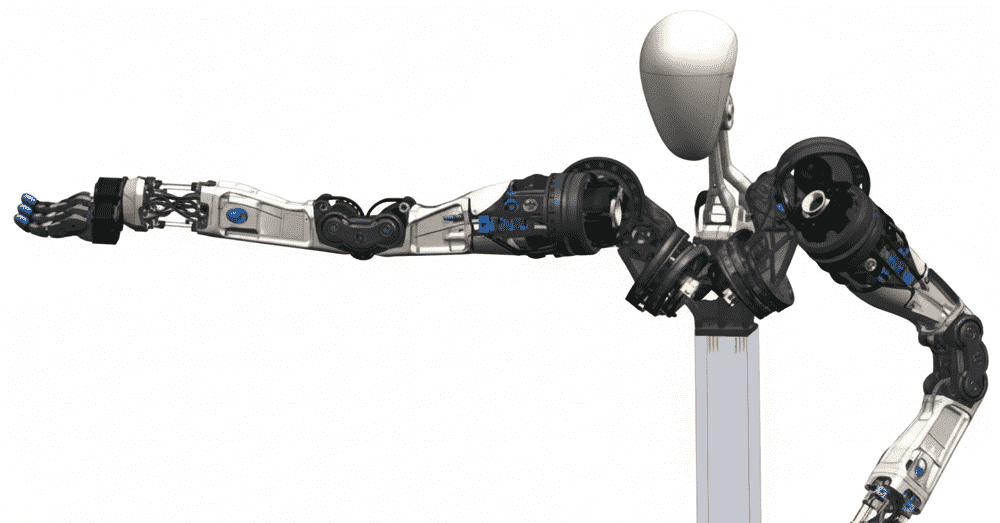
Conveyor belt tensioning, robotic arm joints, valve controls, assembly line automation, and screening equipment for material sorting all rely on torsion springs for consistent, repeatable torque over high cycle counts.

In demanding production environments, springs can exceed 100,000 cycles per year, making fatigue life a primary design factor.
Solar panel tracking systems use torsion springs for precise angular positioning across daily sun cycles.
![]()
Wind turbine blade pitch mechanisms, hydroelectric gate controls, and mining conveyor systems incorporate springs engineered for continuous outdoor operation and extreme loads.
Body length growth: Close-wound springs increase in body length when deflected in the winding direction. In tight axial housings, this growth must be accounted for.
Inner diameter reduction: As the spring winds tighter, its inner diameter shrinks — mandrel clearance must be maintained at maximum deflection. Too small a mandrel risks buckling under large deflections.
Leg bend stress: The highest stress typically occurs at the sharpest leg bends, not in the coil body. Bends that close under load are always preferable to bends that open.
Space efficiency: High torque in a compact radial footprint
Consistent force output: Reliable torque across the full operating range
Long service life: 15,000–20,000 cycles vs. 7,000–10,000 for comparable extension springs
Beyond these core strengths, torsion springs are highly customizable — wire diameter, coil geometry, leg type, material, and finish can all be adjusted to meet exact application requirements, from a miniature spring in a consumer device to a heavy-duty industrial component.
There’s also a safety advantage worth noting: if a torsion spring breaks, it generally stays on its shaft. An extension spring under the same load can snap free and release with considerable force.
In garage door applications, torsion springs are rated for 10,000–20,000 cycles — typically 7–14 years under normal residential use with regular lubrication.
Not recommended. A loaded torsion spring stores significant mechanical energy.
Without proper tools and training, sudden release can cause serious injury. Professional installation also ensures correct sizing and tensioning.
Whether the coils run clockwise (right-hand) or counterclockwise (left-hand).
It determines which rotational direction the spring should be loaded and must always be specified when ordering or replacing a spring.
A simple hand test — described in the Key Design Parameters section above — lets you identify wind direction without any tools.
A torsion bar is a straight metal rod that stores energy by twisting along its length under true torsional (shear) stress.
A helical torsion spring is coiled wire that works by bending stress.
Both deliver rotational force, but through different geometries and stress mechanisms.
A torsion spring stores and releases mechanical energy through rotational movement, making it the right choice wherever angular force, controlled rotation, or positional hold is required.
Its performance is shaped by a handful of interdependent parameters — wire diameter, coil geometry, free angle, wind direction, and material — all adjustable to meet precise application requirements.
From a garage door counterbalancing several hundred pounds, to a hairspring governing the accuracy of a mechanical watch — the principle is the same: resist the twist, store the energy, release it with control.
Most spring failures we see at Lily Bearing trace back to the same root cause: the spring was treated as an afterthought. The bearing got carefully...
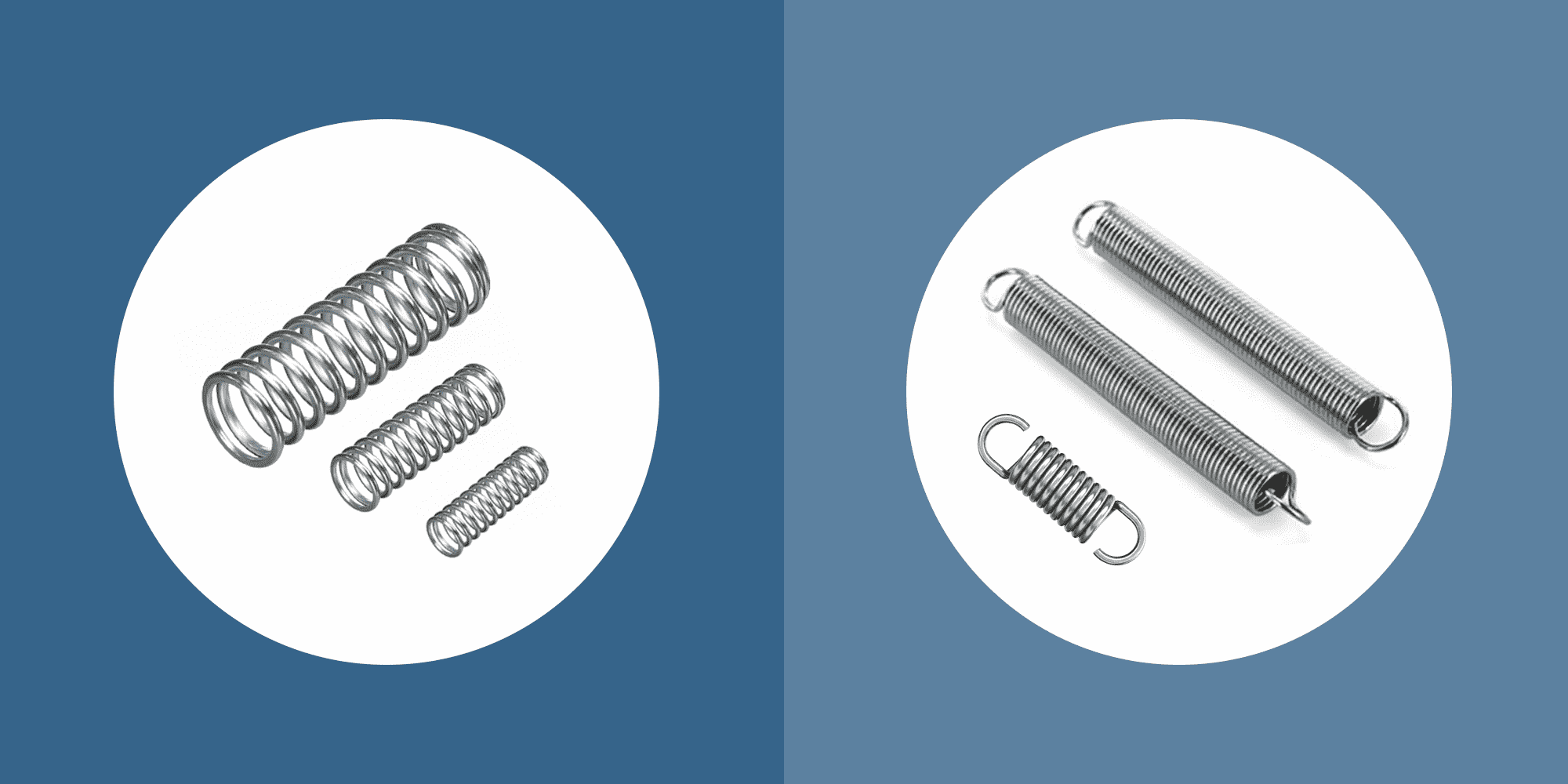
Compression vs. extension springs? One pushes, one pulls. Both store and release mechanical energy—just in different directions. Selecting the...
All precision spring manufacturers recognize that spring performance is a critical concern. If a spring lacks reliability, the equipment it supports...