


Home/
Blog/
Timing Belt Pulley: How It Works, Types & Selection Guide

5 min read

What Is a Timing Belt Pulley? How It Works, Types & Selection Guide

What Is a Timing Belt Pulley? How It Works, Types & Selection Guide
Timing Belt Pulley: How It Works, Types & Selection Guide
10:35

In any drive system where the output shaft must rotate at a precise, predictable ratio to the input shaft—think CNC machine axes, robotic joints, automotive camshafts, or 3D printer motion systems—a timing belt pulley is not optional.

It is the only component that can deliver synchronous, slip-free power transmission with the reliability and repeatability those applications demand.

Timing belt pulleys are one of several pulley categories used in industrial drives—for an overview of how they compare to V-belt, flat belt, idler, and rope pulleys, see types of pulleys.

V-belt sheaves and flat belt pulleys rely on friction—and friction-based drives always slip, by 1–3% under normal load.

For a positioning system moving at 200 mm/s, that 1% slip translates to 2 mm of cumulative position error per second.

Timing belt pulleys eliminate that error entirely by locking belt and pulley together through tooth engagement.

This guide covers how timing belt pulleys work, the standard series and their specifications, material considerations, and a practical framework for selecting the right pulley for your application.

How a Timing Belt Pulley Works

A timing belt pulley is a toothed wheel. Its teeth mesh precisely with the teeth molded into the inner surface of a synchronous belt.

Timing Belt Pulleys

When the drive pulley rotates, its teeth engage the belt teeth sequentially, pulling the belt and driving the driven pulley at a speed determined by the tooth count ratio—not by friction.

SPEED RATIO FORMULA

Speed Ratio = Ndriven / Ndrive

N = number of teeth on each pulley


Example:

20-tooth drive + 40-tooth driven = 2:1 speed reduction / 2× torque multiplication

Because the ratio is determined by tooth count and not by pulley diameter, timing belt pulleys can achieve precise ratios—0.5:1, 1.5:1, 3.75:1—that would be impractical with a V-belt and sheave combination.

Tooth Profile: Trapezoidal vs. Curvilinear

The original timing belt tooth was trapezoidal—flat-sided with angled flanks. This profile works, but stress concentrates at the tooth root under load, limiting fatigue life at high torque.

Curvilinear profiles—HTD (High Torque Drive) and the Gates GT2/GT3 standard—use a rounded tooth shape that distributes contact stress more evenly across the tooth face.

The result: 20–40% higher torque capacity for the same pitch and pulley width, with lower noise and longer belt life.

For new system designs, curvilinear profiles are the current engineering standard; trapezoidal profiles remain in use where interchangeability with legacy systems is required.

Tooth Profile Comparison

Trapezoidal (MXL / XL / L / H)

Tooth shape

Flat-sided, angled flanks

Stress distribution

Concentrated at tooth root

Best for

Legacy compatibility

Standard ANSI series

Curvilinear (HTD / GT2 / GT3)

Tooth shape

Rounded / semicircular profile

Stress distribution

Even across tooth face

Torque advantage

+20–40% vs. trapezoidal

Current engineering standard

Standard Timing Belt Pulley Series

Timing belt pulleys are categorized by pitch—the center-to-center distance between adjacent teeth.

Each series is engineered for a specific power and speed range.

Using the wrong series (too small a pitch for the load) is one of the most common causes of premature timing belt failure.

MXL · XL · L · H Series: Full Specification

MXL — Miniature Extra Light

Pitch: 0.080" (2.032 mm) · Power: <0.5 kW · Profile: Trapezoidal · Materials: Aluminum, Plastic

Applications: Medical instruments, office automation, light robotics, miniature actuators

→ Smallest standard pitch · prioritize weight and space

XL — Extra Light

Pitch: 0.200" (5.08 mm) · Power: 0.5–3 kW · Profile: Trapezoidal · Materials: Aluminum (primary), Steel, Plastic

Applications: 3D printers, packaging machinery, linear motion systems, servo drives

→ Most widely used series in light-to-medium automation

L — Light

Pitch: 0.375" (9.525 mm) · Power: 1–7.5 kW · Profile: Trapezoidal · Materials: Aluminum, Steel

Applications: Industrial automation, conveyor drives, servo motor systems, machine tools

→ Standard choice for moderate industrial power transmission

H — Heavy

Pitch: 0.500" (12.7 mm) · Power: 5–22 kW+ · Profile: Trapezoidal · Materials: Steel (primary), Aluminum

Applications: Machine tools, printing presses, heavy-duty automation, large conveyor systems

→ Highest tooth engagement force in the standard ANSI series

Pitch Size Comparison

Larger pitch = higher tooth engagement force = higher torque capacity

MXL

2.032 mm


XL

5.08 mm


L

9.525 mm


H

12.7 mm


Bar width proportional to pitch size

Material Selection

The pulley material determines wear resistance, weight, corrosion performance, and cost.

Three materials cover the vast majority of applications.

Anodized aluminum pulleys offer improved surface hardness (up to 60 HRC on the anodized layer vs. ~30 HRC for untreated 6061) and better corrosion resistance than bare aluminum, at minimal weight and cost penalty.

Timing Belt Pulley Material Comparison

MATERIAL

WEIGHT

WEAR RESIST.

BEST FOR

Aluminum (6061)

Most common choice

Low

Good

General automation,

robotics, moderate duty

Steel

High-cycle applications

High

Excellent

Heavy-load, machine tools,

high-cycle drives

Stainless Steel (316)

Corrosive environments

High

Excellent

Food, pharma, marine,

outdoor equipment

Plastic (Acetal / Nylon)

Light duty only

Very Low

Moderate

Light loads, low-noise,

non-metallic requirements

Anodized 6061 aluminum: surface hardness up to 60 HRC vs. ~30 HRC untreated — best balance of performance and cost for most applications

Key Parameters When Specifying

5 Key Specification Parameters

01

Pitch

Match pulley pitch exactly to belt pitch. MXL / XL / L / H belts are not interchangeable.

A 5.08 mm (XL) belt will not run on a 9.525 mm (L) pulley.

02

Number of Teeth

Min. 10–12 teeth in mesh (standard). 15+ for high-torque. More teeth in mesh = lower per-tooth load.

Determines pitch diameter and speed ratio.

03

Bore & Hub Configuration

Plain bore, keyed bore, or QD taper-lock. Use H7/k6 or H7/n6 fit for keyed connections.

QD hubs allow pulley removal without shaft disassembly — critical where downtime is costly.

04

Belt Width (Pulley Face Width)

Pulley face must be ≥ belt width + 1–2 mm clearance each side.

Wider belts distribute load more evenly and last longer at equivalent torque levels.

05

Flanges

Retain belt laterally. Flange the smaller pulley in a 2-pulley drive; flange both when shaft misalignment is a concern.

For 3+ pulleys: at least 2 should be flanged.

Timing Belt Pulley Selection Guide

One parameter that surprises engineers new to timing belt systems: belt tension in synchronous drives is lower than in V-belt systems.

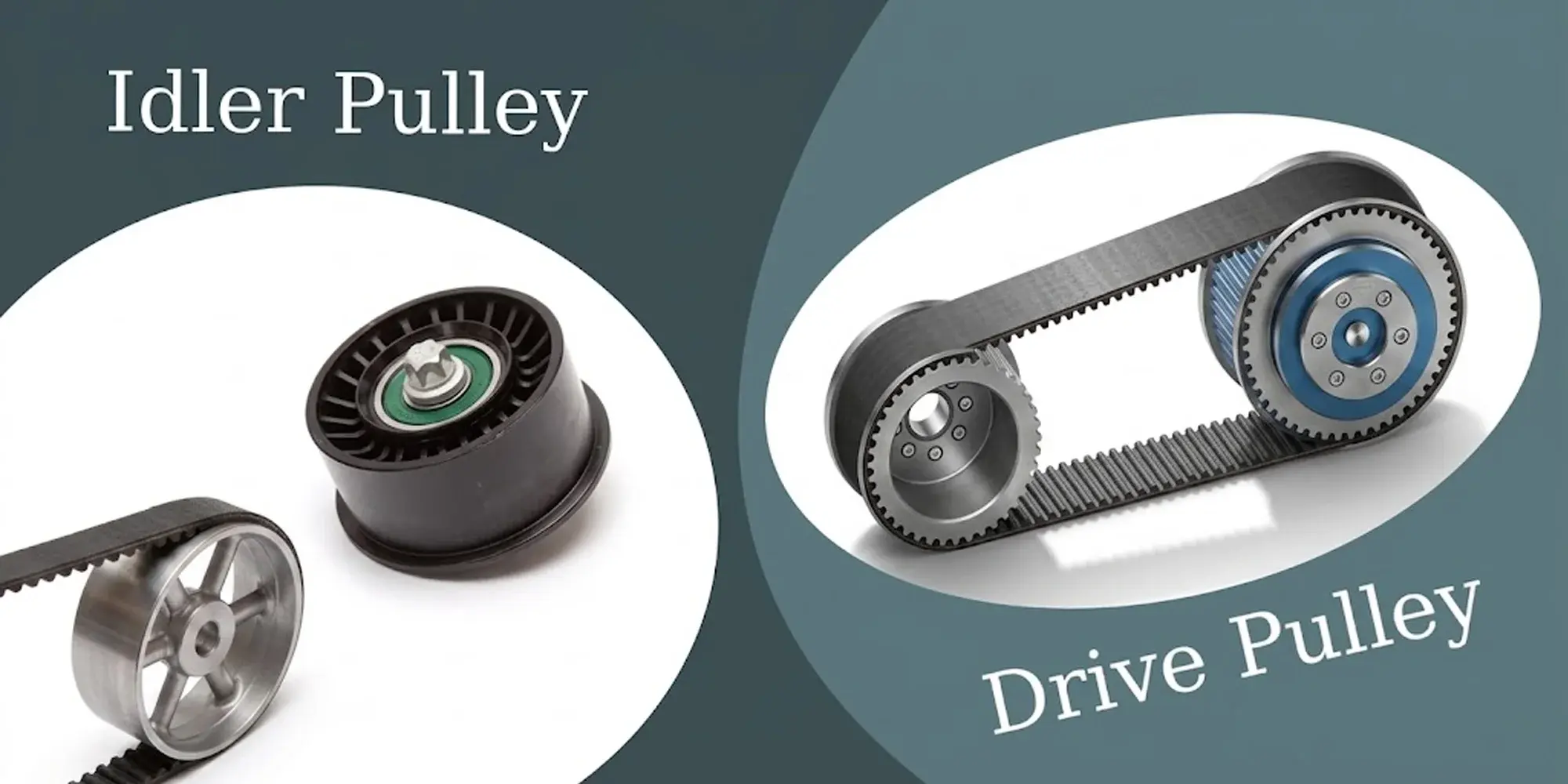
If your system also includes a tensioner or guide idler, see our guide on idler pulley vs drive pulley selection for bearing specification and failure mode reference.

Because drive force is transmitted through tooth engagement rather than friction, the belt only needs enough tension to maintain tooth mesh under load—typically 10–25% of the belt's rated tensile strength.

Over-tensioning is a common error; it accelerates bearing wear and can cause premature belt failure from tensile fatigue.

Step-by-Step Pulley Selection

STEP 1 — Define required speed ratio

Calculate N(driven) / N(drive). Choose tooth counts that achieve the target ratio with standard pulley sizes.

STEP 2 — Calculate design power

Design power = Rated power × Service factor (1.0 smooth load → 2.0+ shock / reversing / frequent start-stop).

STEP 3 — Select pitch from power/speed tables

Confirm selected pitch and tooth count handles design power at operating speed using manufacturer tables.

STEP 4 — Confirm minimum belt width

From power rating table, identify minimum belt width supporting design power. Round up to next standard width.

STEP 5 — Specify bore, hub, and flanges

Match bore to shaft diameter · Add flanges to smaller pulley · Select QD hub if serviceability matters.

LILY Bearing

MXL, XL, L & H Series Timing Belt Pulleys

Aluminum, steel, and corrosion-resistant variants. Plain bore, keyed bore, and quick-disconnect configurations. 497 products in stock.

Shop Timing Belt Pulleys →

FAQ

Are XL and L timing belt pulleys interchangeable?

No. XL pitch is 5.08 mm and L pitch is 9.525 mm—they are not compatible. A belt and its mating pulleys must share the same pitch. Attempting to run an XL belt on an L pulley will result in immediate tooth skipping and belt damage.

How do I calculate the pitch diameter of a timing belt pulley?

Pitch diameter (PD) = (Number of teeth × Pitch) / π. Example: a 20-tooth XL pulley has PD = (20 × 5.08) / 3.14159 = 32.36 mm. Note that pitch diameter differs from outside diameter—the OD is slightly smaller, depending on tooth height.

What is a quick-disconnect timing belt pulley?

A quick-disconnect (QD) pulley uses a split taper bushing that locks onto the shaft with socket-head cap screws. The bushing can be removed by reversing the screws to jack it out of the bore—no shaft disassembly required. This reduces pulley replacement time from hours to minutes in multi-pulley systems.

What is the difference between HTD and XL timing belt profiles?

XL uses a trapezoidal tooth profile. HTD (High Torque Drive) uses a semicircular curvilinear profile that distributes contact stress more evenly. HTD pulleys can handle 20–40% more torque than trapezoidal equivalents at the same pitch. XL and HTD belts and pulleys are not interchangeable even if nominal pitch is similar.

How tight should a timing belt be?

A properly tensioned timing belt should deflect approximately 1/64" (0.4 mm) per inch of span when a light force (typically 0.5–2 kg depending on belt size) is applied perpendicular to the span. For critical applications, a belt frequency meter matched to manufacturer tension specifications is the most accurate method.

References

ANSI/RMA IP-24 – Narrow V-Belt Drives (service factor methodology reference)

NIST – National Institute of Standards and Technology (engineering standards reference)

Norton, R.L. Machine Design: An Integrated Approach, 5th ed. Pearson.

Types of Pulleys and Their Uses: Belt, Idler, Rope & Timing

Types of Pulleys and Their Uses: Belt, Idler, Rope & Timing

A pulley is one of the six classical simple machines—but that simplicity is deceptive. In modern industrial and mechanical applications, pulleys...
Read More
Idler Pulley vs Drive Pulley: What's the Difference?

Idler Pulley vs Drive Pulley: What's the Difference?

Open any belt-driven machine—an automotive engine, an industrial conveyor, a CNC router—and you'll find at least one pulley that spins without being...

Read More
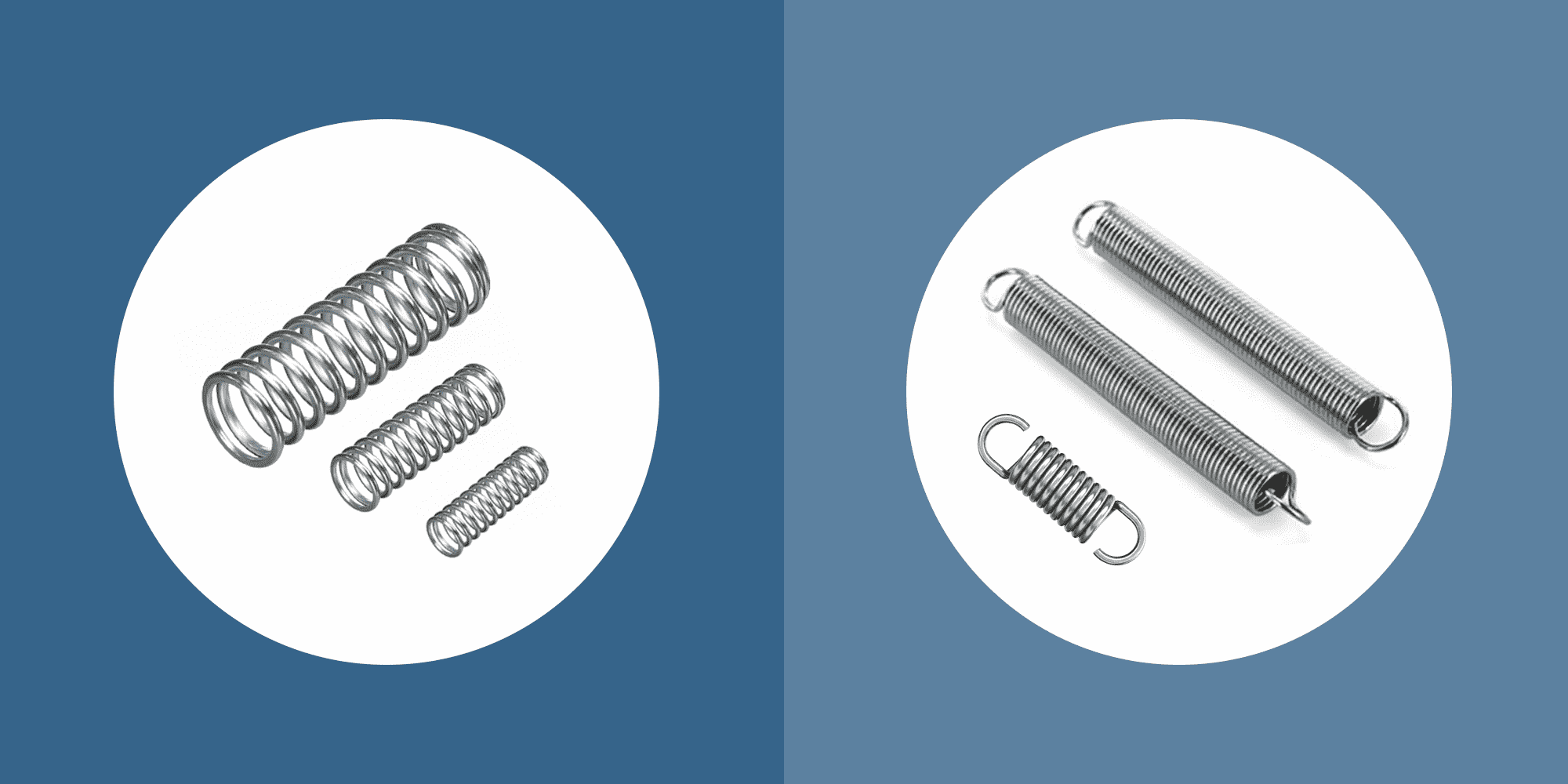
Compression vs Extension Springs: Key Differences

Compression vs Extension Springs: Key Differences

Compression vs. extension springs? One pushes, one pulls. Both store and release mechanical energy—just in different directions. Selecting the...

Read More