

Home/
Blog/
The Importance Of Bearing Preload And Axial Adjustment

2 min read

The Importance Of Bearing Preload And Axial Adjustment

The Importance Of Bearing Preload And Axial Adjustment
4:35

Preloading and axial adjustment are critical but often misunderstood aspects of bearing technology. When applied correctly, preload can significantly reduce issues such as vibration, heat build-up, noise, and premature fatigue in bearings.

Gary Hughes, Product Engineering Manager at The Barden Corporation, outlines the benefits and limitations of the three main methods of applying preload: springs, axial adjustment, and Duplex bearings.


Why Preloading Bearings Matters


Preloading is the process of removing or controlling a bearing’s internal clearance. The level of internal clearance directly affects:

  • Noise and vibration

  • Heat generation

  • Bearing fatigue life

  • System rigidity and stability

When correctly applied, preload can:

  • Control radial and axial play

  • Improve system rigidity and predictability

  • Reduce non-repetitive run-out

  • Minimize differences in contact angles at very high speeds

  • Control ball skidding under extreme acceleration


Bearing Yield: Axial and Radial Deflection


  • Axial yield is the deflection between the inner and outer rings after end play is removed and preload is applied. It is caused by elastic deformation of balls and raceways under thrust loading.

  • Radial yield is the deflection caused by radial loading.

Both types are influenced by bearing design, contact angle, and load characteristics. To optimize bearing life, preload should always be as light as possible to achieve performance without generating excess heat, which reduces speed capability and bearing longevity.


The Three Main Methods of Bearing Preload


Spring Preloading

Spring preloading is considered the simplest method and is often the first choice. Key benefits include:

  • Provides a constant preload

  • Less affected by thermal expansion compared to rigid preloading

  • Accommodates minor misalignment

  • Allows the use of standard bearings without costly preload grinding

However, spring preloading has limitations:

  • Cannot generally handle reversing thrust loads

  • Requires space for springs and spring travel

  • May cause ring misalignment due to clearance fits

Despite drawbacks, spring preloading remains popular, with options such as coil springs, Belleville washers, wave springs, and finger spring washers. Typically, springs are mounted on the non-rotating outer ring with a clearance fit to ensure preload effectiveness across temperature variations.


Axial Adjustment

Axial adjustment is achieved by mounting at least two bearings in opposition so that the rings are offset axially. Preload is applied through:

  • Threaded members

  • Precision shims

  • Spacers

Precision lapped shims are preferred over threaded members to avoid misalignment. Shims must be manufactured to 1–2 μm tolerances, equal to the bearings themselves.

Best practices for axial adjustment:

  • Ensure ring faces are well aligned and seated

  • Maintain extreme cleanliness during assembly

  • Avoid excessive preload during setup or operation due to thermal expansion

Advantages:

  • No increase in bearing friction

  • Ideal for low torque applications


Duplex Bearings

Duplex bearings incorporate built-in preload and are supplied as matched sets, simplifying installation. The preload is established by a precisely relieved offset between inner or outer ring faces.

Advantages of Duplex bearings:

  • Easy assembly and minimal run-out

  • High axial and radial rigidity

  • Ability to withstand bi-directional or heavy uni-directional thrust loads

Limitations:

  • Increased torque and heat generation

  • Reduced speed capacity

  • Sensitive to misalignment and thermal expansion

  • Less adaptable to interference fits


Duplex Configurations

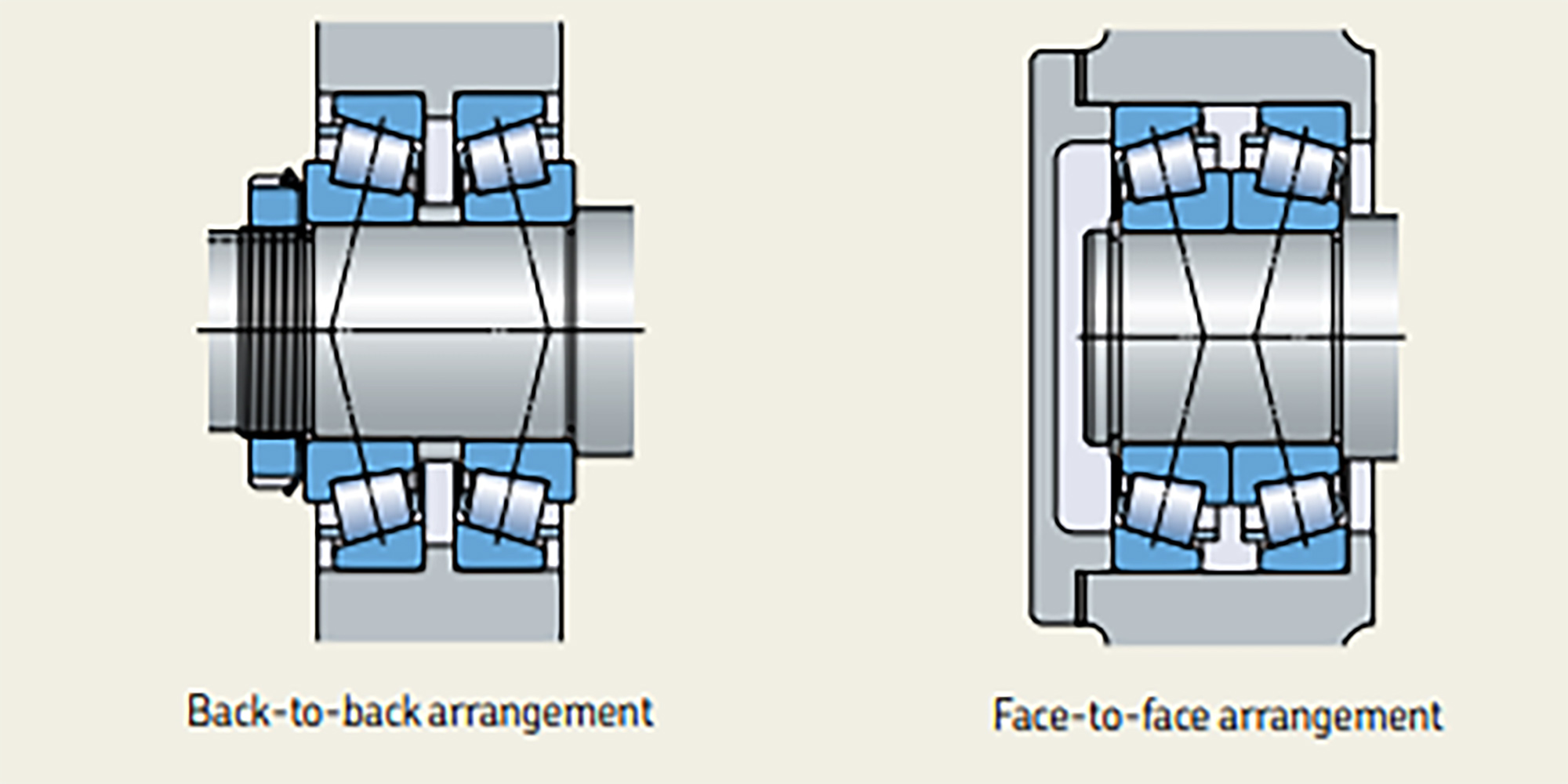
  • DB (Back-to-Back): Best for well-aligned housings, high moment rigidity, and when shafts run warmer than housings.

  • DF (Face-to-Face): Used when misalignment must be accommodated, though speed capability is lower than DB.

  • DT (Tandem): Designed for heavy thrust loads in one direction, offering greater capacity without increasing bearing size. DT sets require spring preloading since they do not have built-in preload.


Choosing the Right Preload Method


The choice between spring preloading, axial adjustment, and Duplex bearings depends on application requirements, alignment conditions, torque limitations, and load characteristics.

When applied correctly, bearing preload and axial adjustment help minimize vibration, reduce heat, extend bearing life, and improve overall system performance — ensuring reliability even under high-speed or heavy-load conditions.


Types of Bearings: A Comprehensive Guide

Types of Bearings: A Comprehensive Guide

Importance of Bearings in Mechanical Systems Bearings are crucial for smooth and efficient motion in mechanical systems, while reducing friction,...
Read More
Tesla and its Gigafactory run with Lily Bearing

Tesla and its Gigafactory run with Lily Bearing

LILY has supplied assistance in Tesla’s create new products at the Gigafactory, a special custom slewing bearing made by Lily Bearing will soon start...
Read More
Bearing Anti-corrosion solution

Bearing Anti-corrosion solution

Take wind power generation and tidal power generation as examples to discuss bearing corrosion prevention Wind power and tidal power, as renewable...

Read More