

Home/
Blog/
Polyurethane Rollers vs Wheels: How to Choose | Engineer's Guide

7 min read

Polyurethane Rollers vs. Wheels: How to Choose

Polyurethane Rollers vs. Wheels: How to Choose
Polyurethane Rollers vs Wheels: How to Choose | Engineer's Guide
15:16

In my 15 years at LILY Bearing, I've seen one specification error cost companies $30K-50K in unplanned downtime: confusing polyurethane rollers with polyurethane wheels.

This isn't a terminology issue. It's a fundamental design mistake that leads to bearing seizure, belt misalignment, and production stops.

Here's the simplest way to understand the difference:

  • Rollers stay mounted in place and move materials past them
  • Wheels move with your equipment, like casters on a cart

Get this wrong, and all your downstream engineering—bearing selection, load calculations, maintenance schedules—becomes worthless.

This guide shows you how to identify which component you need, then spec it correctly for long-term reliability.


What Are Polyurethane Rollers?

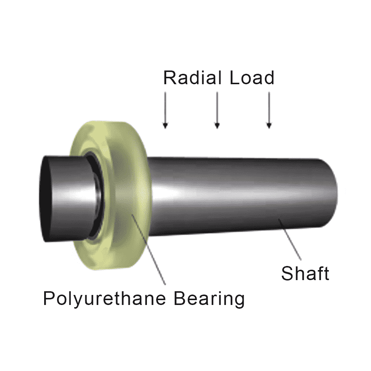
A polyurethane roller is a precision power transmission or guidance component. The roller mounts on a fixed axis with integrated bearings.

As it rotates, it drives, supports, or guides belts, webs, or products through a stationary machine frame.

 Polyurethane Rollers

How do they work? 

The roller sits inside a fixed assembly. The housing stays in place. Only the cylindrical surface rotates to move other items through the system.


What loads do they handle? 

Polyurethane rollers withstand significant radial loads.

Standard conveyor idler rollers support continuous line loads from 1.5 to 4 kN/m.

High-performance versions use polyurethane formulations with a Taber Abrasion Index (H-22 Wheel) under 40 mg loss. This allows service lives exceeding 8,000 hours in demanding conditions.

Polyurethane Roller Load Capacity

How do you optimize performance? 

Manufacturers engineer the polyurethane lining for specific surface interactions. 

Here's how hardness affects performance:

  • For minimal deformation: Specify 95 Shore A/55 Shore D hardness. This keeps deflection under 1% even under high belt tension. Why does this matter? In high-speed conveyors running over 500 RPM, even 2-3% deflection causes belt tracking problems and premature edge wear.
  • For maximum grip: Specify 70 Shore A compound. This delivers a coefficient of friction greater than 0.7 for positive feed applications. I use this specification when clients need precise material advancement without slippage—like in printing presses or packaging lines.


Where are they used? 

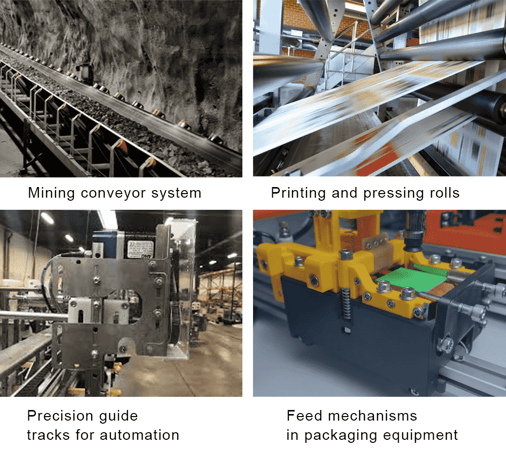
  • Conveyor systems (manufacturing, distribution, mining)
  • Printing and pressing rolls
  • Precision guide tracks for automation
  • Feed mechanisms in packaging equipment

Polyurethane roller applications


What Are Polyurethane Wheels?

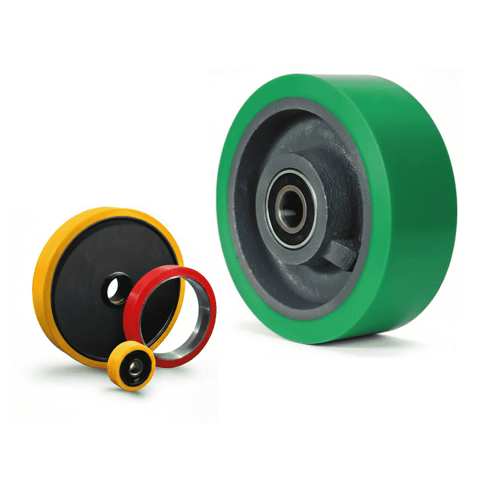
A polyurethane wheel is a load-bearing mobility device. It connects to a moving body (cart, trolley, AGV) and its rotation enables the translation of that entire structure.

Polyurethane Wheels

How do they work? 

The wheel, axle, and mounting bracket function as one integrated unit.

When the wheel rotates, the entire assembly translates horizontally, relocating your equipment from point A to point B.


What loads do they deal with? 

Polyurethane wheels support vertical and axial loads—weight pressing straight down through the axle and hub.

A typical heavy-duty industrial caster uses a wheel rated for 1,200 lb (5.3 kN) static load.

The polyurethane tread measures ¾-inch (19 mm) thick.

This thickness serves two purposes.

It absorbs impact when rolling over debris or expansion joints, and it protects floor surfaces from damage.

The diagram below illustrates how the ¾” tread specification isn‘t arbitrary.

Compared to a thinner tread, it allows the polyurethane to deflect safely under load, directly resulting in the 1,200 lb capacity we specify for heavy-duty casters, while simultaneously fulfilling its dual role of impact absorption and floor protection.

HOW TREAD THICKNESS DRIVES PERFORMANCE


How do you optimize performance? 

Manufacturers balance the tread hardness—typically 80A to 95A—to optimize three factors:

  • Load capacity: How much weight the wheel supports without permanent deformation
  • Rolling resistance: The force required to move the loaded equipment (affects operator ergonomics and battery life in powered vehicles)
  • Floor protection: The wheel's impact on various floor types—concrete, epoxy coatings, tile

In my experience, 85A hits the sweet spot for most industrial applications, providing good load capacity while still protecting finished floors.


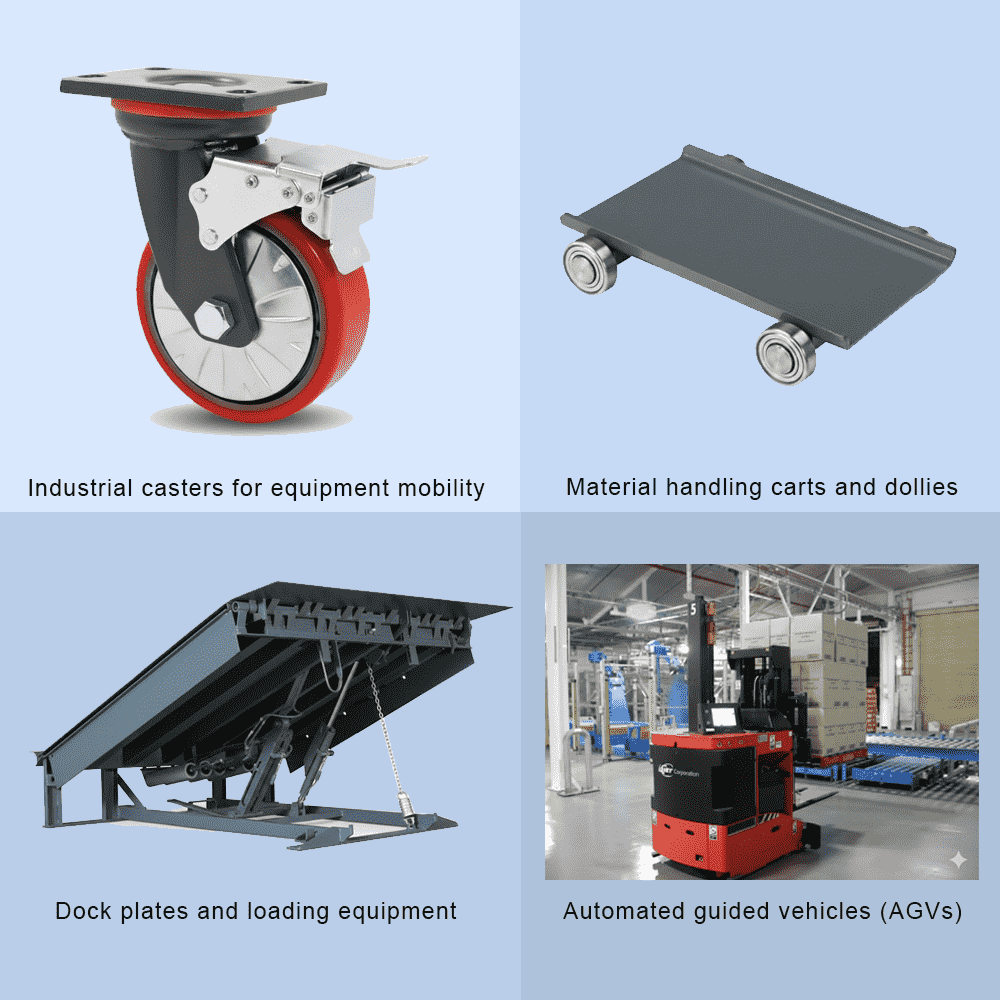
You'll find them in:

  • Industrial casters for equipment mobility
  • Material handling carts and dollies
  • Dock plates and loading equipment
  • Automated guided vehicles (AGVs)

Polyurethane Wheel Applications_compressed


The Critical Differences: A Functional Breakdown

Your choice between polyurethane rollers and wheels depends on one kinematic question.

This comparison clarifies the decision:

Engineering Parameter

Polyurethane Roller

Polyurethane Wheel

Primary Function

Internal Material Handling: Moves product through a machine.

Equipment Mobility: Moves the machine itself.

Kinematic State

Housing fixed. Cylinder rotates.

Entire assembly translates.

Dominant Load Vector

Radial Load (at right angles to the shaft).

Axial/Vertical Load (through the axle/hub).

Design Priority

Surface traction, wear resistance, dimensional precision (TIR < 0.1 mm).

Load rating, tread life, rolling resistance, floor protection.

Key Selection Question

"What moves through my machine?"

"What moves my machine?"

To navigate this fundamental choice, apply the following decision logic:

The Engineering Litmus Test: 

If removing the component halts your production line's material flow, you need a roller. If it only keeps the equipment in place, you need a wheel.

This test has never failed me in many years of application engineering.


Case Study: The $45K Mistake

A food processing plant contacted us after experiencing chronic bearing failures.

Their maintenance team was replacing bearings on their "impact idlers" every 10-12 weeks—at $800 per bearing set plus 4 hours of downtime each time.

The problem? Someone had specified polyurethane wheels instead of proper impact idler rollers at the loading zone where 50-lb bags dropped onto the conveyor belt.


Why wheels failed:

  • Wheels are designed for vertical loads, not the repeated radial impact from falling products
  • The bearing arrangement in a wheel assembly can't handle the shock loads
  • The mounting bracket wasn't rigid enough for a fixed installation


The solution: 

We replaced them with true impact idler rollers—95A hardness polyurethane bonded to steel cores with sealed precision bearings rated for shock loads.


Results:

  • Bearing life extended from 12 weeks to 18+ months
  • Annual savings: $45,000 in parts and labor
  • Eliminated 26 unplanned production stops per year

The wheel assemblies cost $180 each. The proper impact idler rollers cost $420 each. But the "cheaper" option was costing them over 10 times more annually.


How to Specify Polyurethane Rollers: The Complete Process

Once you've confirmed you need a roller, follow this systematic specification process.


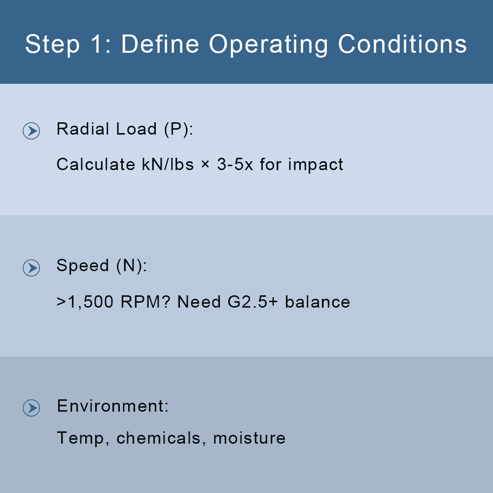
Step 1: Define Operating Conditions

Define Operating Conditions

📏Radial Load (P): Calculate the force acting perpendicular to the roller shaft, measured in kN or lbs.

For impact conditions—like material dropping onto a belt at loading zones—multiply your static load calculation by a dynamic factor of 3x to 5x.

Why? The instantaneous impact force far exceeds steady-state load.

I've seen engineers skip this step and wonder why bearings fail in weeks instead of years.

Example: If 100 lbs of product drops 3 feet onto your belt, don't design for 100 lbs. Design for 300-500 lbs.


⚡Rotational Speed (N): Specify in RPM.

For speeds exceeding 1,500 RPM, you must specify G2.5 or better dynamic balance grade and use precision bearings.

At these speeds, even minor imbalance creates vibration that destroys bearings prematurely.


🌡️Environmental Factors: Document the complete operating environment:

  • Temperature range (minimum and maximum)
  • Chemical exposure (oils, solvents, cleaning agents)
  • Moisture/humidity levels
  • Indoor vs. outdoor installation

Polyester-based urethanes, for example, typically exhibit swell resistance of less than 5% after prolonged oil immersion.

But polyether urethanes can swell 15-20% in the same conditions. This detail matters.


Step 2: Specify Material Properties

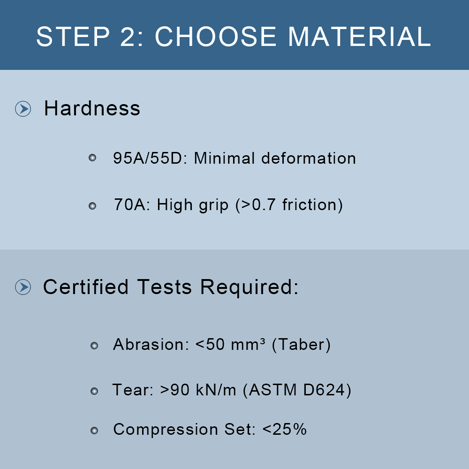
STEP 2 CHOOSE MATERIAL

🔧Hardness (Durometer): This single parameter controls most performance characteristics.

Hardness

Characteristics

Best Applications

95 Shore A / 55 Shore D

Minimal deformation, high load capacity, excellent abrasion resistance

High-tension belt drives, heavy-load conveyors, drive rollers

70 Shore A

Compliant surface, high coefficient of friction (>0.7), good shock absorption

Delicate product feeding, grip rollers, applications requiring traction

Honestly, hardness selection is where I see most specification errors.

Engineers often assume "harder equals longer life."

But in high-vibration applications, I've found that a properly selected 70A compound can outlast 95A by 2-3x because it absorbs shock energy instead of transmitting it to the bearings.


📊Performance Data Requirements:

Always demand certified test reports. Don't accept verbal assurances or generic spec sheets. Premium rollers should demonstrate:

Test Parameter

Standard/Method

Required Performance

Abrasion Resistance

Taber Abraser, volume loss

<50 mm³

Tear Strength

ASTM D624 Die C

>90 kN/m

Compression Set

ASTM D395, 22 hrs at 70°C

<25%


These aren't arbitrary numbers. They're the thresholds below which I've consistently seen premature failures in industrial service.


Step 3: Design the Mechanical Assembly

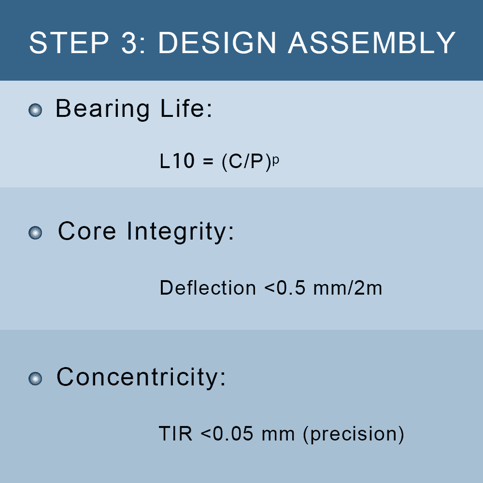
STEP 3 DESIGN ASSEMBLY

Bearing Life Calculation:

Use the standard bearing life formula: L10 = (C/P)^p

Where:

  • L10 = bearing life (in millions of revolutions) at which 10% of bearings will have failed
  • C = dynamic load rating of the bearing (from manufacturer)
  • P = equivalent dynamic load on the bearing
  • p = exponent (3 for ball bearings, 10/3 for roller bearings)


Worked Example:

  • Roller operates under 2.5 kN radial load
  • Speed: 600 RPM
  • Bearing selected: C = 15 kN dynamic rating
  • L10 = (15/2.5)³ = 216 million revolutions

At 600 RPM, this equals 360 hours of operation, or roughly 45 eight-hour production shifts.


Critical insight from field experience: 

This calculation assumes clean, room-temperature conditions.

In real industrial environments—high heat, dust, chemical exposure—I reduce the theoretical L10 by 40-50% for maintenance planning.

It's better to replace bearings "early" than to suffer unplanned failures.


Core and Dimensional Integrity:

The steel core must be designed to limit deflection to less than 0.5 mm over a 2-meter span under full load.

Excessive deflection causes belt tracking issues and uneven wear patterns.

Specify final machined concentricity (Total Indicated Runout, or TIR) within 0.05 mm for precision applications.

At speeds above 800 RPM, runout over 0.1 mm creates vibration you can feel from 10 feet away—and that vibration destroys bearings.


How to Specify Polyurethane Wheels

Wheel specification is more straightforward but still requires attention to four critical parameters:

Dynamic and Static Load Ratings 

  • Static: Maximum weight when parked
  • Dynamic: Maximum weight while moving
  • Always verify both—they're not the same number
Polyurethane Wheels

Wheel Diameter and Tread Width 

  • Larger diameter = lower rolling resistance and easier floor obstacle clearance
  • Wider tread = better load distribution and floor protection
  • Must fit your equipment's mounting dimensions and ground clearance


Tread Hardness 

  • I typically recommend 85A durometer for general industrial use
  • It provides the best balance of load capacity, floor protection, and durability
  • Use harder (92-95A) for maximum load capacity on smooth floors
  • Use softer (75-80A) for floor protection and shock absorption


Hub and Bearing Type 

  • Match to your duty cycle: continuous operation requires sealed precision bearings
  • Intermittent use can often work with standard roller bearings
  • Consider maintenance access—some designs allow bearing replacement without replacing the entire wheel


Select and Specify the Right Product

Once you know what your roller needs to do, the next step is choosing the right LILY Bearing product engineered for that task.

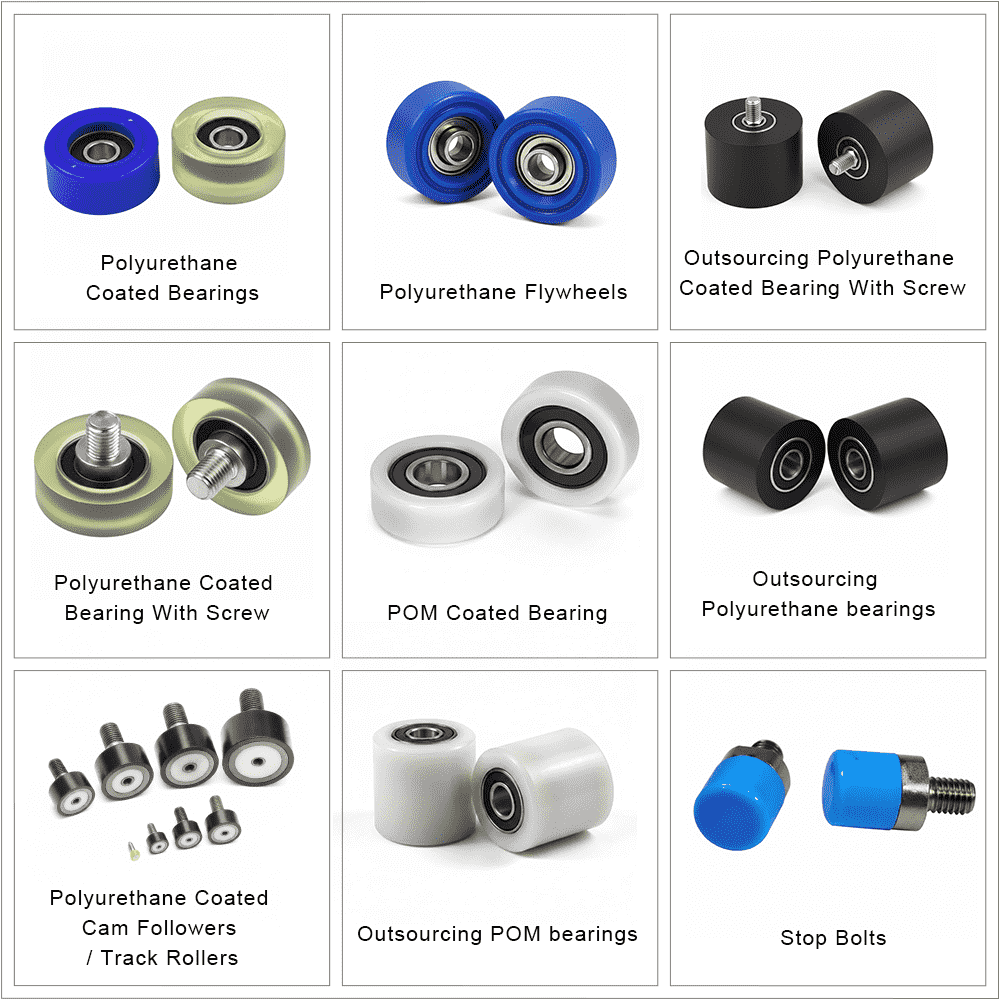
Types of Polyurethane Rollers


Each line offers specific construction advantages for its intended application.

Application Scenario

Recommended Product

Key Features

Best For

Conveyor Systems
(Drive/Idler/Impact)

Standard Polyurethane Coated Bearings

• MDI-based chemical bonding to steel core
• Resists thermal cycling & shock loads
• Integrated precision bearings

• Drive rollers
• Idler rollers (trough, return)
• Impact idlers

Fast Installation & Maintenance

Polyurethane Coated Bearings with Screw

• Integrated mounting thread
• Eliminates press-fitting
• Reduces installation time by 40-60%

• Quick installation
• Field replacement
• High-maintenance areas

Precision Guidance & Linear Motion

Polyurethane Coated Cam Followers / Track Rollers

• Sealed precision bearings (>50,000 hrs L10)
• Crowned profile for self-alignment
• Optimized hardness (85-90A) for low noise

• Guide rollers
• Track rollers
• V-guide rollers
• Automated machinery

Special Function Components

Polyurethane Flywheels

• Absorbs/releases rotational energy
• Smoothes speed fluctuations
• Enhances drive system stability

• Energy storage in drives
• Motion smoothing applications


The Stop Bolt

• Positive mechanical hard-stop
• Precise travel limitation
• Ensures safety and repeatable positioning

• Linear/rotational travel limits
• Safety positioning devices


Conclusion

Choosing between polyurethane rollers and wheels boils down to one question: fixed rotation or mobile translation?

For critical systems, off-the-shelf parts add risk.

At LILY Bearing, we’ve engineered custom rollers and wheels for 500+ installations across automotive, food processing, and logistics.

Our formulations are specified by top conveyor OEMs, and every component is backed by ISO-9001 certified processes.


Get Your Free Engineering Review
Send us three numbers—your load, RPM, and operating environment—and within 24 hours you’ll receive:

  • Custom component specifications matched to your exact application
  • Material recommendations with certified test data
  • Calculated service life based on your operating conditions
  • Cost comparison between custom and off-the-shelf options

No obligation. No sales pressure. Just engineering.


FAQ


Q: Can I use a wheel instead of a roller to save money?

A: No. The cost difference is $50-200, but using the wrong component causes $5K-50K in failures. Use the Engineering Litmus Test above.


Q: How long do polyurethane rollers last?

A: 8,000-12,000 hours with proper specification. Key factors: hardness match, load rating, and environment.


Q: What's the lead time for custom rollers?

A: 3-4 weeks for prototypes, 4-6 weeks for production. Rush service available.


Cast Urethane vs. Machined Polyurethane Rollers: Engineering Guide

Cast Urethane vs. Machined Polyurethane Rollers: Engineering Guide

In modern manufacturing—from food processing lines to mining conveyors—the roller is a critical component. Polyurethane rollers can last up to four...
Read More
Polyurethane Rollers with Bearings: Features and Uses

Polyurethane Rollers with Bearings: Features and Uses

Polyurethane rollers with bearings are crucial for enhancing machinery efficiency and performance. They provide durability, low friction, and high...

Read More
How to Choose the Right Polyurethane Rollers

How to Choose the Right Polyurethane Rollers

In the realm of industrial operations, selecting the perfect parts is crucial. They can significantly impact efficiency, performance, and the overall...

Read More