

Home/
Blog/
Pillow Block Bearing Size Chart: How to Determine the Right Size for Your Shaft

11 min read

Pillow Block Bearing Size Chart: How to Determine the Right Size for Your Shaft

Pillow Block Bearing Size Chart: How to Determine the Right Size for Your Shaft
22:30

The most common sizing mistake we see: someone measures their shaft with a tape measure, rounds to the nearest half-inch, and orders the wrong bore.

The bearing arrives, won't slide on cleanly, and they assume it's defective.

It's not—the shaft was 1.000" but they ordered a 1-1/16" bore.

Getting pillow block bearing size right starts with an accurate shaft measurement and ends with cross-checking three dimensions: bore, center height, and bolt spacing.

This guide walks through all of it, with complete size charts for UCP200 metric and imperial series.


How to Read a Pillow Block Bearing Model Number

Every UCP model number encodes the housing type, series, bore size, and—for inch variants—the exact shaft diameter.

Once you know the pattern, you can decode any unit in seconds.

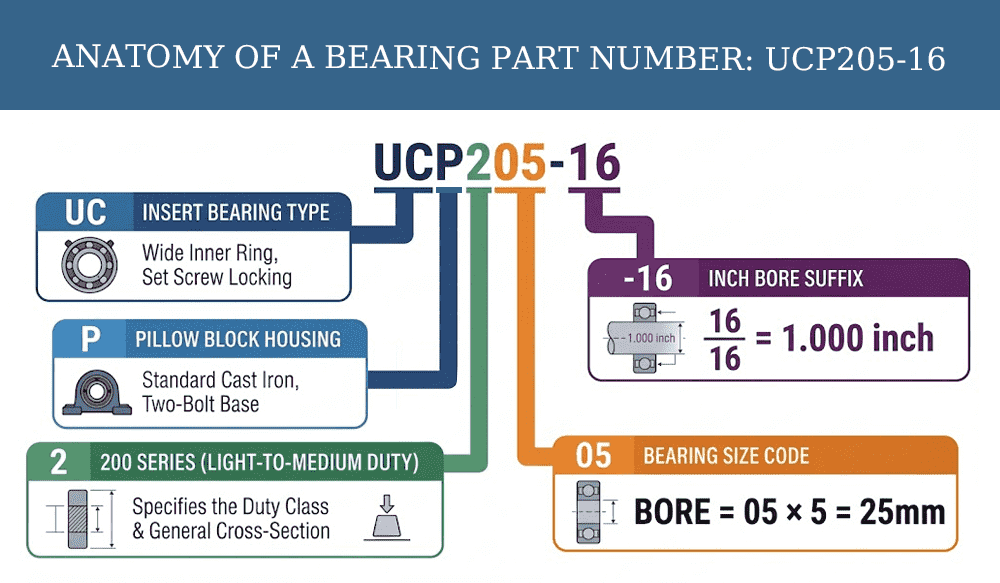
Anatomy of a pillow block bearing model number UCP205-16 showing UC insert type, P housing, 200 series, 05 bore code, and -16 inch suffix


Take UCP205-16 as an example:

UC

Insert bearing type (wide inner ring, set screw)

P

Pillow block housing

2

200 series (light-to-medium duty)

05

Bearing size code → bore = 05 × 5 = 25mm

-16

Inch bore suffix: 16/16 = 1.000 inch


Metric vs Imperial Suffixes

Units without a suffix (e.g. UCP205) are metric—bore is 25mm. Units with a numeric suffix are inch bore—the suffix is the bore in 1/16 inch increments.

So UCP205-14 has a bore of 14/16 = 7/8 inch, and UCP205-16 has a 1-inch bore.


✅ Quick bore calculation for metric units

For UCP204 onward, the bore in mm = last two digits × 5.

So UCP204 = 20mm, UCP205 = 25mm, UCP206 = 30mm, UCP207 = 35mm, UCP208 = 40mm, and so on.


Note:

UCP201, UCP202, and UCP203 are exceptions—their bores are 12mm, 15mm, and 17mm respectively, not derived from the ×5 rule.


Other Common Prefixes

Prefix Housing Type Shaft Orientation
UCP Pillow block (standard) Parallel to mounting surface
UCPA Tapped base pillow block Parallel, compact footprint
UCPH High-center pillow block Parallel, elevated shaft
UCF Four-bolt square flange Perpendicular to mounting surface
UCFL Two-bolt oval flange Perpendicular, compact
UCT Take-up unit Adjustable, belt tensioning
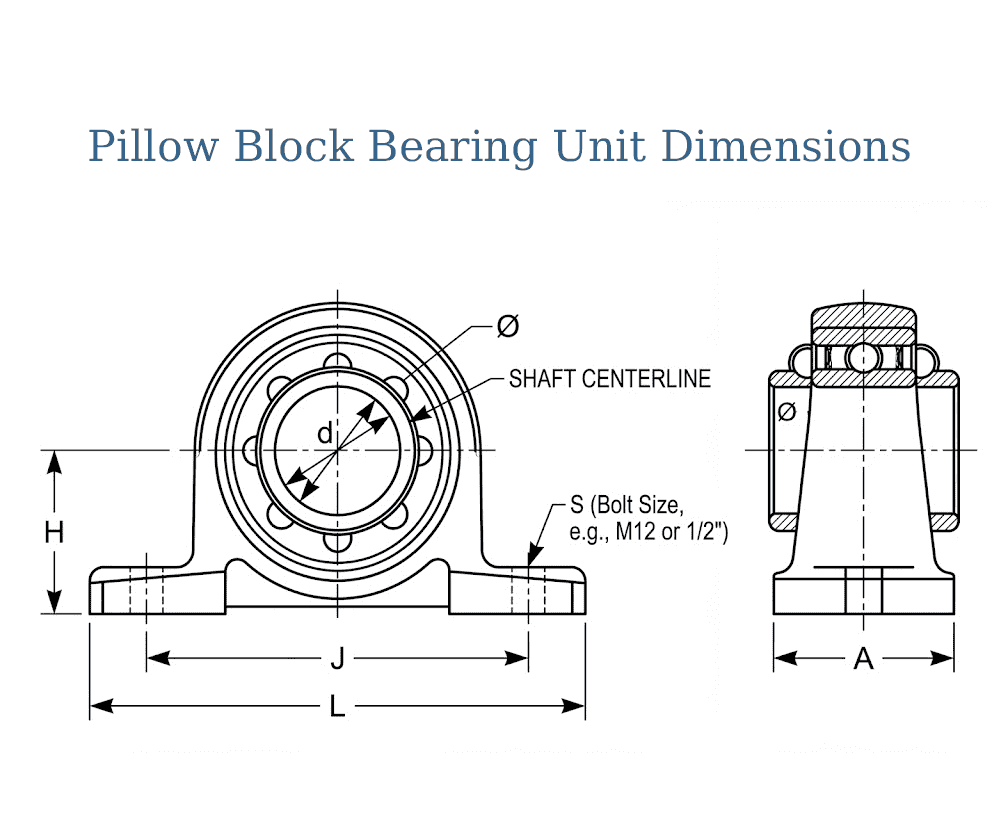
Dimension Symbol What It Means Why It Matters
Bore diameter d Inner diameter of bearing insert—must match shaft Wrong bore = bearing won't mount or will slip on the shaft
Base to center height H Distance from mounting surface to shaft centerline Critical for alignment—a 2mm mismatch misaligns the entire drivetrain
Housing length L Overall length of the housing Determines whether the unit fits your available frame space
Bolt hole spacing J Center-to-center distance between mounting bolt holes Must match your existing hole pattern; wrong J means drilling new holes
Bolt size S Recommended mounting bolt diameter Undersized bolts can't maintain clamping force under vibration
Housing width A Width across the housing base Affects footprint and washer bridging clearance over mounting slots
 
ℹ️ H dimension is critical for shaft alignment
If you're replacing an existing bearing, the H dimension of the new unit must match the old one exactly—or you'll introduce shaft misalignment across the whole drivetrain. Always check H before ordering a replacement.


UCP200 Series Size Chart (Metric)

The UCP200 series is the most widely used pillow block bearing series globally.

Bore sizes run from 12mm (UCP201) to 75mm (UCP215), covering the vast majority of industrial shaft diameters.

All dimensions below conform to ISO standards and are consistent across reputable manufacturers.

Unit No. Bore d (mm) Center Height H (mm) Housing Length L (mm) Bolt Spacing J (mm) Bolt Size Dynamic Load Cr (kN)
UCP201 12 30.2 127 95 M10 6.82
UCP202 15 30.2 127 95 M10 7.65
UCP203 17 30.2 127 95 M10 9.56
UCP204 20 33.3 127 95 M10 12.8
UCP205 25 36.5 140 105 M10 14.0
UCP206 30 42.9 165 121 M14 19.5
UCP207 35 47.6 167 127 M14 25.5
UCP208 40 49.2 184 137 M14 29.0
UCP209 45 54.0 190 146 M14 32.5
UCP210 50 57.2 206 159 M16 35.1
UCP211 55 63.5 219 171 M16 43.2
UCP212 60 67.5 229 178 M16 52.7
UCP213 65 71.4 248 194 M20 57.2
UCP214 70 74.6 260 203 M20 63.7
UCP215 75 82.6 275 217 M20 66.3

Source: industry-standard UCP200 series technical specifications. Dynamic load ratings (Cr) are for standard UC200 insert bearings. Highlighted rows = most commonly stocked sizes. Always verify with your supplier's specific catalog for tolerance details. 

Browse Lily Bearing's full UCP200 series range by bore size and material: Pillow Block Bearings — Product Range →

✅ Most commonly ordered metric sizes

UCP204 (20mm), UCP205 (25mm), UCP206 (30mm), UCP207 (35mm), and UCP208 (40mm) account for the majority of industrial orders.

If you're specifying a new design, using one of these five sizes gives you the widest supplier availability and fastest lead times.


UCP200 Series Size Chart (Imperial / Inch)

Imperial inch bore variants use a suffix indicating bore size in 1/16 inch increments.

A UCP205-16 has a 1-inch bore (16 × 1/16 = 1.000").

The housing dimensions are identical to the metric counterpart—only the bore changes.

Unit No. Bore (inches) Bore (decimal) Center Height H (in) Housing Length L (in) Bolt Spacing J (in) Bolt Size
UCP201-8 1/2" 0.500" 1.189" 5.000" 3.740" 3/8"
UCP202-9 9/16" 0.5625" 1.189" 5.000" 3.740" 3/8"
UCP202-10 5/8" 0.625" 1.189" 5.000" 3.740" 3/8"
UCP203-11 11/16" 0.6875" 1.189" 5.000" 3.740" 3/8"
UCP204-12 3/4" 0.750" 1.312" 5.000" 3.740" 3/8"
UCP205-13 13/16" 0.8125" 1.437" 5.500" 4.125" 3/8"
UCP205-14 7/8" 0.875" 1.437" 5.500" 4.125" 3/8"
UCP205-15 15/16" 0.9375" 1.437" 5.500" 4.125" 3/8"
UCP205-16 / UCP205-100 1" 1.000" 1.437" 5.500" 4.125" 3/8"
UCP206-101 1-1/16" 1.0625" 1.689" 6.500" 4.750" 1/2"
UCP206-102 1-1/8" 1.125" 1.689" 6.500" 4.750" 1/2"
UCP206-103 1-3/16" 1.1875" 1.689" 6.500" 4.750" 1/2"
UCP206-104 1-1/4" 1.250" 1.689" 6.500" 4.750" 1/2"
UCP207-104 1-1/4" 1.250" 1.874" 6.562" 5.000" 1/2"
UCP207-105 1-5/16" 1.3125" 1.874" 6.562" 5.000" 1/2"
UCP207-107 1-7/16" 1.4375" 1.874" 6.562" 5.000" 1/2"
UCP208-108 1-1/2" 1.500" 1.937" 7.250" 5.375" 1/2"
UCP208-109 1-9/16" 1.5625" 1.937" 7.250" 5.375" 1/2"
UCP209-110 1-5/8" 1.625" 2.125" 7.500" 5.750" 1/2"
UCP209-112 1-3/4" 1.750" 2.125" 7.500" 5.750" 1/2"
UCP210-114 1-7/8" 1.875" 2.250" 8.125" 6.250" 5/8"
UCP210-200 2" 2.000" 2.250" 8.125" 6.250" 5/8"
UCP211-203 2-3/16" 2.1875" 2.500" 8.625" 6.750" 5/8"
UCP215-48 3" 3.000" 3.252" 10.812" 8.543" 3/4"

Source: industry-standard UCP200 series technical specifications. Highlighted rows = highest search volume / most commonly ordered inch sizes. Housing dimensions are identical for metric and inch variants of the same bearing number. 


⚠️ Don't confuse UCP205-16 and UCP205-100

Both designate a 1-inch bore UCP205. The "-16" suffix means 16 × 1/16 = 1.000".

The "-100" suffix is an alternative designation used by some manufacturers for the same 1.000" bore.

They are the same bearing—just different catalog naming conventions.

Always confirm bore size in decimal, not just the suffix number.


UCP200 vs UCP300: Which Series Do You Need?

For the same shaft diameter, UCP300 series uses a larger bearing insert than UCP200, which means a bigger housing but higher load capacity.

Here's a direct comparison for a 25mm shaft:

Parameter UCP205 (200 series) UCP305 (300 series)
Bore 25mm 25mm
Insert bearing UC205 (52mm OD) UC305 (62mm OD)
Center height H 36.5mm 45.2mm
Housing length L 140mm 178mm
Dynamic load Cr 14.0 kN 22.5 kN
Speed limit (grease) ~5,850 rpm ~4,500 rpm
Best for Light-to-medium loads, higher speeds Medium-to-heavy loads, lower speeds

For most conveyor, fan, and general industrial applications, UCP200 series is the right choice.

But knowing when to switch is just as important as knowing how to read the chart.

The practical trigger for moving to UCP300 is load, not preference.

When the equivalent dynamic load consistently exceeds 60–70% of the UCP200 unit's Cr rating—after applying your safety factor—you're running the bearing harder than it's designed for.

The UCP300 insert uses a larger ball complement and a bigger OD for the same bore, which gives you roughly 60% more load capacity (14.0 kN → 22.5 kN for a 25mm bore) at the cost of a taller, longer housing.

Speed is the other factor.

The larger rolling elements in UC300 series don't spin as fast—UC305 tops out around 4,500 rpm with grease versus ~5,850 rpm for UC205.

If your application needs both high speed and high load on the same shaft, you're looking at a different bearing category altogether, not just a series upgrade.

One practical note: UCP300 housings are not bolt-pattern compatible with UCP200.

The center height H and bolt spacing J are different, so you can't swap series without drilling new mounting holes.

Need help understanding load capacity calculations for your application? Load Capacity and Performance Analysis of Pillow Block Bearings →


Shaft Tolerance and Bore Fit

Pillow block bearing bore is manufactured to a specific tolerance.

The shaft needs to be within tolerance for the bearing to grip correctly—too loose and it spins on the shaft, too tight and you can't install it.


Recommended Shaft Tolerances for UCP Series

Locking Method Shaft Tolerance Notes
Set screw (standard UCP) h6 or js6 Slight clearance to interference fit; shaft must be smooth and round
Eccentric collar h6 or h7 Light clearance fit; collar rotation provides clamping
Adapter sleeve h9 or h10 Looser shaft tolerance acceptable; sleeve compensates


What Happens with the Wrong Shaft Tolerance

A shaft undersize by more than 0.05mm relative to the bore creates enough clearance for the inner ring to creep rotationally under load—called "shaft spinning."

This scores both the shaft and the bearing bore within hours of operation.

We've seen shafts that looked fine visually but had worn 0.08–0.10mm undersize from years of previous bearing contact; a new bearing on that shaft will fail just as fast as the old one did.

A shaft oversize by more than 0.025mm above the h6 upper limit makes installation extremely difficult and can crack the inner ring during assembly.

If the bearing won't slide on by hand with a thin oil coat, stop—don't force it.

For detailed H7 shaft tolerance standards and precision installation protocols: Mounted Bearing Installation: H7 Standards →


Surface Finish Requirements

The shaft surface finish in the bearing contact zone should be Ra ≤ 1.6 µm (63 µin).

In practice, what kills set screw grip isn't usually a shaft that was machined too rough—it's a shaft that's been in service long enough to develop circumferential scoring from a previous bearing that spun.

Those grooves don't look serious, but they give the set screws nothing to bite against.

A quick pass with fine emery cloth in the axial direction, not circumferential, is enough to restore a functional surface before installing a new unit.


3-Step Selection Process

Most selection errors happen because people jump straight to bore size and ignore the other two critical checks. Here's the complete process:


Measure the Shaft Accurately

Use a micrometer, not a tape measure or caliper eyeballing.

Measure at least two points along the shaft and two orientations at each point to check for taper and out-of-round.

A shaft that measures 24.98mm is a 25mm shaft—order UCP205.

A shaft that measures 25.40mm is a 1-inch shaft—order UCP205-16 or UCP205-100.

For imperial shafts, convert to decimal first: 1-7/16" = 1.4375".

Then find the corresponding suffix in the chart: UCP207-107.


Confirm Load and Speed Requirements

Check that the dynamic load rating (Cr) of your chosen unit exceeds the actual radial load by a safety factor of at least 1.5× for smooth loads, or 2.0–3.0× for shock or impact loads.

Speed limits vary significantly by bore size—UC205 (25mm) handles up to ~5,850 rpm with grease, while UC215 (75mm) is limited to ~1,400 rpm.

Always verify the speed limit for your specific unit before running at high speeds; exceeding it generates heat that degrades grease rapidly.

In our experience, undersized load rating is the most common spec mistake—people pick the unit that fits the shaft and forget to check whether it can handle the actual load at the required service life.


Basic bearing life check (L10 formula)

L10 = (Cr/Pr)³ million revolutions, where Pr is the equivalent dynamic radial load. For a target life of 20,000 hours at 500 rpm, you need L10 ≥ 600 million revolutions. If UCP205 (Cr = 14.0 kN) falls short, step up to UCP206 (Cr = 19.5 kN). Always apply the safety factor before comparing to Cr.


Verify the Housing Footprint Fits

This is the check most people skip when ordering online—then the bearing arrives and the bolt holes don't line up.

Before confirming your order, cross-check H (center height), J (bolt spacing), and L (housing length) against your mounting surface.

If you're replacing an existing unit, H must match exactly—a 2mm difference introduces misalignment across the entire drivetrain.

For new designs, pull the dimensions from the size chart above and design your bolt pattern around the bearing from the start.

Get these three numbers right and the installation is straightforward. Miss one and you'll be back ordering again.


Ready to install?

Our step-by-step installation guide covers shaft prep, alignment, torque values, and expansion unit setup: How to Install Pillow Block Bearings →

Browse Lily Bearing's full range of pillow block bearings by bore size, series, and material: Pillow Block Bearings — Product Range →


FAQ


How do I determine the right pillow block bearing size?

Start by measuring your shaft diameter with a micrometer—not a tape measure.

Then match that diameter to the bore size in the UCP series chart.

For a 25mm shaft, you need UCP205. For a 1-inch shaft, you need UCP205-16 or UCP205-100.

Finally, confirm the housing footprint (L and J dimensions) fits your mounting surface.


Are all pillow block bearings with the same model number the same size?

Yes—UCP200 series pillow block bearings follow ISO-standardized dimensions.

A UCP205 from any reputable manufacturer will have the same bore (25mm), center height H (36.5mm), housing length L (140mm), and bolt spacing J (105mm).

Minor tolerances may vary, but the key mounting dimensions are interchangeable across brands.


What does the model number on a pillow block bearing mean?

For UCP205-16: UC = insert bearing type, P = pillow block housing, 2 = 200 series, 05 = bore size code (25mm metric), -16 = inch bore suffix (16/16 = 1.000").

For metric units without a suffix (UCP205), the bore is the standard metric size—25mm for UCP205, 30mm for UCP206, 35mm for UCP207, and so on.


What is the difference between UCP200 and UCP300 series?

For the same bore size, UCP300 uses a larger bearing insert with a bigger OD—giving higher load capacity but a larger, heavier housing.

A UCP205 has a dynamic load rating of 14.0 kN; a UCP305 (same 25mm bore) has approximately 22.5 kN, though the exact rating varies by manufacturer—always verify with your supplier's catalog before finalizing a design.

UCP200 is the right choice for most standard industrial applications.

Use UCP300 when loads consistently exceed 70% of the UCP200 unit's rated capacity.


How do I tell what size pillow block bearing I need for my shaft?

Measure the shaft with a micrometer.

For metric shafts, find the matching UCP model—a 30mm shaft needs UCP206.

For imperial shafts, read the suffix directly: UCP207-107 means 1-7/16" bore.

The leading digit is the whole-inch part, and the two digits after it are the fractional part in sixteenths—so 107 = 1 and 7/16 = 1.4375".

Always verify shaft roundness and surface finish before ordering.

A worn shaft will cause the bearing to spin even with set screws correctly torqued.


What are common problems with pillow block bearings related to wrong sizing?

The most common sizing-related problems are: bore too large (shaft spins inside bearing, scoring both surfaces within hours), bore too small (can't install, or inner ring cracks under force), H dimension mismatch (shaft misalignment across drivetrain), and J dimension mismatch (bolt holes don't line up with mounting surface). All four are avoidable with accurate measurement before ordering.


Final Thoughts

Thirty seconds with a micrometer prevents the most common mistake in this whole process.

After that it's three checks: bore match, load rating, housing footprint.

The size charts above cover the vast majority of what you'll encounter—if your shaft is between 12mm and 75mm metric or 1/2" to 3" imperial, there's a standard UCP unit for it.

If you're specifying a new design, lock in one of the five most common sizes (UCP204–UCP208) from the start.

Supplier availability is widest there, lead times are shortest, and replacement sourcing will never be a problem years down the line.

For housing material selection—cast iron, stainless steel, or thermoplastic: Cast Iron Pillow Block Bearings: Properties, Grades, and When to Choose One →


Technical note:

Dimension data in this article references industry-standard UCP200 series technical specifications, cross-referenced with ISO standard dimensions. Dynamic load ratings (Cr) are for standard UC200 series insert bearings under normal operating conditions. Always consult the specific manufacturer's catalog for your selected unit before finalizing a design. Lily Bearing assumes no liability for applications specified without consulting relevant manufacturer documentation.


How to Install Pillow Block Bearings: Step-by-Step Guide

How to Install Pillow Block Bearings: Step-by-Step Guide

Quick Answer — 8 Steps Clean and inspect the shaft Slide the bearing into position Lightly bolt the housing down Set the final mounting...
Read More
Pillow Block vs. Flange Bearing: Differences, Selection Guide & When to Use Each

Pillow Block vs. Flange Bearing: Differences, Selection Guide & When to Use Each

The difference between a pillow block bearing and a flange bearing comes down to one thing: shaft orientation. Shaft parallel to the mounting...

Read More
Pillow Block Bearing Seals: Lip vs. Labyrinth Guide

Pillow Block Bearing Seals: Lip vs. Labyrinth Guide

Pillow block bearings are indispensable components in a wide array of industrial equipment, providing robust support for rotating shafts. However,...

Read More