

Home/
Blog/
Needle Roller Bearing Size Chart: HK, NK, NA & RNA Dimensions Guide

7 min read

Needle Roller Bearing Size Chart: Dimensions, Tolerances & Selection Guide

Needle Roller Bearing Size Chart: Dimensions, Tolerances & Selection Guide
Needle Roller Bearing Size Chart: HK, NK, NA & RNA Dimensions Guide
14:39

Needle roller bearings pack a high load capacity into a radial cross-section that can be 3–4 mm thin.

That combination of small envelope and strong performance makes them the default choice in gearboxes, automotive transmissions, two-stroke engines, and hydraulic pumps — anywhere a full-size roller bearing simply won't fit.

This guide covers the complete needle roller bearing size chart across the most common metric series — HK, NK, NA, and RNA — along with tolerance classes, load ratings, and a practical selection checklist.

All dimensional data aligns with ISO 15:2017.

What Is a Needle Roller Bearing?

A needle roller bearing is a radial rolling-element bearing whose rollers have a length-to-diameter ratio of at least 4:1 — typically between 4:1 and 10:1.

Standard needle diameters range from 1.5 mm to 5 mm, whereas the rollers in a conventional cylindrical roller bearing start at 6 mm and go up from there.

Cutaway cross-section of a caged needle roller bearing showing outer ring, needle rollers, cage, inner ring, bore diameter (d) and outer diameter (D) with dimension lines. d (bore) D (outer dia.) Outer ring Needle roller Cage Inner ring Bore (shaft) Roller L/D ratio: 4:1–10:1 · Roller ø: 1.5–5 mm Wall thickness (D−d)/2 as low as 3 mm in HK series

That slim geometry delivers three practical advantages:

Why Engineers Choose Needle Roller Bearings

Compact cross-section Radial wall thickness as low as 3 mm, enabling tight shaft-to-housing fits where ball or cylindrical bearings cannot be used
High radial load capacity Line contact between roller and raceway distributes load over a larger area than ball bearings of equivalent bore
Low inertia Small rolling elements produce low centrifugal forces, supporting speeds up to 15,000 rpm in caged designs

Needle bearings are not suited to axial loads unless paired with a thrust washer or combined with a thrust bearing assembly. Pure radial or combined radial-axial configurations each require different series selections — covered in Section 5.

Needle Roller Bearing Size Chart

Side-by-side front-view profiles of four needle roller bearing series: HK drawn cup closed end, NK machined ring no inner ring, NA with inner ring, RNA without inner ring. HK Drawn cup Full complement, no cage Closed NK Machined ring No inner ring Shaft ≥ 58 HRC Open Inner ring NA With inner ring Standard shaft OK RNA Without inner ring Larger bore than NA Shaft ≥ 58 HRC All series per ISO 15 · HK wall 0.6–1.0 mm · NK / NA / RNA machined outer ring

The tables below list standard metric dimensions for the four most widely stocked series.

All values in millimetres (mm); basic dynamic load ratings (Cr) and static load ratings (C0r) in kilonewtons (kN).

Data follows ISO 15 and INA/Schaeffler catalog conventions.

HK Series — Drawn Cup, Closed End

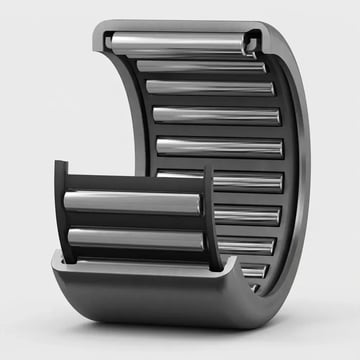
HK Series Needle Roller Bearing

HK bearings have a drawn steel outer cup with one closed end.

Bore range: 3–60 mm. Wall thickness: 0.6–1.0 mm.

The series suits blind-hole housings where a shaft must seat against the cup bottom.

Designation Bore d (mm) OD D (mm) Width B (mm) Cr (kN) C0r (kN)
HK 0306 3 6.5 6 1.43 1.08
HK 0408 4 8 8 2.55 2.00
HK 0608 6 10 8 3.70 3.10
HK 1012 10 14 12 8.30 7.80
HK 1516 15 21 16 16.40 17.00
HK 2016 20 26 16 22.50 24.50
HK 2520 25 32 20 34.00 38.00
HK 3020 30 37 20 43.00 50.00

NK Series — Machined Ring, No Inner Ring

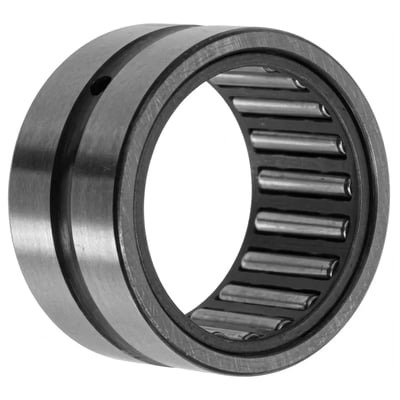
NK Series Needle Roller Bearing

NK bearings use a precision-machined steel outer ring with a caged roller complement.

They run directly on a hardened (58–64 HRC) ground shaft — no inner ring.

Bore range: 10–90 mm.

Typical applications: connecting rods, rocker arms, camshaft followers.

Designation Bore d (mm) OD D (mm) Width B (mm) Cr (kN) C0r (kN)
NK 10/12 10 17 12 8.60 8.00
NK 15/16 15 23 16 16.30 16.60
NK 20/16 20 28 16 19.60 21.20
NK 25/20 25 33 20 29.00 33.50
NK 35/20 35 45 20 46.50 57.00
NK 50/25 50 62 25 79.00 104.00
NK 73/25 73 85 25 116.00 170.00

NA Series — With Inner Ring

NA Series Needle Roller Bearing

NA bearings include a precision inner ring, which means the shaft does not need to be hardened or ground to bearing tolerances.

This is the right choice when retrofitting onto a standard shaft, or when shaft hardness cannot be guaranteed above 58 HRC.

Bore range: 4–160 mm.

Designation Bore d (mm) OD D (mm) Width B (mm) Cr (kN) C0r (kN)
NA 4904 20 37 17 19.50 22.50
NA 4905 25 42 17 23.20 28.00
NA 4906 30 47 17 27.00 33.50
NA 4908 40 62 22 52.00 67.00
NA 4910 50 72 22 60.00 80.00
NA 4912 60 85 25 83.00 115.00

RNA Series — Without Inner Ring

RNA Series Needle Roller Bearing

RNA bearings are the outer-ring-and-cage assembly only — no inner ring.

They fit into bored housings where the shaft acts as the inner raceway.

The shaft must be hardened and ground.

Outer dimensions are identical to NA; bore (d) is larger because there is no inner ring wall.

Designation Bore d (mm) OD D (mm) Width B (mm) Cr (kN) C0r (kN)
RNA 4904 25 37 17 19.50 22.50
RNA 4905 30 42 17 23.20 28.00
RNA 4906 35 47 17 27.00 33.50
RNA 4908 45 62 22 52.00 67.00
RNA 4910 55 72 22 60.00 80.00
RNA 4912 65 85 25 83.00 115.00

How to Read a Needle Roller Bearing Designation

Take NK 25/20 as an example. The letters identify the series; the numbers encode the bore and width.

Designation Breakdown: NK 25/20

NK 25 /20

NK — Series Code

Machined outer ring, caged rollers, no inner ring. Shaft serves as inner raceway.

25 — Bore Diameter

Bore d = 25 mm. This is the shaft diameter the bearing seats on.

/20 — Width

Bearing width B = 20 mm. A wider bearing increases Cr but requires more axial space.

For HK bearings, the convention differs slightly: HK 2016 means bore = 20 mm, width = 16 mm — both encoded directly in the four-digit suffix with no slash.

For NA/RNA, the suffix follows the bearing series number (4904, 4906, etc.), which corresponds to ISO dimension series 49.

Needle Roller Bearing Tolerances

Tolerance classes follow ISO 492 for radial bearings.

Most standard catalog needle bearings are supplied to Normal (PN) class.

Precision applications — machine tool spindles, high-speed servo axes — typically require class P6 or P5.

ISO 492 Tolerance Classes for Needle Roller Bearings

Class Bore Tolerance (d) OD Tolerance (D) Typical Use
PN (Normal) 0 / −8 µm (d ≤18 mm) 0 / −8 µm General industrial machinery, automotive drivetrains
P6 0 / −7 µm 0 / −7 µm CNC spindles, precision gearboxes, pumps above 3,000 rpm
P5 0 / −5 µm 0 / −5 µm High-speed spindles, servo axes, precision instruments
P4 0 / −4 µm 0 / −4 µm Ultra-precision grinding spindles, aerospace actuators

For NK and RNA bearings where the shaft is the inner raceway, shaft dimensional tolerance should be h5 or h6 for a free fit, or k5/m5 for a tighter interference fit.

Housing bore tolerance is typically H6 for standard applications and H5 for precision work.

How to Select the Right Needle Roller Bearing

Five parameters drive the selection decision. Work through them in order.

Step 1 — Radial Space

Define bore and housing bore

Measure the shaft (d) and housing bore (D). The wall thickness (D−d)/2 of a drawn cup HK series is typically 1.7–4.0 mm, making it the choice when radial space is below 5 mm per side. If space allows 6 mm or more, NK or NA gives better load capacity.

Step 2 — Shaft Condition

Can the shaft act as the inner raceway?

NK and RNA bearings run directly on the shaft. The shaft must be hardened to 58–64 HRC and ground to Ra ≤ 0.4 µm. If those conditions cannot be met — or if the shaft is a standard turned bar — choose NA (with inner ring).

Step 3 — Radial Load

Verify Cr against your equivalent dynamic load Pr

Target a basic rating life L10 ≥ 1,000,000 revolutions (the ISO reference). L10 = (Cr / Pr)³ × 10⁶. For a bearing where Cr = 29 kN and Pr = 9.7 kN, L10 = (29/9.7)³ × 10⁶ ≈ 26.9 × 10⁶ revolutions.

Step 4 — Speed

Check the limiting speed for your series

Caged NK and NA bearings support oil-lubricated speeds up to 8,000–15,000 rpm depending on bore size. Full-complement drawn cup HK bearings are limited to roughly 3,000–6,000 rpm because roller-to-roller contact generates higher heat at speed.

Step 5 — Axial Load Handling

Axial loads require a supplementary bearing

Standard needle roller bearings carry no axial load. If the application has combined loading, pair the needle bearing with an axial needle roller and cage assembly (AXK series) or use a combined needle roller/angular contact ball bearing unit.

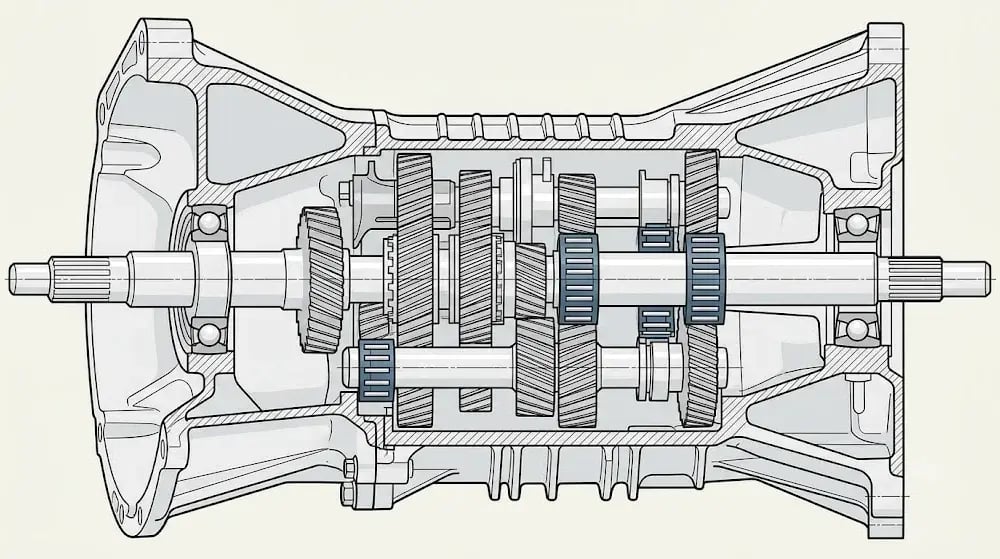
Cutaway diagram of an automotive gearbox with needle roller bearings installed on gear shafts

Quick Series Selector

HK Blind-hole housing, tightest radial envelope, bore 3–60 mm, moderate speed
NK Through-hole housing, hardened shaft required, higher Cr than HK, bore 10–90 mm
NA Standard shaft acceptable, self-contained unit, easiest to install, bore 4–160 mm
RNA Same OD as NA, larger bore — hardened shaft required, saves radial space vs NA

Lubrication Requirements

Needle roller bearings have a large roller-to-raceway contact area relative to their size, which makes adequate lubrication critical.

Under-lubrication is the primary cause of premature failure in this bearing type.

  • Oil lubrication is preferred for speeds above 50% of the limiting speed. ISO VG 32–68 mineral oil covers most industrial applications. For food-processing or pharmaceutical equipment, use NSF H1-registered oils.

  • Grease lubrication suits lower speeds and sealed or semi-sealed housings. Fill the bearing cavity to 30–50% with an NLGI 2 lithium-complex grease; over-packing generates heat and accelerates oxidation. Relubrication intervals depend on operating temperature: at 70°C, relubricate every 6–12 months; at 100°C, every 3 months.

Cross-section diagram of a needle roller bearing showing grease fill, outer ring, needle rollers, cage and inner ring

Frequently Asked Questions

What is the standard bore range for needle roller bearings?

The bore range depends on the series. HK drawn cup bearings start at 3 mm. NK machined-ring bearings cover 10–90 mm. NA bearings with inner ring extend from 4 mm to 160 mm, making them the widest coverage series in the metric range.

What shaft hardness is required for NK and RNA needle roller bearings?

The shaft must reach 58–64 HRC and a surface roughness of Ra ≤ 0.4 µm (equivalent to N5 or N6 on the ISO surface finish scale). A shaft that is too soft — typically below 55 HRC — will develop brinelling and spalling at the roller contact zone, cutting service life significantly.

Can needle roller bearings handle axial loads?

No — not in isolation. Standard radial needle roller bearings have no axial load capacity. For combined loading, pair a radial needle bearing with an AXK thrust washer and needle roller assembly on each side, or specify a combined needle/thrust unit from the catalog.

What is the difference between NA and RNA needle roller bearings?

Both use the same outer ring. NA includes a precision inner ring, so a standard (unhardened) shaft can be used. RNA omits the inner ring — the shaft itself acts as the inner raceway. For an identical housing bore (D), RNA has a larger effective bore (d) because there is no inner ring wall, which also gives marginally higher load capacity per unit of radial space.

How do I calculate bearing life for a needle roller bearing?

Use the ISO 281 basic rating life formula: L10 = (Cr / Pr)³ × 10⁶ revolutions, where Cr is the dynamic load rating from the size chart and Pr is your equivalent dynamic bearing load. Convert to hours by dividing by (60 × operating speed in rpm). For modified life calculations incorporating lubrication viscosity ratio and contamination level, apply the aISO factor per ISO 281:2007.

Are needle bearing sizes interchangeable between brands?

For standard metric series (HK, NK, NA, RNA) that conform to ISO 15 and DIN 617/618, bore, OD, and width are interchangeable between compliant manufacturers. Load ratings and limiting speeds may vary slightly due to internal design differences — always verify Cr, C0r, and speed ratings against the replacement supplier's catalog rather than assuming equivalence.

For the complete range — drawn cup, machined ring, cage assemblies, thrust washers, and combined units, with cross-references to IKO, INA, Koyo, and other major brands — browse the LILY Bearing needle roller bearing catalog. Need help confirming dimensions or load ratings for your application? Our engineering team can review your requirements directly.

How to Evaluate a Needle Roller Bearing Supplier for US Buyers

How to Evaluate a Needle Roller Bearing Supplier for US Buyers

Four hundred hours into service — well short of its rated life — a conveyor drive assembly goes down. The maintenance team traces it back to a...
Read More
Needle Bearings vs Roller Bearings: 2026 Selection Guide

Needle Bearings vs Roller Bearings: 2026 Selection Guide

Can you fit a bearing with 35,000N load capacity in a 30mm radial envelope? The answer is no for cylindrical roller bearings, but yes for needle...

Read More
How to Read a Bearing Size Chart + Free Dimension Reference Tables

How to Read a Bearing Size Chart + Free Dimension Reference Tables

Bearing size charts are not complicated once you know the logic. The numbers follow a fixed pattern — and once you get one bearing number right,...

Read More