

Bearing Suppliers Near Me: Find Reliable Bearing Manufacturers
"Choosing the right bearing supplier isn't just about price — it's about finding a partner who can deliver consistent quality, technical support, and...
6 min read
Robert
:
Mar 26, 2026 3:38:56 AM
Table of Contents
Pillow block bearings are among the most widely deployed mounted bearing solutions in industrial machinery. Understanding their load capacity — from static ratings to dynamic fatigue life — is critical for reliable system design, reduced downtime, and optimal total cost of ownership.
Whether you're an OEM engineer sizing a new conveyor, a maintenance manager troubleshooting premature failures, or a procurement specialist comparing supplier catalogs, this guide provides the technical depth and practical data you need to make the right decision in 2025 and beyond.

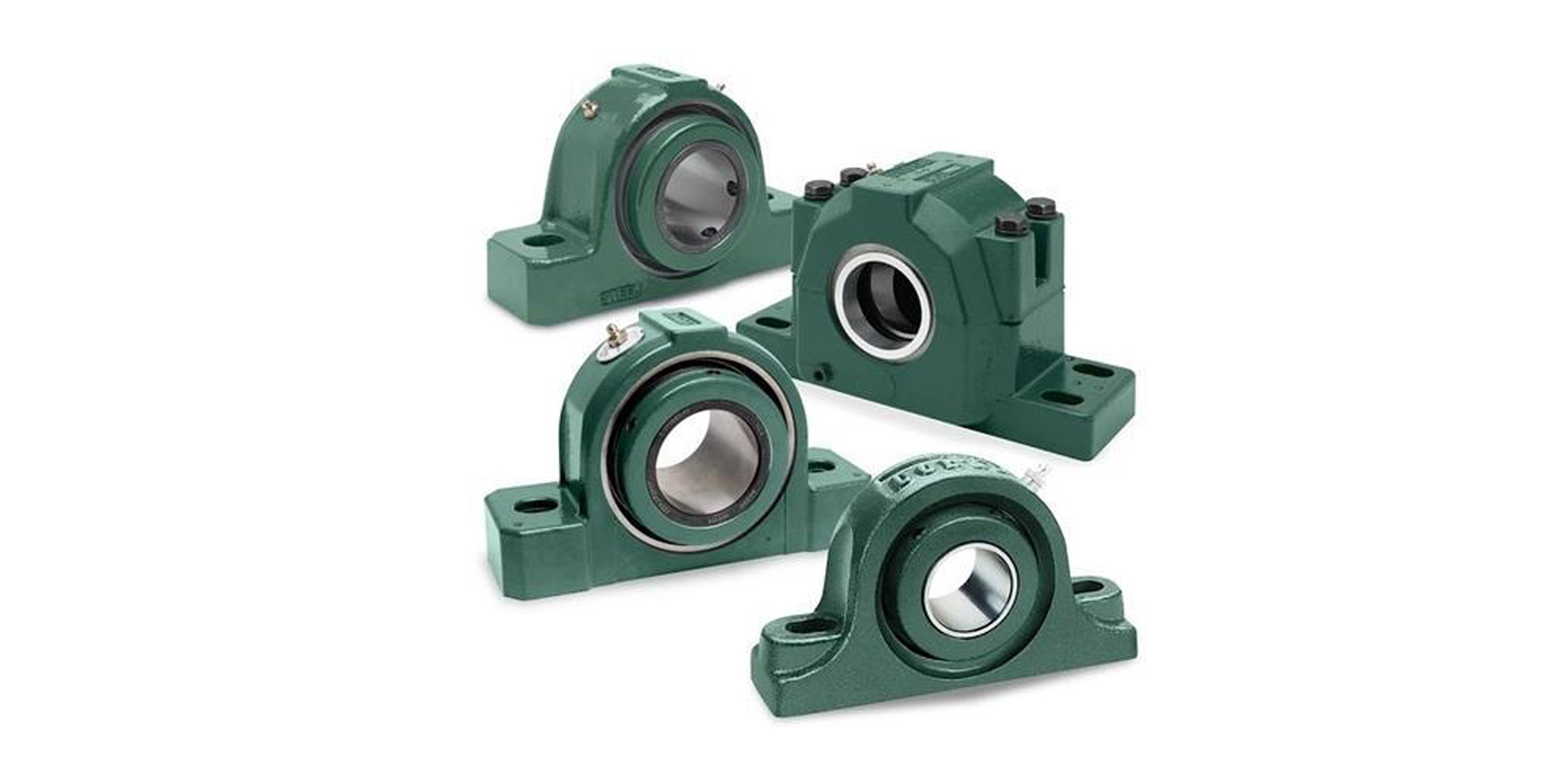
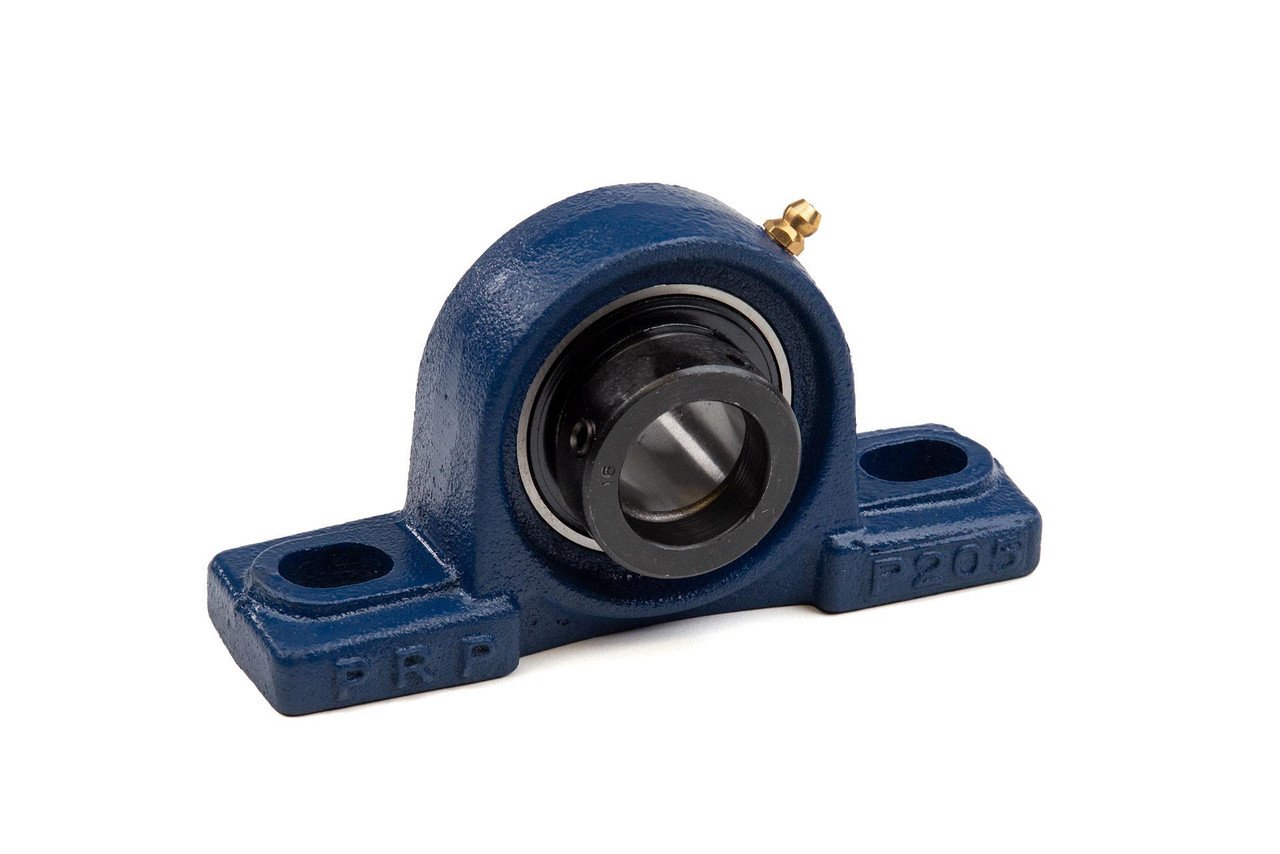
A pillow block bearing (also called a plummer block or housed bearing unit) is a pre-assembled unit consisting of a housing and a bearing insert designed to support a rotating shaft.
The housing — typically cast iron, ductile iron, or stainless steel — is bolted to a frame or base plate, while the bearing insert handles the rotational load.
The defining feature of modern pillow block units is the self-aligning capability: most inserts use a spherical outer race seated in a conforming socket, allowing the bearing to compensate for shaft misalignment up to ±2°–3° without imposing bending stress on the inner ring.
Key Insight: The total load capacity of a pillow block unit is determined by the weakest link — either the bearing insert's dynamic/static load rating (C / C₀) or the housing's structural strength. Engineers must evaluate both independently.

Correctly classifying the applied load is the single most important step in bearing selection. Using a bearing rated primarily for radial loads in a predominantly axial application is a leading cause of premature failure.
Acts perpendicular to the shaft axis. For a horizontal shaft, radial load is primarily gravitational (the weight of the shaft and attached components). This is the primary design load for standard UCP pillow block bearings.
Acts parallel to the shaft axis (thrust). Standard single-row deep-groove inserts can absorb limited axial loads — typically Fa / Fr ≤ 0.3 for ball bearing units. Exceeding this ratio without using angular contact or tapered roller variants accelerates wear on the ball-race shoulders.
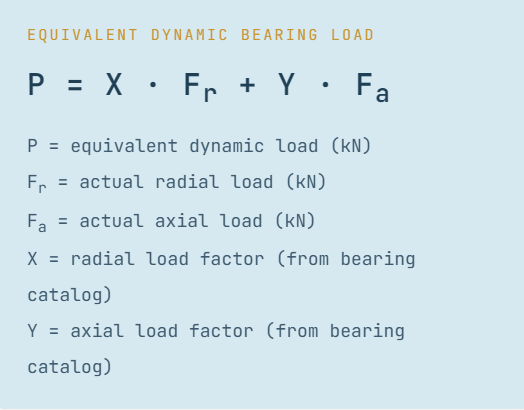
When both radial and axial loads are present simultaneously, engineers calculate an equivalent dynamic bearing load (P) that combines both forces into a single value used for life calculations.

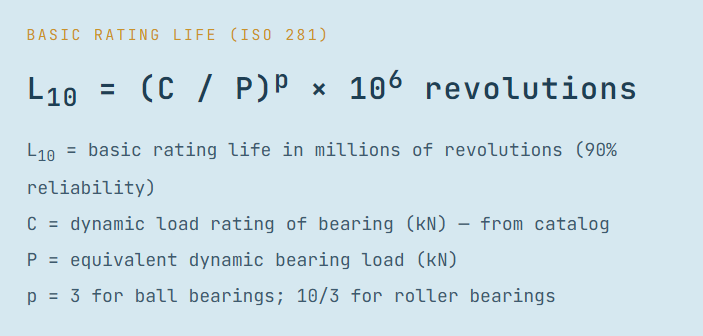
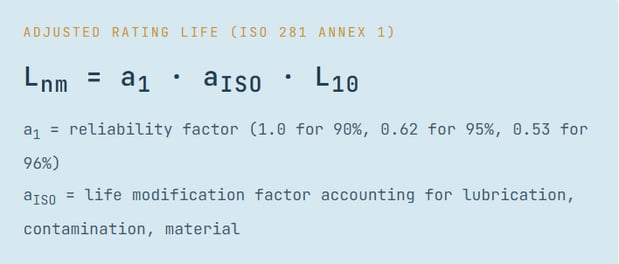
The ISO 281 standard provides the framework for calculating bearing fatigue life, widely adopted across all major manufacturers (SKF, NSK, Timken, FAG).


|
Application |
Required L₁₀ Life (hrs) |
Reliability Target |
Operation Type |
Notes |
|
Agricultural machinery |
1,000 – 3,000 |
90% |
Seasonal |
Acceptable downtime |
|
Light conveyor systems |
8,000 – 12,000 |
90% |
Single-shift |
Standard industrial |
|
Industrial fans / blowers |
20,000 – 30,000 |
95% |
Continuous |
High-speed shafts |
|
Paper / textile mills |
40,000 – 60,000 |
95–96% |
24/7 |
Costly unplanned stops |
|
Mining & heavy industry |
60,000+ |
96–99% |
24/7 extreme |
Remote locations |
The choice of bearing insert within the pillow block housing fundamentally determines the load envelope, speed capability, and misalignment tolerance of the assembled unit.
|
Insert Type |
Radial Load |
Axial Load |
Speed Rating |
Misalign. |
Best For |
|
Deep-groove ball (UC) |
Moderate |
Limited ≤30% Fr |
High |
±3° |
Conveyors, fans, light machinery |
|
Spherical roller (SRB) |
Very High |
Moderate ≤55% Fr |
Moderate |
±2.5° |
Mining, paper mills, heavy conveyors |
|
Cylindrical roller (CRB) |
High |
Very Low |
High |
±0.1° |
Precision spindles, high-speed shafts |
|
Tapered roller (TRB) |
High |
High |
Low-Mod. |
±0.05° |
Gear drives, axles, mixed loads |
|
Angular contact ball |
Moderate |
High (one dir.) |
Very High |
±0.15° |
Thrust-dominant, high-speed pumps |
The housing is not merely a mounting bracket — it is a structural component that must transfer bearing reaction forces safely to the base frame. Material selection has a direct and significant impact on the maximum permissible housing load.
|
Material |
Tensile (MPa) |
Yield (MPa) |
Corrosion Resist. |
Shock Resist. |
Typical Use |
|
Gray Cast Iron (GG-25) |
200 – 250 |
N/A (brittle) |
Moderate |
Low |
Standard light-duty |
|
Ductile Iron (SG Iron) |
400 – 500 |
250 – 320 |
Moderate |
High |
Heavy industry, mining |
|
Cast Steel |
480 – 620 |
260 – 380 |
Moderate |
Very High |
Extreme loads, OEM |
|
Stainless Steel 316L |
480 – 620 |
170 – 310 |
Excellent |
High |
Food, pharma, marine |
|
Thermoplastic PA66-GF30 |
90 – 130 |
70 – 100 |
Excellent |
Moderate |
Wet/corrosive, light loads |
Engineering Note: Ductile iron housings offer approximately twice the yield strength of gray cast iron and far superior breakage resistance. For applications with non-horizontal loads, off-axis mounting, or impact-prone environments, ductile iron is strongly preferred despite the higher material cost.
Systematic bearing selection follows a structured decision process. Skipping any step increases the risk of under-specification (early failure) or over-specification (unnecessary cost).
Calculate or measure Fr and Fa. Include dynamic factors for shock (KA = 1.2–2.5) and unbalanced rotating masses. Always work with the worst-case sustained load, not rated or average load.
Use Table 1 as a starting reference, then adjust for operating hours per year and target maintenance interval. Convert to millions of revolutions using operating RPM.
Solve for required dynamic load rating: C = P × (L10)1/p. From this, select the smallest catalog bearing that meets or exceeds the required C value. Check static load rating C₀ for start/stop and shock scenarios.
Confirm that the bearing reaction force does not exceed the housing's published safe load — particularly important when the load direction deviates from vertical downward.
|
Designation |
Bore (mm) |
C (kN) |
C₀ (kN) |
Max Speed (rpm) |
Weight (kg) |
Typical Application |
|
UCP 204 |
20 |
12.8 |
6.65 |
5,600 |
0.32 |
Light conveyor, fans |
|
UCP 205 |
25 |
14.0 |
7.80 |
5,000 |
0.44 |
Agricultural, packaging |
|
UCP 206 |
30 |
19.5 |
11.2 |
4,300 |
0.57 |
General industrial |
|
UCP 208 |
40 |
29.0 |
17.8 |
3,400 |
0.90 |
Medium conveyor |
|
UCP 210 |
50 |
35.5 |
23.2 |
2,800 |
1.30 |
Heavy conveyor, pumps |
|
UCP 212 |
60 |
47.5 |
32.5 |
2,400 |
1.95 |
Industrial machinery |
|
UCP 215 |
75 |
66.0 |
45.5 |
1,900 |
3.20 |
Heavy shafts |
|
UCP 218 |
90 |
86.5 |
63.0 |
1,600 |
5.10 |
Mining, heavy industry |
Even a correctly specified pillow block bearing will underperform if operating conditions are not managed. The following factors account for the majority of premature failures in field applications.
Inadequate lubrication is the single largest cause of pillow block bearing failures, estimated to account for over 36% of all early failures. Key recommendations:
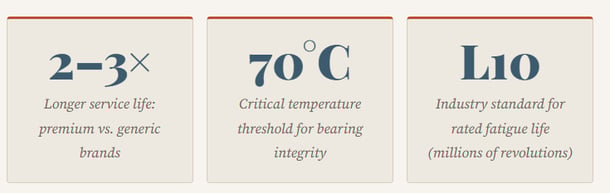
Temperature above 70°C accelerates lubricant degradation and can cause thermal expansion leading to preload or clearance issues. At 90°C, standard grease oxidizes at 4× the rate it does at 70°C. Monitor bearing housing temperature with infrared thermometry monthly or install continuous temperature sensors in critical applications.
Even within the self-aligning tolerance of the bearing, persistent misalignment causes asymmetric load distribution in the raceway, accelerating fatigue spalling. Vibration velocity thresholds from ISO 10816 classify severity:
|
Vibration Velocity (mm/s RMS) |
Classification |
Action Required |
Risk Level |
|
< 2.3 |
Good |
Continue normal operation |
None |
|
2.3 – 4.5 |
Acceptable |
Monitor trend; schedule inspection |
Low |
|
4.5 – 7.1 |
Alert |
Investigate cause; prepare maintenance |
Medium |
|
7.1 – 11.2 |
Alarm |
Reduce load; plan immediate maintenance |
High |
|
> 11.2 |
Danger |
Shut down — risk of imminent failure |
Critical |
Particulate contamination (dust, metal chips, moisture) is the second leading cause of premature failure. The ISO contamination code (ISO 4406) should be monitored for circulating oil systems.
For pillow block units in dusty or wet environments, always specify triple-lip contact seals (Triple-Labyrinth) over standard single rubber lip seals.
|
Frequency |
Inspection Task |
Method / Tool |
|
Monthly |
Temperature check of bearing housing |
IR thermometer or contact probe |
|
Monthly |
Vibration measurement |
Handheld analyzer (mm/s RMS) |
|
Quarterly |
Visual inspection — seals, housing, cracks |
Visual + torque check on bolts |
|
Quarterly |
Re-greasing (if not sealed units) |
Manual or auto-luber, purge old grease |
|
Annually |
Full disassembly and condition inspection |
Raceway, roller surfaces, cage, seals |
|
At L₁₀ / 2 |
Proactive bearing replacement |
Replace regardless of apparent condition |
It depends entirely on the bearing series, bore size, and housing material. A small UCP 204 (20mm bore) has a dynamic load rating of ~12.8 kN, while a heavy SAF 22538 spherical roller plummer block can handle over 2,200 kN. Always refer to the manufacturer's catalog — never estimate by size alone.
Standard UC ball insert pillow blocks can absorb limited axial loads (typically up to 30% of the concurrent radial load). For predominantly axial or high-axial applications, use angular contact ball or tapered roller inserts with appropriate thrust collars.
C (Dynamic Load Rating) is used for life calculations when the bearing is rotating under load. C₀ (Static Load Rating) is used to evaluate the bearing under stationary or very slow rotation (<10 rpm), shock loads, or start/stop cycles. Both must be checked independently.
Field data from major manufacturers consistently point to: (1) insufficient or incorrect lubrication (36%), (2) contamination ingress (29%), (3) incorrect mounting / misalignment (19%), and (4) overloading / incorrect selection (16%). Fatigue from normal operation accounts for fewer than 5% of failures in well-maintained systems.
For critical applications — continuous production lines, mining, paper mills — yes unambiguously. Premium brands (SKF, NSK, Timken, FAG) offer 2–3× longer service life due to tighter dimensional tolerances (±0.01mm vs ±0.05mm+ for generics), certified steel chemistry, and validated L₁₀ ratings. For light-duty, intermittent, or easily-accessible applications, quality generic bearings are often cost-effective.
"Choosing the right bearing supplier isn't just about price — it's about finding a partner who can deliver consistent quality, technical support, and...
It is known that Lily Bearing has long been enjoying a worldwide reputation in making roller bearingswith different models. Recently, customized...
When you turn on the tap, have you ever wondered how the tap water you use every day reaches the water pipes in your home? Actually, this should be...