

Home/
Blog/
Linear Guides: How They Work and Why They Matter

6 min read

Linear Guides: How They Work and Why They Matter

Linear Guides: How They Work and Why They Matter
13:12
 

Every time a CNC router cuts a perfect slot, a 3D printer lays down a precise bead of filament, or a laser etches a microchip — a linear guide is making it possible. These unassuming components quietly underpin billions of dollars' worth of manufactured goods every year.


At a Glance

±1 μm

Typical positional accuracy of precision-class guides

50,000+

Operating hours achievable with proper maintenance

0.002

Typical coefficient of friction (vs. 0.1–0.3 for sliding guides)


What Is a Linear Guide?

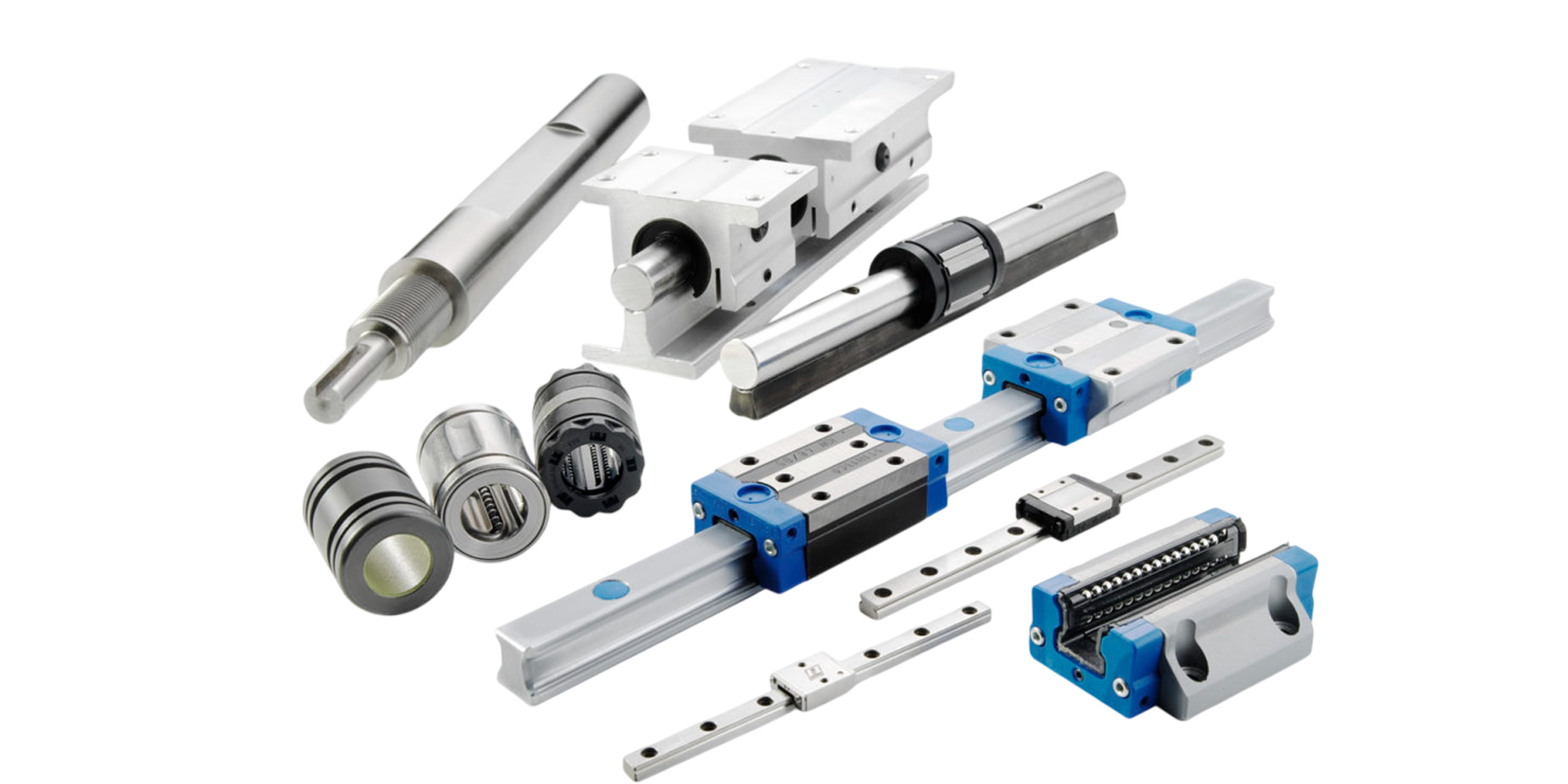
A linear guide (also called a linear rail, linear motion guide, or profiled rail guide) is a mechanical component that constrains motion to a single axis while bearing loads in all other directions.

In plain language: it lets something move in a perfectly straight line, smoothly and repeatedly, while holding everything else perfectly still.

Linear guides are found wherever controlled straight-line movement is needed — from the print head on your desktop printer to the gantry arm of a multi-ton industrial milling center. They are the workhorses of precision motion control.


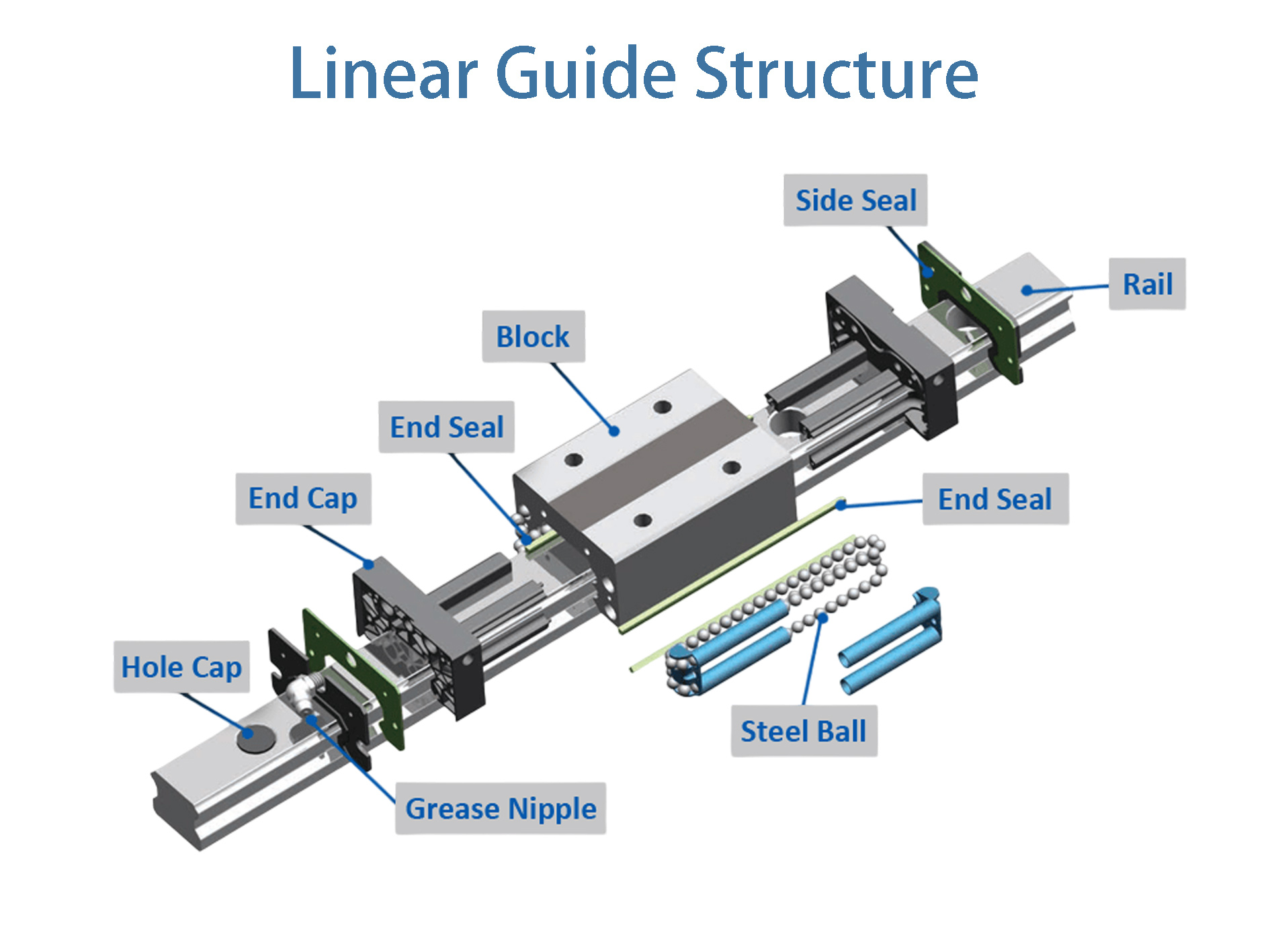
Key Components Breakdown 

Component

Material

Purpose

Rail

Carbon Steel / Stainless Steel

Provides the precision track and mounting surface.

Runner Block

Alloy Steel / Aluminum

Houses the bearings and attaches to the payload.

Rolling Elements

Chrome Steel / Ceramics / Silicon Nitride

The "muscles" that carry the load.

End Seals

Synthetic Rubber / NBR

Keeps dust out and lubrication in.

Grease Nipple

Brass / Steel

The entry point for maintenance lubrication.


Linear Guide Structure


How Do Linear Guides Work?

The core operating principle of a modern profiled linear guide involves rolling contact between precision-hardened steel balls (or sometimes rollers) and a matched pair of raceways — one on the rail, one inside the carriage block. This rolling contact dramatically reduces friction compared to sliding surfaces.


The Recirculating Ball System

Inside the carriage block, a chain of hardened steel balls circulates through a closed loop. The load-bearing balls travel along the precision-ground raceway on the rail, transmitting force.

When they reach the end of the load zone, they are swept into a return channel, travel back to the start, and rejoin the load zone — continuously and silently.

This recirculation means the carriage can travel any distance along the rail with the same number of load-bearing balls always in contact.

The contact angle — typically 45° in a Gothic-arch profile — allows the guide to carry loads in all four directions simultaneously: downward, upward, and both lateral directions.

PRO TIP — Contact Angle

The 45° contact angle in Gothic-arch raceway profiles distributes load across four rows of balls. This gives profiled rail guides up to 10× the load capacity and 100× the rigidity of equivalent round-shaft guides — making them the standard choice for any serious precision application.


Types of Linear Guides

Not all linear guides are created equal. The right type depends on your load, speed, precision requirements, and budget. Here are the four most common families:

Type

Load Capacity

Max Speed

Accuracy

Best For

Profiled Rail (Ball)

High (up to 100+ kN)

Up to 4 m/s

±1–5 μm

CNC, automation, robotics

Roller Guide

Very High

Up to 2 m/s

±1–3 μm

Heavy milling, grinding

Round Shaft

Low–Medium

Up to 3 m/s

±10–50 μm

3D printers, light automation

Miniature Rail

Low

Up to 2 m/s

±1–3 μm

Medical, optics, semicon

Cross-Roller

Medium

Up to 1 m/s

±0.5–2 μm

Ultra-precision instruments


⚠ SELECTION WARNING

Never select a linear guide based on dynamic load rating alone. Moment loads (torques around pitch, yaw, and roll axes) are often the true limiting factor in carriage life, especially in cantilevered or offset-load applications. Always check the manufacturer's moment capacity table.


Key Specifications Explained

Understanding the spec sheet is essential for making the right selection. Here is a breakdown of the most important parameters:

Specification

What It Means

Why It Matters

Dynamic Load Rating (C)

Load at which 90% of guides reach 50 km travel life

Baseline for life calculations

Static Load Rating (C₀)

Max load before permanent deformation

Critical for shock/impact loads

Accuracy Grade

H (Normal) → P → SP → UP (Ultra)

Determines parallelism & height variance

Preload Class

Z0 (no preload) → Z3 (heavy)

Higher preload = more rigidity, less play

Rated Travel Life (L₁₀)

Distance where 90% survive without fatigue

Determines maintenance intervals

Coefficient of Friction

Typically 0.001–0.004

Drives motor sizing & heat generation


“Precision is not a luxury in linear motion — it’s the product. A 5-micron error repeated across 10,000 machining cycles becomes a 50-millimeter dimensional drift. The guide is where tolerance is either built in or lost forever.”

— Motion Engineering Principle


Real-World Applications

Linear guides appear in a remarkable range of industries, often in places you would not expect:


Machine Tools & CNC

The most demanding application. CNC machining centers use profiled rail guides on all three (or more) linear axes.

The requirement: sub-micron repeatability under loads of several kilonewtons, at traverse speeds up to 60 m/min, for millions of cycles. Only precision-class profiled rail guides with heavy preload meet this bar.


Semiconductor & Electronics Manufacturing

Wafer handlers, die bonders, and PCB pick-and-place machines push linear guides to their limits in the opposite direction — ultra-light loads but nanometer-level accuracy. This is the domain of miniature and cross-roller guides, often paired with air bearings at the extreme end of precision.


Medical Devices

Surgical robots, CT scanner gantries, and lab automation equipment all require smooth, repeatable, whisper-quiet linear motion. Miniature profiled guides in stainless steel (for cleanability) are the standard solution here.


Consumer & Prosumer Equipment

FDM 3D printers use round-shaft linear guides for the print head axes. Higher-end desktop CNC routers and laser cutters step up to miniature profiled rails. Even some premium camera sliders and film rigs use precision linear guides.


Industry

Guide Type

Key Requirement

Example Machine

CNC Machining

HG/EG Profiled Rail

Rigidity + load capacity

5-axis milling center

Semiconductor

Miniature + Cross-Roller

Nanometer precision

Wafer stepper

Robotics

HG Profiled Rail

Repeatability + speed

SCARA linear axis

Medical

Miniature SS Rail

Cleanability + smooth

Surgical robot arm

3D Printing / DIY

Round Shaft / MGN

Low cost + light load

FDM printer

Packaging

HG or QH Rail

Speed + cycle life

Form-fill-seal machine


How to Select the Right Linear Guide

Choosing the wrong guide is an expensive mistake. A systematic selection process follows these steps:

Step 1

Define Loads

Calculate forces F, moment loads M, and apply a shock factor (1.5–3×) for dynamic conditions.


Step 2

Speed & Stroke

Determine maximum velocity, acceleration profile, and required stroke length.


Step 3

Life Target

Set the required L₁₀ travel life in km, or convert from operating hours × duty cycle.


Step 4

Environment

Assess dust, coolant, temperature extremes, and cleanliness requirements.


Step 5

Size Selection

Use the life equation: C ≥ F × (L/50)^(1/3) to find the minimum dynamic load rating.


Step 6

Accuracy Grade

Select H / P / SP / UP based on positional tolerance requirements.


Step 7

Environment

Assess dust, coolant, temperature extremes, and cleanliness requirements.


✓ SELECTION RULE OF THUMB

Apply a safety factor of 1.5–3× to your calculated dynamic load before selecting a guide size. For applications involving vibration, shock loads, or contaminated environments, use the higher end of this range. Under-specifying linear guides is one of the most common causes of premature failure in machine design.


Installation & Maintenance


Installation Best Practices

Surface preparation is non-negotiable. The mounting surface must be flat to within the guide's accuracy grade tolerance — typically ±5–25 μm across the full rail length.

Use a reference edge. Always install the rail against a precision-machined datum edge, not just bolted to a flat plate. The lateral reference is what gives you straightness.

Torque bolts in sequence. Tighten from the center outward in a cross pattern, in at least two passes, to the manufacturer's specified torque. Over-tightening distorts the rail.

Never hammer the carriage off the rail. Use the manufacturer's assembly jig or a smooth mandrel — or the balls will scatter.

Initial lubrication is critical. Apply the specified grease before first operation. A dry start will score the raceways.

Align parallel rails with a dial indicator. Parallelism must be within 20–50 μm or you'll dramatically reduce guide life.


Lubrication Schedule

Operating Condition

Lubricant Type

Interval

Note

Normal (clean, ambient)

Lithium grease NLGI #2

Every 500 km / 3 months

Use lube port or remove end cap

High speed (>1 m/s)

Low-viscosity oil (ISO VG 32–68)

Continuous or every 50 km

Oil mist or drip system recommended

Contaminated / coolant

Heavy grease + seals

Every 100 km or monthly

Install additional wipers/seals

Clean room / medical

PFPE grease (fluorinated)

Per manufacturer schedule

Avoid standard greases

Food & beverage

NSF H1 certified grease

Every 200 km or monthly

Stainless steel rail preferred


⚠ MAINTENANCE WARNING

Never mix different grease types. Incompatible base oils and thickeners can react and liquify, washing out of the carriage and leaving the raceways dry. When switching lubricant types, fully purge the old grease first.


Signs of Wear — What to Watch For

Increased Running Noise

Clicking, grinding, or increased audible noise during traversal typically indicates ball damage, contamination, or insufficient lubrication.


Positional Drift

If a machine's dimensional accuracy degrades over time, worn raceways causing increased play are often the root cause.


Elevated Carriage Temperature

A hot carriage block after running suggests dry running, incorrect preload, or over-lubrication impeding ball circulation.


Frequently Asked Questions


Q: What is the difference between a linear guide and a linear bearing?

"Linear bearing" is a broad term that includes any bearing supporting linear motion — including plain bushings, round-shaft ball bushings, and profiled rail systems. A "linear guide" most commonly refers specifically to a profiled rail guide system. All linear guides include linear bearings, but not all linear bearings are linear guides.


Q: How long do linear guides last?

With correct selection, proper installation, and regular lubrication, profiled linear guides routinely achieve 10,000–50,000+ hours of service life, or hundreds of thousands of kilometers of travel. In practice, contamination and dry running kill guides far sooner than mechanical fatigue.


Q: Can I use a linear guide vertically?

Yes. Profiled linear guides support loads in all four perpendicular directions, so vertical orientation presents no technical challenge. However, lubricant may drain faster — check the manufacturer's lube interval recommendations for vertical mounting.


Q: What is preload and why does it matter?

Preload is a slight interference fit between the balls and raceways, applied by using slightly oversized balls. It eliminates all clearance (play), dramatically increasing rigidity and accuracy. The trade-off: higher preload increases friction and reduces rated travel life.


Q: HIWIN vs. THK vs. Bosch Rexroth — which brand is best?

All three are world-class manufacturers. THK invented the profiled linear guide and sets the benchmark for ultra-precision grades. HIWIN offers excellent quality-to-cost ratio and dominates cost-sensitive CNC and automation. Bosch Rexroth excels in European industrial automation with excellent global service networks.


Conclusion

Linear guides convert any actuator — motor, cylinder, or human hand — into controlled, repeatable straight-line movement.

The profiled rail system, with its recirculating Gothic-arch raceways, has become the universal standard because it uniquely combines high load capacity, ultra-low friction, four-direction support, and long service life in a compact, bolt-on form factor.

Whether you're sizing a CNC axis, specifying a robotic joint, or building a precision instrument, understanding linear guides is one of the most high-value skills in mechanical engineering.

What Is a Compression Spring? Types, Design & Applications

What Is a Compression Spring? Types, Design & Applications

A compression spring is an open-coil helical spring that resists compressive axial forces. When load is applied, it shortens and stores potential...
Read More
Small but Mighty: The Engineering Behind Needle Bearings

Small but Mighty: The Engineering Behind Needle Bearings

What Are Needle Bearings? Needle bearings are a specialized type of roller bearing that use long, thin cylindrical rollers — called needles — to...

Read More
Load Capacity and Performance Analysis of Pillow Block Bearings

Load Capacity and Performance Analysis of Pillow Block Bearings

Pillow block bearings are among the most widely deployed mounted bearing solutions in industrial machinery. Understanding their load capacity — from...

Read More