

Home/
Blog/
Linear Bearing Noise & Failure: Causes, Diagnosis & When to Replace

7 min read

Linear Bearing Noise & Failure: Causes, Diagnosis & When to Replace

Linear Bearing Noise & Failure: Causes, Diagnosis & When to Replace
14:51

A linear bearing that's failing doesn't always give you much warning.

Sometimes it starts with a subtle grinding sound at one end of the stroke.

Sometimes motion just gets stiff on cold mornings.

And sometimes it sounds completely fine right up until the carriage seizes mid-cycle and destroys your workpiece.

This guide covers the most common linear bearing failure modes, how to diagnose each one, and the clearest signals that it's time to replace rather than re-lubricate.


Why Linear Bearings Fail: The Big Picture

The vast majority of linear bearing failures trace back to four root causes:

  1. Lubrication failure — insufficient lubrication, wrong lubricant type, or contaminated lubricant
  2. Contamination — particles, chips, or debris entering the bearing and scoring the raceways
  3. Overloading — running above rated capacity, or with shock loads the design didn't account for
  4. Misalignment or improper mounting — rail or shaft not straight, flatness not achieved, carriages forced into a bind

SKF's Bearing Damage and Failure Analysis handbook is one of the most widely referenced guides in industrial maintenance. It consistently attributes 60–80% of premature bearing failures to lubrication-related problems. Everything else combined makes up the remainder.

That's actually good news: most linear bearing failures are preventable.


Noise Diagnosis: What Each Sound Tells You

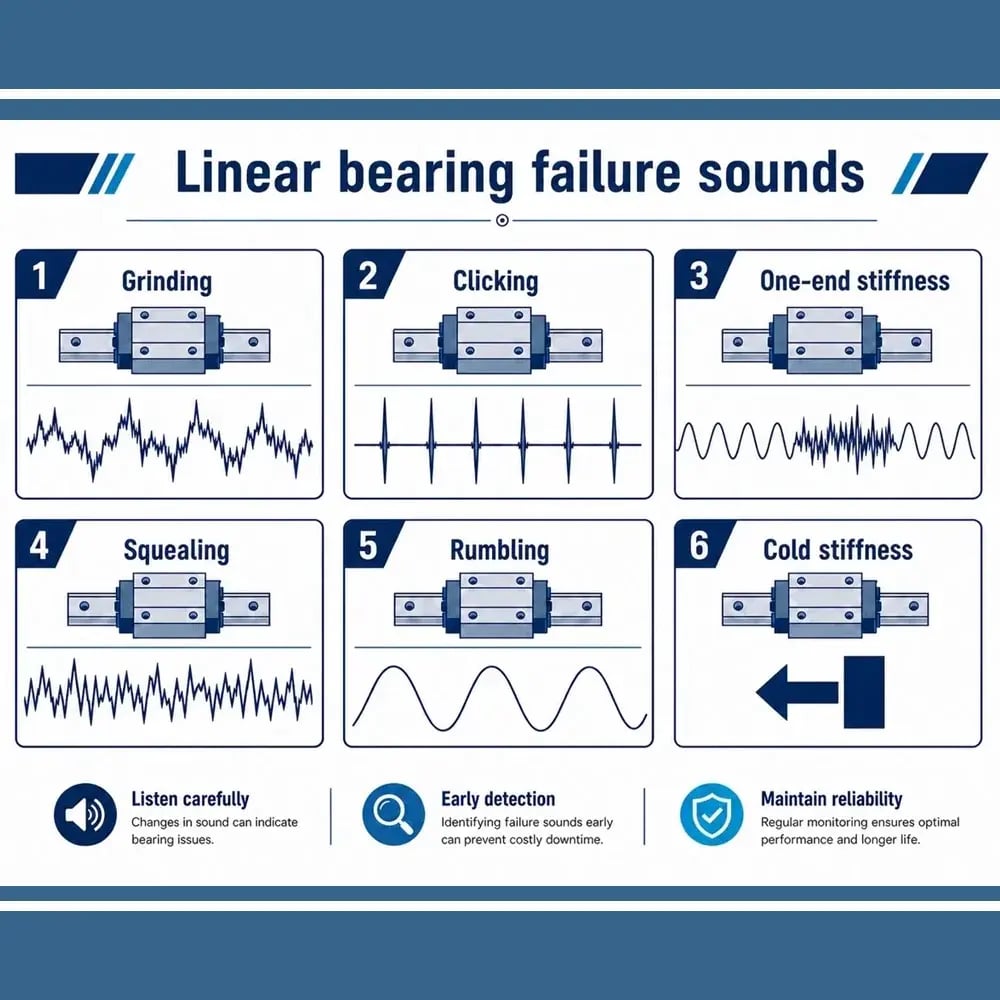
Six linear bearing failure sound patterns: grinding, clicking, one-end stiffness, squealing, rumbling, and cold stiffness with waveform illustrations


1. Grinding or Crunching Throughout the Stroke

What it sounds like:
Continuous, rough grinding from one end of travel to the other. Similar to rolling over coarse gravel.
 
What it usually means:
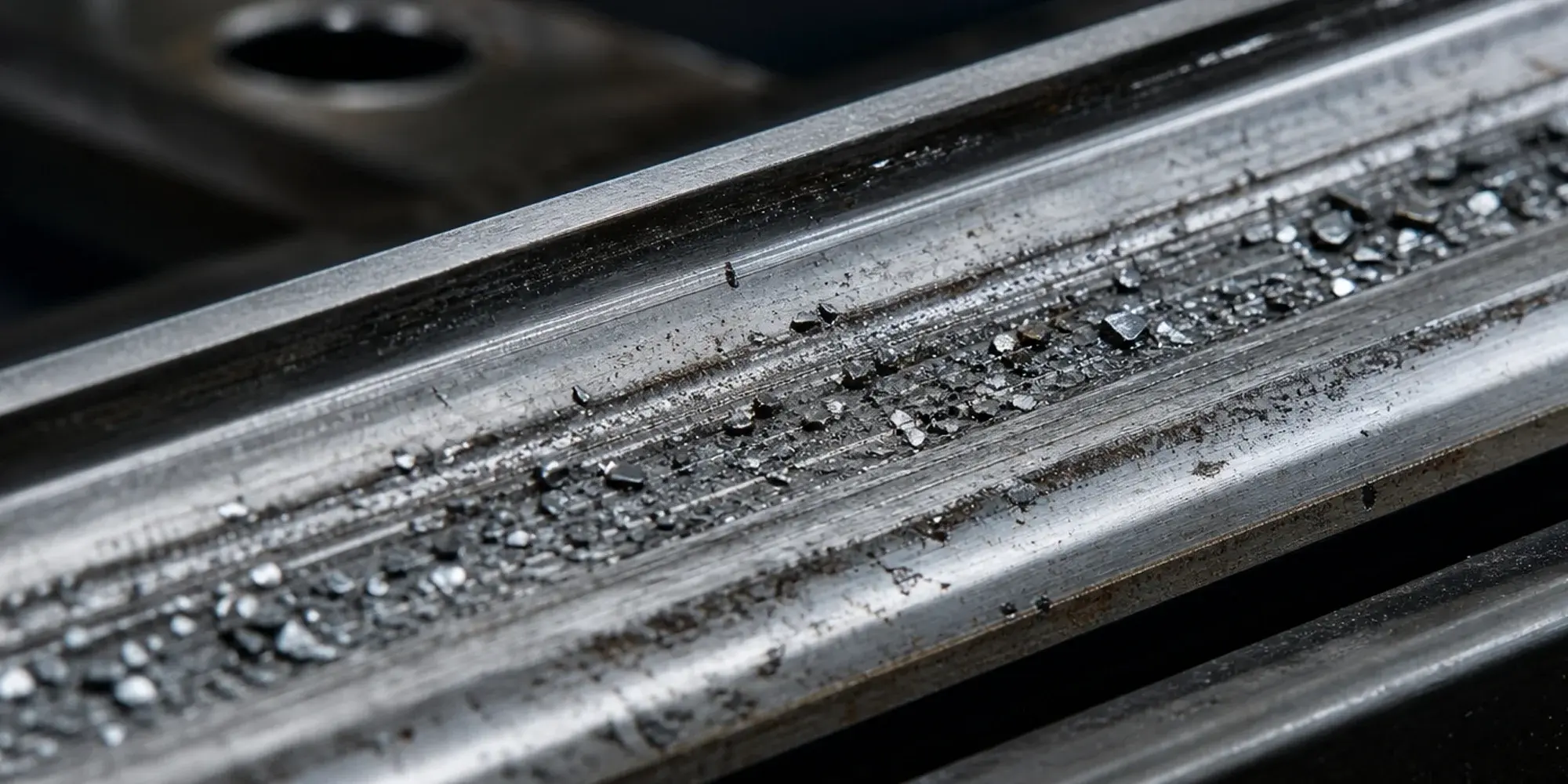
Contamination. Metallic chips, abrasive dust, or debris has entered the ball circuit and is scoring the raceways. Once scoring starts, the debris it generates accelerates the damage — a self-reinforcing failure cycle.
 
How to confirm:
Wipe the linear bearing rail clean and run the carriage slowly by hand. If you feel roughness throughout the stroke, contamination is likely. Remove the carriage if the design allows, wipe the raceways, and look for metallic debris or scoring marks.
 
Fix:
If caught early, flush with solvent, re-lubricate with clean grease, and inspect or upgrade the seals. If the raceways are visibly scored, replacement is required — raceway damage cannot be corrected through field re-machining or lapping in a standard precision linear guide. (Industrial-grade heavy-rail rebuilding services exist but are rarely cost-effective compared to replacement.)


2. Cyclical Clicking or Knocking

What it sounds like:
A rhythmic click or light knock at a fixed interval that correlates with travel speed — not a continuous sound.
 
What it usually means:
One or more damaged balls in the recirculating circuit. A chipped or flat-spotted ball produces a click each time it passes through the load zone.
 
How to confirm:
Mark a reference point on the carriage. Move it at a consistent slow speed and measure the distance between clicks. A consistent, repeatable interval points to a damaged ball.
 
Fix:
Ball replacement requires complete disassembly — most engineers replace the carriage. Approximate replacement costs: round-shaft linear bearings (LM6UU, LM8UU, LM12UU, LM16UU, LM20UU, LM25UU): approximately $5–$30 each. Profiled rail carriages (25mm class): approximately $45–$150.
 LM8UU round shaft linear bearing bushing compared to HG25 profiled rail carriage block side by side


3. Intermittent Noise or Stiffness at One End of Stroke

What it sounds like:
The carriage moves smoothly for most of its travel, then becomes rough or stiff near one end — then returns to normal.
 
What it usually means:
Either localized rail damage (a ding, burr, or corrosion spot in one zone) or a bow in the rail or shaft at that location causing the carriage to bind.
 
Fix:
Minor surface burrs can sometimes be smoothed with a polishing stone. Bent or extensively damaged linear bearing rail must be replaced. Mounting surface problems require re-facing or shimming — see our Pairing & Sizing Guide for flatness tolerances.


4. Squealing or Squeaking

What it sounds like:
High-pitched squeal, often worst when starting from rest or when cold. Usually improves after the bearing warms up.
 
What it usually means:
Insufficient linear bearing lubrication. Ball elements are running without an adequate oil film, causing metal-to-metal contact and the audible stick-slip effect.
 
Fix:
Re-lubricate and recalculate your lubrication interval. A $10–$20 tube of grease and 10 minutes of labor fixes a squealing bearing; a seized bearing costs $500+ in parts and hours of lost production.


5. Rumbling at High Speed

What it sounds like:
Low-frequency rumble or vibration that appears only above ~0.5 m/s. Similar to an unbalanced tire, but in linear motion.
 
What it usually means:
Raceway waviness — a periodic variation in raceway geometry from wear or a manufacturing defect. It can also indicate a damaged retainer causing uneven ball spacing.
 
Fix:
Raceway waviness is not correctable in the field. Replace the rail and carriage set.


6. Binding or Stiffness That Clears After Warmup

What it sounds like:
Motion requires noticeably more force when cold (0–15°C), then becomes normal after 15–30 minutes of operation.
 
What it usually means:
Grease that's too viscous for the operating temperature. Standard NLGI #2 grease becomes noticeably stiff below 10°C. At -20°C, viscosity can increase by 10× or more depending on the base oil type.
 
Fix:
Switch to a low-temperature grease (-40°C to +150°C rated). Flush the old grease out first — adding oil on top of cold grease doesn't solve the viscosity problem.


Failure Mode Quick Reference

Linear Bearing Noise — Quick Diagnosis Reference
Grinding / crunching
Continuous throughout stroke · like coarse gravel
Cause: Contamination — debris in the ball circuit scoring raceways
Action: Inspect raceways. Flush + re-lube if caught early. Replace if scored.
HIGH
Cyclical clicking
Fixed interval · correlates with travel speed
Cause: Damaged ball(s) — chipped or flat-spotted, clicking each pass
Action: Replace carriage. LM8UU/LM12UU/LM25UU: approx. $5–30. Profiled rail (25mm class): approx. $45–150.
MED
One-end stiffness
Rough near one end only · smooth mid-stroke
Cause: Rail damage (burr/dent) or local bow causing bind
Action: Run dial indicator along rail. Burr → polish stone. Bent rail → replace.
MED
Squealing
Worst when cold · improves with warmup
Cause: Insufficient lubrication — metal-to-metal stick-slip
Action: Lubricate immediately. Inspect for heat damage if ran dry. $10–20 grease vs $500+ seized bearing.
LOW→HIGH
High-speed rumble
Above ~0.5 m/s · frequency scales with speed
Cause: Raceway waviness or damaged ball retainer
Replace rail + carriage. Not correctable in the field.
HIGH
Cold stiffness
Stiff at 0–15°C · normal after 15–30 min
Cause: Grease too viscous — NLGI #2 stiffens below 10°C
Action: Switch to low-temp grease (-40°C to +150°C rated). Flush old grease first.
LOW
Per SKF's Bearing Damage and Failure Analysis handbook — 60–80% of premature failures are lubrication-related and preventable.


Visual Inspection: What to Look For

Don't wait for noise. Regular visual inspection catches linear bearing problems earlier and at lower cost.

Raceway surface: Should be mirror-bright. Brown staining = corrosion starting. Blue or dark discoloration = heat damage from dry running. Pitting = fatigue or active corrosion.

Seal condition: End seals on profiled rail carriages should be intact and making light contact with the rail. Torn or missing seals allow contamination directly into the ball circuit.

Grease condition (when purged grease emerges at seals):

  • Clean gray or amber = healthy
  • Black = contaminated with metal particles
  • Dark brown = thermally degraded
  • White or foamy = water contamination

Four bearing grease conditions side by side: healthy, metal contaminated, thermally degraded, and water contaminated

Carriage play: Mount a dial indicator perpendicular to the rail. Apply and release a 5 N load. Deflection should be <0.01 mm for a correctly preloaded precision carriage.

Dial indicator measuring linear bearing carriage play on a profiled rail guide, with gloved hand applying load


Linear Bearing Lubrication Intervals: Concrete Numbers

This is where most maintenance programs fall short — they run on calendar time rather than actual travel distance.

THK recommendations for HSR series (standard operating conditions):

  • Grease: every 100 km of travel, or every 6 months — whichever comes first
  • Oil: continuous supply at 0.01–0.05 mL per 1,000 mm of travel

Compatible alternatives to THK HSR series following the same lubrication schedule are available — see our linear bearing range.

General recommendations for profiled rail systems (standard operating conditions):

  • Normal conditions: every 100 km of travel
  • Harsh environments (coolant, chips, abrasive dust): every 30–50 km

Always verify against your specific model's documentation — intervals vary by carriage size, seal type, and operating load.

How to calculate your lubrication interval:

Take a machine doing a 0.3 m stroke at 30 cycles/min over an 8-hour shift:

0.3 m × 2 × 30 cycles/min × 60 min/hr × 8 hr = 8,640 m = 8.64 km/day

At a 100 km re-grease interval, that's a lubrication event every 11.6 days — round down to every 10 days to stay ahead of the interval.

A rising line from 0 to 103.7 km over 12 days intersects a dashed red threshold line at 100 km, marked as the re-grease point at day 11.6. 0 20 40 60 80 100 Cumulative travel (km) Day 0 Day 2 Day 4 Day 6 Day 8 Day 10 Day 12 Re-grease point day ~11.6 Cumulative travel (8.64 km/day) Re-grease threshold (100 km)
If your maintenance schedule says "monthly," and your machine runs like this, it is running severely under-lubricated.


Preventive Maintenance Schedule

Interval Task
Per calculated travel interval
(e.g., every 10 days at 8.6 km/day)
Re-grease via lube port; verify purge at seals
Monthly Visual inspection of rail surface and seal condition
Every 3 months Check carriage play with dial indicator; inspect purged grease color
Every 6 months Full inspection: seals, rail surface, mounting fastener torque
At any unusual noise Immediate diagnosis per the section above
At carriage replacement Clean rail thoroughly; re-check rail flatness before installing new carriage


When to Replace vs. When to Lubricate

This decision comes down to one question: has raceway damage occurred?

Lubrication will fix it if:
  • The bearing is noisy but motion feels smooth (no grinding)
  • Squeal disappears within 2–3 strokes of adding lubricant
  • No visible scoring on the raceways
  • Carriage play under a 5 N load is less than 0.01 mm
Linear bearing replacement is needed if:
  • Visible pitting, scoring, or chipping on raceways
  • Carriage play exceeds 0.02–0.05 mm under light load
  • Repeated lubrication hasn't resolved the noise
  • Heat discoloration (blue or brown) on raceways or balls
  • Any crack in the carriage body or rail


On costs:

A replacement profiled rail carriage (25mm class) runs approximately $45–$150. Linear bearing rail replacement costs approximately $30–$100 per meter.

In a production environment running two shifts, even 2 hours of unplanned downtime typically exceeds those costs. The math almost always favors proactive replacement.


Preventing Linear Bearing Failures: The Short List

  1. Calculate your lubrication interval in km, not calendar days. Machines with short, fast strokes accumulate travel much faster than the calendar suggests.
  2. Use the correct lubricant. Manufacturer-specified grease for standard use; ISO VG 68–100 oil for oil-lubricated systems; low-temperature grease for operation below 10°C.
  3. Protect against contamination. Bellows covers, way wipers, and labyrinth seals are worth the cost in any environment with chips, coolant, or abrasive dust.
  4. Verify mounting flatness at installation. Fifteen minutes with a dial indicator prevents months of unexplained positioning error. Flatness requirements are covered in our Pairing & Sizing Guide.
  5. Act on early noise. A squealing bearing takes $10–$20 in grease and 10 minutes to fix. A seized bearing takes $500+ in parts and hours of lost production.
  6. Keep a travel log per axis. Track kilometers, not machine hours. An axis doing 10 mm strokes at 60 cycles/min accumulates travel far faster than one doing 500 mm strokes at 5 cycles/min.


Frequently Asked Questions


What causes linear bearing noise?

The cause depends on the sound. Grinding throughout the stroke means contamination in the ball circuit. Cyclical clicking at a fixed interval points to a damaged ball. Squealing — especially when cold — is almost always insufficient lubrication. High-speed rumble indicates raceway waviness, which requires full replacement. See the noise diagnosis section above for confirmation steps and fixes for each failure mode.


How often should linear bearings be lubricated?

Calculate by travel distance, not calendar time. Leading manufacturers recommend re-greasing every 100 km under normal conditions, or every 30–50 km in harsh environments. A typical machine running a 0.3 m stroke at 30 cycles/min accumulates roughly 8.6 km per day — that's a lubrication event every 10 days, not monthly.


Can a linear bearing be repaired, or does it need replacing?

If the noise clears within a few strokes of adding lubricant and there is no visible scoring on the raceways, re-lubrication is sufficient. Replacement is needed once raceway damage has occurred — visible pitting, carriage play exceeding 0.02–0.05 mm under light load, or noise that persists after repeated lubrication. A replacement profiled rail carriage (25mm class) costs approximately $45–$150, almost always less than two hours of unplanned downtime.


Hearing something unusual from a bearing on your machine? Describe the noise — when in the stroke it occurs, what it sounds like, and what changed recently — in the comments and we'll help you diagnose it.


Linear Bearings, Rods & Shafts: Complete Pairing & Sizing Guide

Linear Bearings, Rods & Shafts: Complete Pairing & Sizing Guide

A linear bearing is only as good as the shaft it runs on. Pair an LM20UU with an undersized, un-hardened rod and you'll get sloppy motion and early ...
Read More
Linear Bearings vs Rotary Bearings — Key Differences Explained

Linear Bearings vs Rotary Bearings — Key Differences Explained

Linear Bearings vs Rotary Bearings — Key Differences Dimension ▶ Linear Bearing ▶ Rotary Bearing Motion type TranslationBack-and-forth...

Read More
Bearing Static vs Dynamic Load: C, C0, L10 Explained + Free Calculator

Bearing Static vs Dynamic Load: C, C0, L10 Explained + Free Calculator

Bearings play a vital role in machinery by ensuring smooth motion and reducing friction. Understanding load capacities, specifically static load vs...

Read More