

Wind Turbine Slewing Bearings: Pitch, Yaw & Selection Guide
Wind turbines depend on precise, reliable rotation at every level — from individual blade angle adjustments to full nacelle orientation. The...
7 min read
William
:
Aug 27, 2025 11:17:03 PM
Table of Contents
The slew ring bearing is one of the hardest-working components on any excavator.
It carries the full weight of the upper structure — cab, engine, boom, arm, and bucket — while enabling smooth 360° rotation under load.
When it fails, the machine stops working.
This guide covers everything you need to know: how excavator slew rings work, the different types available, how to spot wear before it becomes a costly breakdown, and how to choose the right replacement.

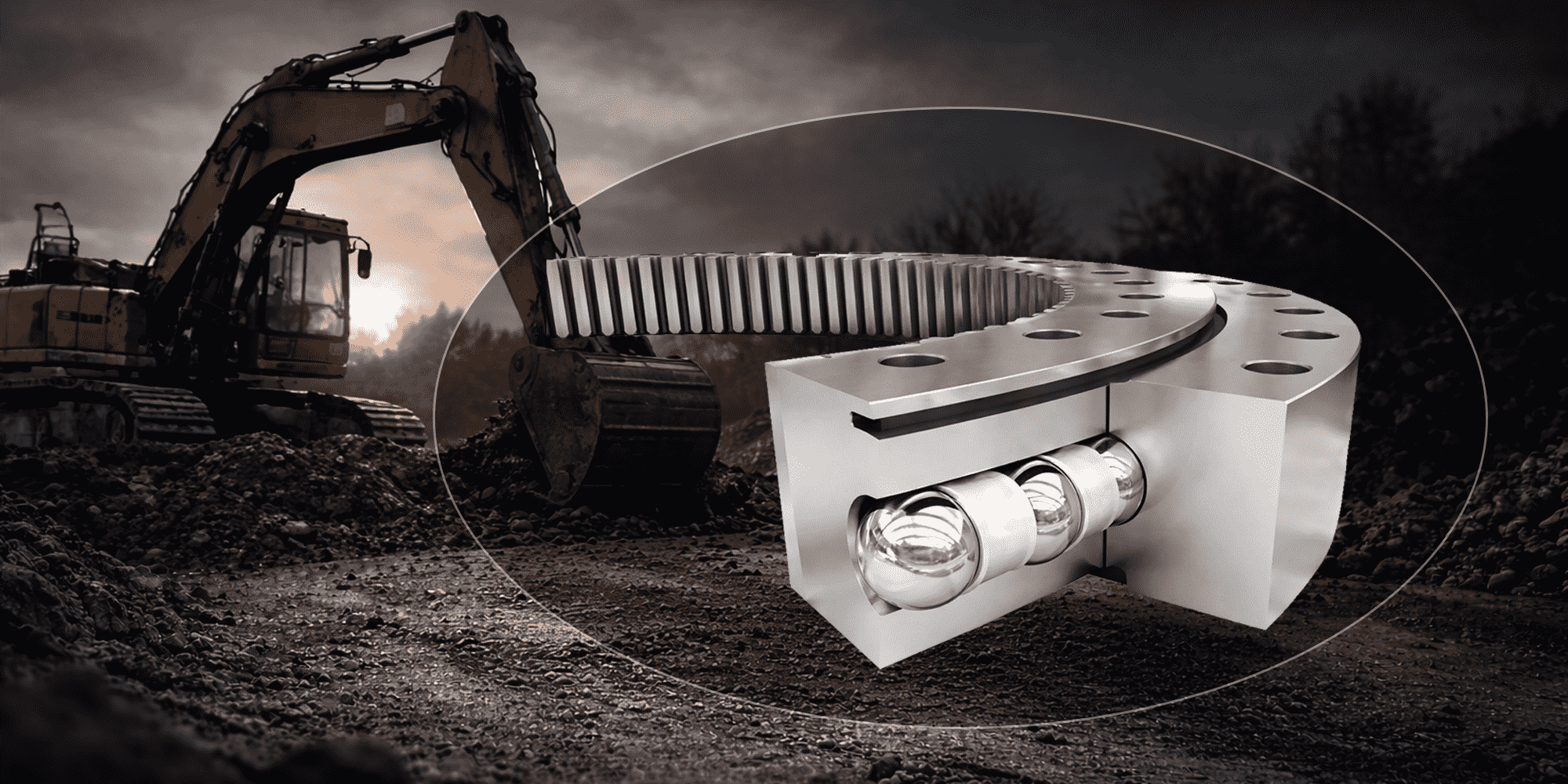
An excavator slew ring bearing — also called a swing bearing, slewing ring, or turntable bearing — is a large-diameter rotational bearing mounted horizontally between the excavator's upper structure (house) and its undercarriage.
It does three things simultaneously:
Unlike standard bearings, a slew ring integrates rolling elements, mounting holes, and gear teeth into a single compact assembly.
This is what allows the upper structure to swing continuously in both directions without any additional pivot mechanism.

Made from high-strength forged steel — typically 42CrMo or 50Mn alloy steel — the rings form the structural backbone of the bearing.
The raceways machined into both rings must be precisely finished to ensure smooth rotation and even load distribution.
Balls or cylindrical rollers sit between the inner and outer rings, reducing friction and carrying the load.
The choice between balls and rollers depends on the load requirements of the application.
Lip or labyrinth seals prevent mud, water, and debris from entering the bearing cavity.
Seal integrity is critical on excavators, which operate in some of the most contaminated environments of any heavy machinery.
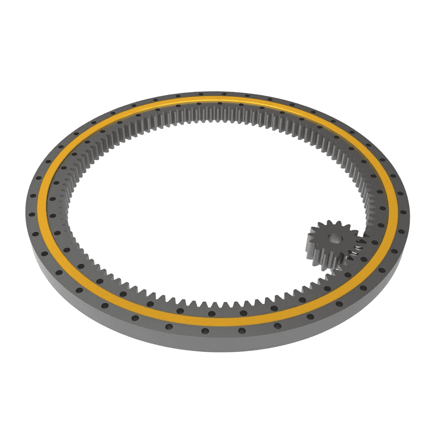
Most excavator slew rings feature either internal or external gear teeth, induction-hardened for wear resistance.
These mesh with the swing motor's drive pinion to power rotation.
When the operator activates the swing control, hydraulic fluid drives the swing motor.
The motor turns a small pinion gear, which meshes with the gear teeth on the slew ring.
As the pinion rotates, it drives the entire upper structure to swing left or right.
The rolling elements inside the bearing carry the load throughout this motion, ensuring smooth rotation even when the excavator is working at full reach with a loaded bucket.

Single-row ball slewing bearings are the most common type for small to medium excavators. Ball bearings use point contact, which minimizes friction and allows smooth, efficient rotation. They handle combined axial, radial, and moment loads well for general construction work.
Roller slewing bearings use cylindrical rollers instead of balls. The line contact between rollers and raceways gives them significantly higher load capacity and shock resistance — the preferred choice for large excavators and high-impact applications like demolition and mining.
Three-row roller slewing bearings are used in the largest heavy-duty machines. Three separate rows of rollers handle axial, radial, and moment loads independently, maximizing capacity in all directions. This design is standard on large mining and construction excavators with extreme load requirements.
Ring deformation from improper installation is a leading cause of premature failure across all types.
Research published in Lubricants (MDPI) confirms that even minor elliptical deformation significantly reduces load-bearing contact and degrades fatigue life — underscoring why dimensional accuracy matters.
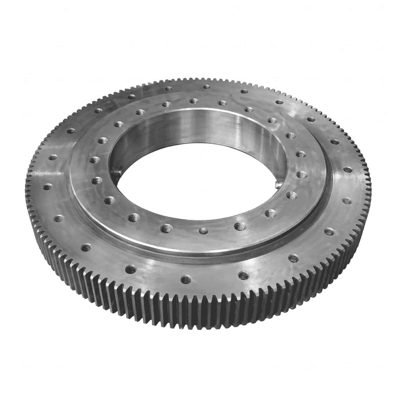
External gear slew rings have gear teeth on the outside of the outer ring. They are the most common configuration — straightforward to manufacture and install, and found on the majority of small to medium excavators.
Internal gear slew rings have gear teeth on the inside of the inner ring. This design allows for a more compact swing drive arrangement and is commonly used on larger machines where the drive system is mounted inside the slew ring diameter.
These bearing types are also widely used in lifting equipment — if you are evaluating requirements for both excavators and lifting machinery, our crane slewing bearing guide covers the key differences in load requirements and selection criteria.
Catching wear early prevents a minor maintenance job from turning into a costly breakdown and extended downtime.
OSHA identifies being caught between the rotating superstructure of an excavator and surrounding objects as a serious recognized hazard — making slew ring maintenance a safety obligation, not just a mechanical one.
Watch for these warning signs:
Squeaking, clicking, grinding, or rhythmic popping during rotation are the first warning signs of bearing wear.
A rhythmic knock that repeats at regular intervals often indicates brinelling — localized raceway deformation caused by parking with the boom fully extended under load for extended periods.
If the upper structure hesitates, binds, or moves unevenly during swing, the rolling elements or raceway may be worn.
Resistance that increases at specific points in the rotation arc often points to a localized defect such as a crack or deformed raceway section.
Gently push the upper structure laterally while the machine is stationary.
Some axial play is normal, but visible rocking — especially with the boom extended — means the bearing clearance has exceeded its wear limit.
Contamination-driven wear can increase raceway clearance by close to 1mm over 1,000 hours in severe conditions.
Check the lubricant at the grease fittings during routine servicing.
Metal flakes, dark discoloration, or a gritty texture indicates active internal wear.
Clean grease should be smooth and uniform.
Metal particles mean the bearing surfaces are deteriorating — replacement should be planned promptly.
Visible grease leaking from around the slew ring seal indicates seal failure.
Once the seal is compromised, contaminants enter the bearing cavity and accelerate wear rapidly.
Do not delay when seal leakage is observed.
LILY Bearing manufactures and supplies slew ring bearings compatible with major excavator brands including:
Can't find your model? Send us your excavator model number, or the slew ring dimensions (outer diameter, inner diameter, height, gear module), and we'll confirm compatibility or manufacture to your specification.

When sourcing a replacement, four things matter most:
1. Dimensional Accuracy
Outer diameter, inner diameter, height, bolt circle diameter, and number of bolt holes must match your machine's specifications exactly.
A poor fit creates stress concentrations that shorten bearing life significantly.
2. Material and Heat Treatment
Quality excavator slew rings use 42CrMo or 50Mn alloy steel with induction-hardened raceways.
This combination delivers the surface hardness needed to resist wear while maintaining a tough core to absorb shock loads during digging and demolition.
Academic research on slewing bearing fatigue life confirms that 42CrMo ring material combined with induction-hardened raceways is the industry benchmark for contact fatigue resistance in heavy-duty applications.
3. Gear Specifications
The gear module, number of teeth, and tooth profile must match the drive pinion exactly to ensure proper meshing.
Incorrect gear specs cause accelerated wear on both the slew ring and the pinion.
4. Sealing System
Excavators work in contaminated environments.
Choose a slew ring with robust multi-lip or labyrinth seals to protect the rolling elements from dirt, water, and debris — the leading causes of premature bearing failure in the field.
If you are also sourcing slew rings for jib cranes or other lifting equipment alongside your excavator, our jib crane bearing guide covers the specific load calculations and selection criteria for those applications.
Proper maintenance makes a significant difference.
According to Kaydon Bearings, up to 96% of slewing ring failures are preventable through regular maintenance.
For a full breakdown of maintenance procedures that apply across all slewing bearing types, see our complete slewing ring maintenance guide.
Here are the four key areas to focus on:
Grease the bearing raceway every 100 hours under normal operating conditions.
In tropical, humid, or high-dust environments, reduce this to weekly.
Always rotate the upper structure through a full 360° while greasing to ensure even distribution around the full circumference.
The gear teeth require more frequent lubrication than the raceway.
Apply grease at the gear mesh point every 8 hours on excavators with intermittent swing cycles.
Use the grease type specified in your operator manual — EP-2 lithium-based grease is standard for most construction equipment.
Check mounting bolt pre-torque at 100 hours and again at 500 hours after installation.
After that, check every 1,000 hours.
If 10% of bolts are loose, the remaining bolts carry disproportionately higher stress — accelerating the loosening process and risking bolt fracture.
Inspect seals visually at every service interval.
A damaged seal is inexpensive to address early.
Left unchecked, contamination from a failed seal can destroy the entire bearing.
Two operator habits that cause premature failure:
LILY Bearing specializes in large-diameter slewing bearings for heavy equipment.
Our excavator slew rings are used in construction, mining, and demolition applications worldwide, manufactured from 42CrMo alloy steel with induction-hardened raceways, and available in standard and custom configurations.
Contact us with your excavator model or slew ring dimensions for a fast quote →
A well-maintained, high-quality slew ring typically lasts between 8,000 and 20,000 operating hours, depending on operating conditions, maintenance frequency, and load cycles.
In harsh environments with infrequent maintenance, failure can occur significantly earlier.
The raceway should be greased every 100 hours under normal conditions — more frequently in wet, dusty, or high-temperature environments.
The gear teeth require separate greasing every 8 hours. Always rotate the upper structure through a full 360° while greasing.
Check your operator manual for model-specific intervals.
The most common early signs are abnormal noise during swing (clicking, grinding, or rhythmic knocking), resistance or binding at specific points in the rotation arc, and metal particles in the grease during routine servicing.
Catching these signs early prevents a maintenance issue from becoming a machine-down situation.
Yes, provided the key dimensions match: outer diameter, inner diameter, height, bolt circle diameter, gear module, and number of teeth.
Load capacity should be equal to or greater than the original.
If you are unsure, provide your excavator model number and we can confirm a compatible replacement.
Position the excavator on level ground. Attach a dial indicator to the stationary lower ring and place the tip against the upper rotating ring.
Lift a loaded bucket at maximum reach, then raise the arm to its highest point.
The difference in indicator readings is the current axial play. Record this regularly and compare over time — an increasing trend indicates accelerating wear.
Wind turbines depend on precise, reliable rotation at every level — from individual blade angle adjustments to full nacelle orientation. The...
slewing ring bearings, or slewing bearings, are a fundamental component in numerous industrial machines, particularly in the renewable energy sector.
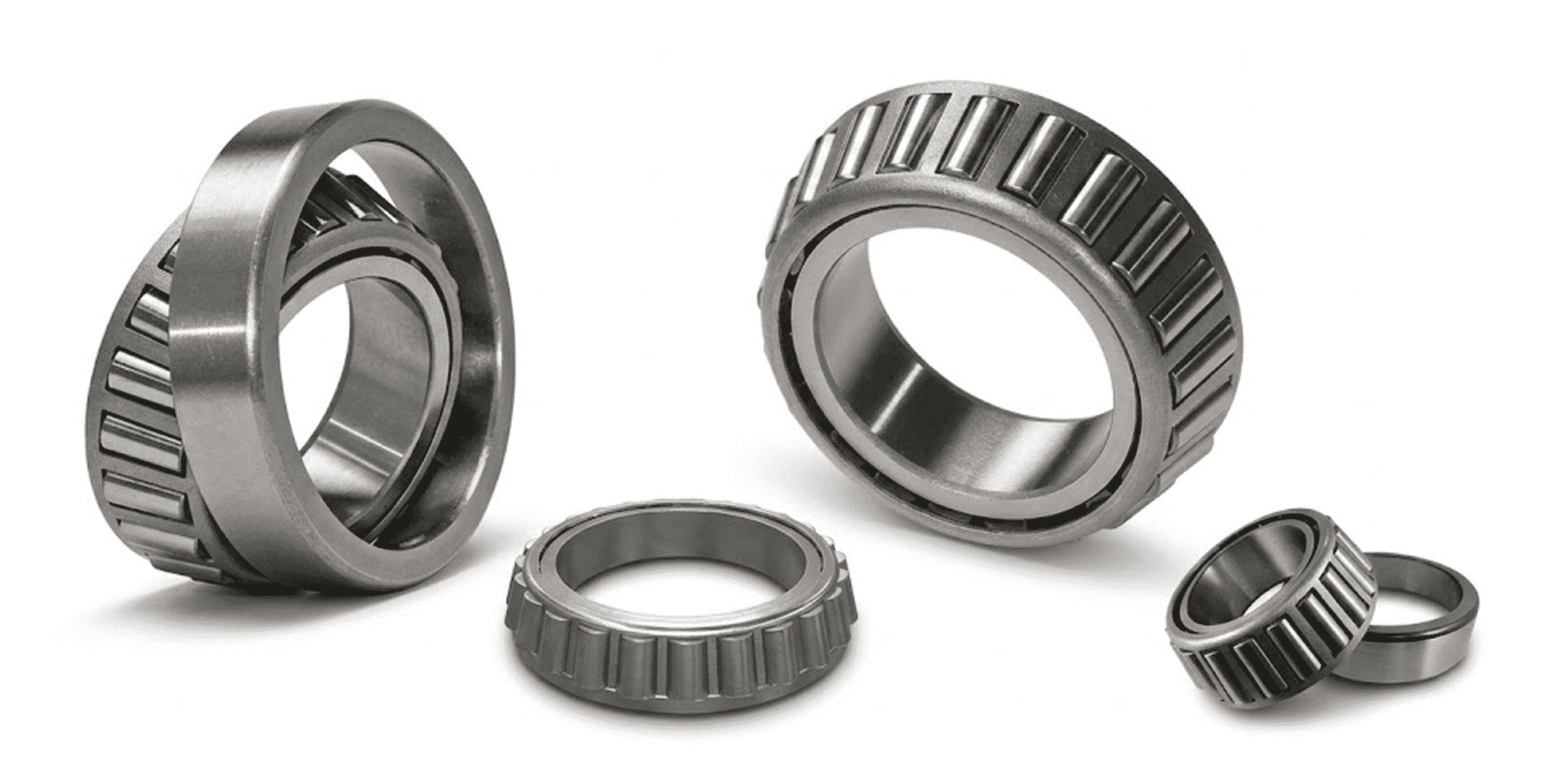
A good tapered roller bearings supplier does more than list products and send back a number. For industrial buyers, the real question is whether the...