

Who Invented Springs? A Complete History from Ancient Bows to Modern Coils
The short answer: no single person invented the spring. But if you want the name most associated with turning springs from a crude mechanical trick...
8 min read
William
:
Jan 29, 2026 3:44:50 AM
Table of Contents
Springs are ubiquitous mechanical components, essential to the function of countless devices and systems, from intricate medical instruments to heavy industrial machinery.
Their ability to store and release mechanical energy makes them indispensable for applications requiring force, motion control, vibration isolation, and energy absorption. However, the reliable performance of a spring is not a given; it is a complex interplay of numerous factors, encompassing material science, geometric design, manufacturing processes, and environmental conditions.
This comprehensive guide delves into these critical factors, providing a technical and professional overview suitable for engineers, designers, and anyone seeking to optimize spring performance and ensure long-term reliability. Understanding these elements is paramount for effective spring design, preventing premature failure, and achieving desired operational characteristics.

The choice of material is arguably the most fundamental decision in spring design, directly influencing a spring's strength, elasticity, fatigue life, and environmental resistance. Key material properties include:
These moduli define a material's stiffness. For helical springs, which primarily experience torsional stress, the Modulus of Rigidity (G) is particularly critical. A higher G indicates greater resistance to shear deformation, resulting in a stiffer spring (higher spring rate) for a given geometry. Conversely, the Modulus of Elasticity (E) is relevant for beam-type springs (e.g., leaf springs) that undergo bending. Typical values for common spring materials are:
|
Material Type |
Modulus of Rigidity (G) [GPa] |
Modulus of Elasticity (E) [GPa] |
|
Music Wire (ASTM A228) |
79.3 |
200 |
|
Stainless Steel 302 |
69 |
190 |
|
Chrome Silicon (ASTM A401) |
79.3 |
200 |
|
Oil Tempered (ASTM A229) |
79.3 |
200 |
Ultimate Tensile Strength (UTS) represents the maximum stress a material can withstand before fracturing, while Yield Strength is the stress at which permanent deformation begins. For springs, it is crucial to operate below the yield strength to ensure elastic behavior and prevent permanent set. Higher tensile strength generally correlates with higher fatigue strength, allowing the spring to endure more stress cycles.
Springs are often subjected to cyclic loading, making fatigue resistance a paramount concern. Fatigue failure occurs when a material breaks under repeated stress cycles, even if the applied stress is below its yield strength. Factors influencing fatigue resistance include material purity, surface finish, and the presence of residual stresses. Materials with higher endurance limits are preferred for dynamic applications.
In corrosive environments, standard carbon steel springs can quickly degrade, leading to reduced performance and premature failure. Stainless steels (e.g., 302, 316) and exotic alloys (e.g., Inconel, Monel) offer superior corrosion resistance, albeit at a higher cost. Coatings, such as zinc plating or epoxy, can also provide protection but may affect fatigue life if not applied correctly.
Extreme temperatures can significantly impact spring performance. At elevated temperatures, materials can experience stress relaxation (loss of load over time at constant deflection) and creep (gradual deformation under constant load). Conversely, at very low temperatures, some materials may become brittle. Specialized alloys are required for high-temperature applications, as typical spring steels lose significant strength above 250°C.

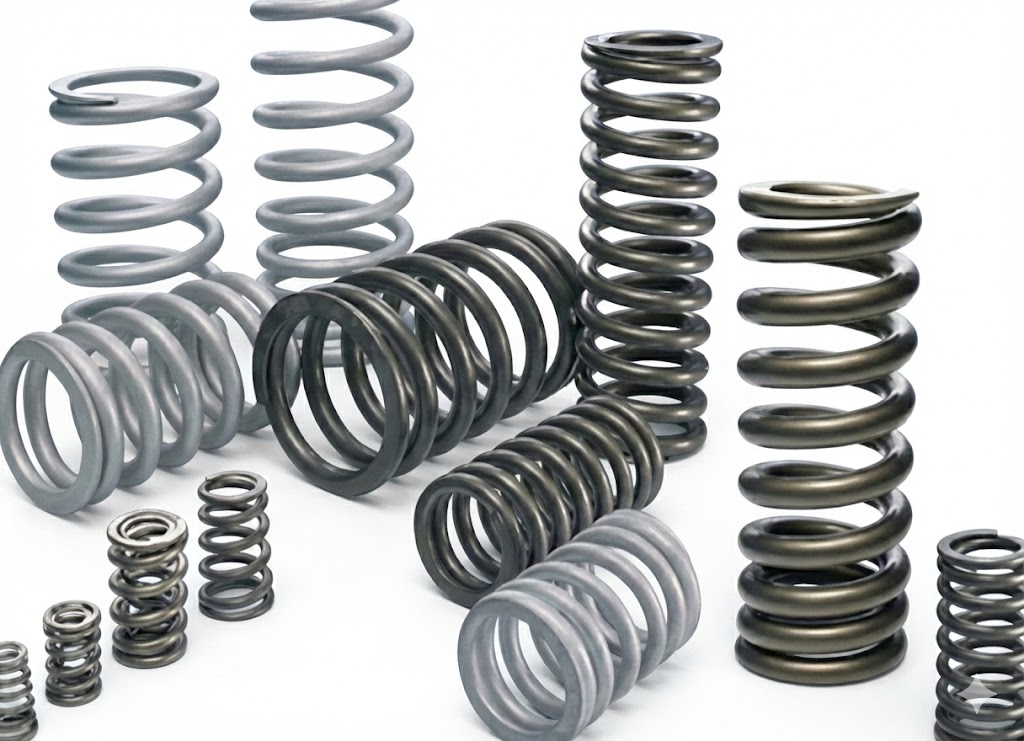
Figure 1: A high-quality 3D technical illustration of a heavy-duty industrial helical compression spring, highlighting its robust design and shot-peened surface.
The physical dimensions and geometry of a spring are as critical as its material composition. These parameters dictate the spring's rate, maximum deflection, stability, and stress distribution.
The wire diameter has a profound impact on spring rate and stress. A larger wire diameter increases the spring's stiffness and its load-carrying capacity, but also increases the material volume and cost. The stress in a spring is inversely proportional to the cube of the wire diameter, meaning small changes in 'd' can lead to significant stress variations.

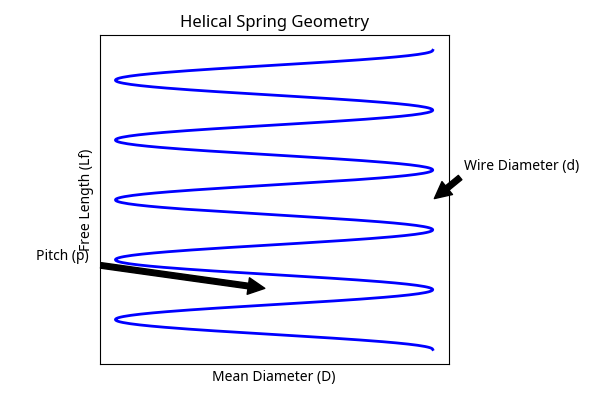
Figure 2: Diagram illustrating key geometric parameters of a helical spring, including wire diameter (d), mean coil diameter (D), pitch (p), and free length (Lf).
The mean coil diameter (D) is the average diameter of the spring coils. The spring index (C) is the ratio of the mean coil diameter to the wire diameter (C = D/d). This dimensionless parameter is crucial for manufacturability and stress analysis:
An ideal spring index typically falls between 4 and 12, balancing manufacturability with performance.
The number of active coils directly influences the spring rate and deflection. More active coils result in a softer spring (lower rate) and greater deflection capacity. Conversely, fewer active coils lead to a stiffer spring. The ends of a spring (e.g., squared and ground) are typically inactive and do not contribute to deflection.
Free length is the overall length of an unloaded spring. Solid height is the length of the spring when it is compressed until all coils are touching. These parameters are essential for determining the maximum allowable deflection and ensuring the spring does not go solid under normal operating conditions, which can lead to permanent deformation.
The slenderness ratio, defined as the free length divided by the mean coil diameter (L_f/D), is a critical factor for preventing buckling in compression springs. If this ratio is too high, the spring may buckle sideways under compression, leading to instability and failure. Design guidelines often recommend keeping this ratio below a certain threshold, typically around 4, depending on the end conditions.
Accurate stress analysis is paramount to designing reliable springs. Springs are primarily subjected to torsional shear stress, but other factors must be considered.
The maximum shear stress (τ) in a helical compression or extension spring is calculated using the formula:
τ = K * (8 * F * D) / (π * d^3)
Where:
τ = Maximum shear stress
K = Wahl Factor (stress concentration factor)
F = Applied axial load
D = Mean coil diameter
d = Wire diameter
The Wahl Factor (K) accounts for two effects: the curvature of the wire and the direct shear stress. The stress on the inside of the coil is higher than on the outside due to curvature. The formula for the Wahl Factor is:
K = (4C - 1) / (4C - 4) + 0.615 / C
Where C is the spring index. Ignoring the Wahl Factor can lead to underestimation of stress and premature spring failure.
Beyond the Wahl Factor, other geometric discontinuities, such as sharp bends or nicks on the wire surface, can create localized stress concentrations, significantly reducing fatigue life. Proper design and manufacturing aim to minimize these stress risers.
Many spring applications involve millions of load cycles, making fatigue the primary failure mode. Designing for infinite life or a specified finite life requires careful consideration of fatigue phenomena.
When a spring is subjected to repeated loading and unloading, microscopic cracks can initiate and propagate, eventually leading to macroscopic failure. The fatigue limit (or endurance limit) is the maximum stress amplitude a material can withstand for an infinite number of cycles without failing. For spring steels, this limit is often determined through extensive testing.

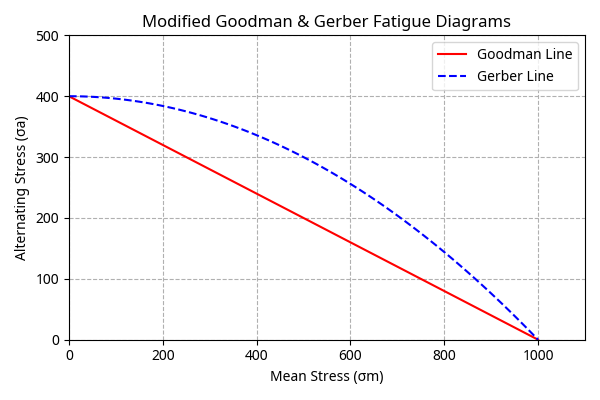
Figure 3: A Modified Goodman and Gerber diagram illustrating the safe operating regions for springs under fluctuating stresses, crucial for predicting fatigue life.
These diagrams are graphical tools used to predict fatigue life under fluctuating stresses (i.e., when both mean and alternating stresses are present). The Modified Goodman Diagram is commonly used for spring design, providing a conservative estimate of fatigue strength. It plots alternating stress against mean stress, defining a safe operating region below the fatigue failure line. The Gerber Diagram offers a less conservative, often more accurate, prediction for ductile materials.
Shot peening is a cold working process that significantly enhances a spring's fatigue life. It involves bombarding the spring surface with small, high-velocity media (shots), creating a layer of compressive residual stress. Since fatigue cracks typically initiate at the surface under tensile stress, this compressive layer counteracts applied tensile stresses, thereby delaying crack initiation and propagation. Shot peening can increase fatigue life by 30% to 50%.
The manufacturing process plays a crucial role in translating a design into a functional spring. Deviations or improper techniques can severely compromise performance.
The coiling process itself can introduce residual stresses. Cold coiling (forming at room temperature) is common for smaller wire diameters, while hot coiling (forming at elevated temperatures) is used for larger wires. Precise control over coiling parameters is essential to maintain dimensional accuracy and minimize internal stresses.
After coiling, springs typically undergo heat treatment (hardening and tempering) to achieve desired mechanical properties, such as hardness and tensile strength. Stress relieving is a subsequent low-temperature heat treatment that reduces residual stresses introduced during coiling, improving dimensional stability and fatigue life without significantly altering hardness. This step is critical for optimal performance.
A smooth surface finish is vital for fatigue resistance, as surface imperfections can act as stress concentrators. Grinding, polishing, or barrel tumbling can improve surface quality. As mentioned, coatings provide corrosion protection but must be carefully selected and applied to avoid hydrogen embrittlement or other detrimental effects on fatigue life.
Beyond internal material and design factors, the operating environment imposes external stressors that can degrade spring performance over time.
Exposure to moisture, chemicals, or saltwater can lead to corrosion, which pits the spring surface, creating stress risers and accelerating fatigue failure. Hydrogen embrittlement is a particular concern for high-strength steels, where hydrogen atoms (often introduced during plating processes or from corrosive environments) diffuse into the material, causing a drastic reduction in ductility and premature brittle fracture.

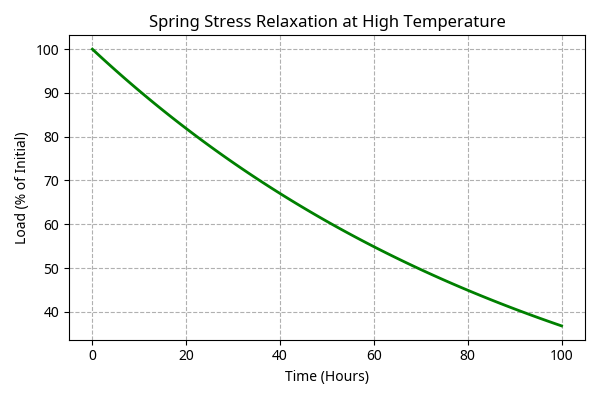
Figure 4: Chart demonstrating the phenomenon of stress relaxation in a spring at high temperatures, showing the gradual loss of load over time.
As discussed, high temperatures cause stress relaxation and creep, leading to a permanent loss of load. Low temperatures can reduce ductility, making the spring more susceptible to brittle fracture under impact or shock loading. Designers must select materials and apply temperature compensation techniques appropriate for the operating temperature range.
If a spring's natural frequency coincides with the frequency of an external excitation, resonance can occur. This leads to dangerously high deflections and stresses, often resulting in rapid fatigue failure. Proper design involves calculating natural frequencies and ensuring they are sufficiently separated from operating frequencies, often by a factor of at least 10-15%.
Achieving optimal spring performance involves a holistic approach, balancing often-conflicting requirements such as cost, space constraints, desired life, and manufacturability.
Modern spring design heavily relies on iterative processes involving CAD modeling, Finite Element Analysis (FEA), and specialized spring design software. These tools allow engineers to simulate stress distributions, predict deflections, and analyze fatigue life under various loading conditions, significantly reducing the need for costly physical prototyping.
Choosing the right material often involves trade-offs. For instance, while stainless steel offers excellent corrosion resistance, it generally has a lower fatigue limit than music wire. High-performance alloys provide superior properties but come at a premium cost. The selection must align with the application's specific requirements and budget.
Rigorous quality control throughout the manufacturing process, from raw material inspection to final product testing, is essential. This includes dimensional checks, load testing, fatigue testing, and non-destructive examination (NDE) techniques to detect flaws. Adherence to industry standards (e.g., ASTM, ISO, DIN) ensures consistent quality and performance.
Adherence to established industry standards is crucial for ensuring the quality, interchangeability, and reliable performance of springs. These standards provide guidelines for material specifications, testing methods, and dimensional tolerances.
The American Society for Testing and Materials (ASTM) publishes numerous standards relevant to spring materials, including:
ASTM A228/A228M: Standard Specification for Steel Wire, Music Spring Quality
ASTM A313/A313M: Standard Specification for Stainless Steel Spring Wire
ASTM A401/A401M: Standard Specification for Steel Wire, Chromium-Silicon Alloy, Spring Quality
International Organization for Standardization (ISO) and Deutsches Institut für Normung (DIN) also provide comprehensive standards for spring design and manufacturing:
ISO 10243: Compression springs for tools and dies
ISO 8752: Spring-type straight pins – Coiled
DIN 2098: Compression springs – Dimensions and forces for cylindrical helical compression springs made from round wire
Compliance with these standards ensures that springs meet specified performance criteria and are manufactured to acceptable quality levels.
Optimizing spring performance is a multifaceted engineering challenge that demands a deep understanding of material science, mechanical design principles, manufacturing processes, and environmental considerations. From the initial selection of a material with appropriate modulus and fatigue resistance to the precise control of geometric parameters like spring index and wire diameter, every decision impacts the spring's ultimate reliability and service life. Advanced techniques such as shot peening and meticulous stress analysis using tools like the Wahl Factor and Goodman diagrams are indispensable for dynamic applications.
Furthermore, acknowledging and mitigating environmental stressors like corrosion and temperature extremes, alongside adherence to rigorous industry standards, are crucial for ensuring long-term durability. By meticulously addressing each of these factors, engineers can design and produce springs that not only meet functional requirements but also deliver consistent, reliable performance throughout their intended lifespan, contributing to the overall integrity and efficiency of the systems they serve.
Discover high-quality, reliable spring and bearing solutions with LILY Bearing. Contact us today to find the perfect components for your application and enhance your equipment’s performance and longevity!
The short answer: no single person invented the spring. But if you want the name most associated with turning springs from a crude mechanical trick...
Most spring failures we see at Lily Bearing trace back to the same root cause: the spring was treated as an afterthought. The bearing got carefully...
A spring isn't just coiled wire—it's a critical energy-storage component where choosing the wrong springs means system failure. Whether you're...